304 vs 316 vs 430 Stainless Steel Cookware: A Manufacturer’s Guide
Most buyers learn what stainless steel grade they want from a marketing brochure. We learn what it’s actually worth from the factory floor — where we test incoming steel, handle warranty returns, and watch which grades fail under pressure.
This guide covers 304, 316, and 430 stainless steel from the manufacturer’s side. What makes each grade what it is. Where each one belongs in a product line. And how to tell them apart before a shipment arrives — not after.
What Makes Stainless Steel ‘Stainless’: The Chemistry
All stainless steel is iron-based with chromium added. Chromium is the critical element: when it reaches roughly 10.5%, it forms a passive chromium oxide layer on the steel surface that continuously self-repairs when scratched or exposed to air. That’s the ‘stainless’ property.
Beyond chromium, manufacturers adjust nickel, molybdenum, carbon, and manganese content to create different grades — each with different corrosion resistance, hardness, heat tolerance, and magnetic properties.
The three grades most relevant to cookware:
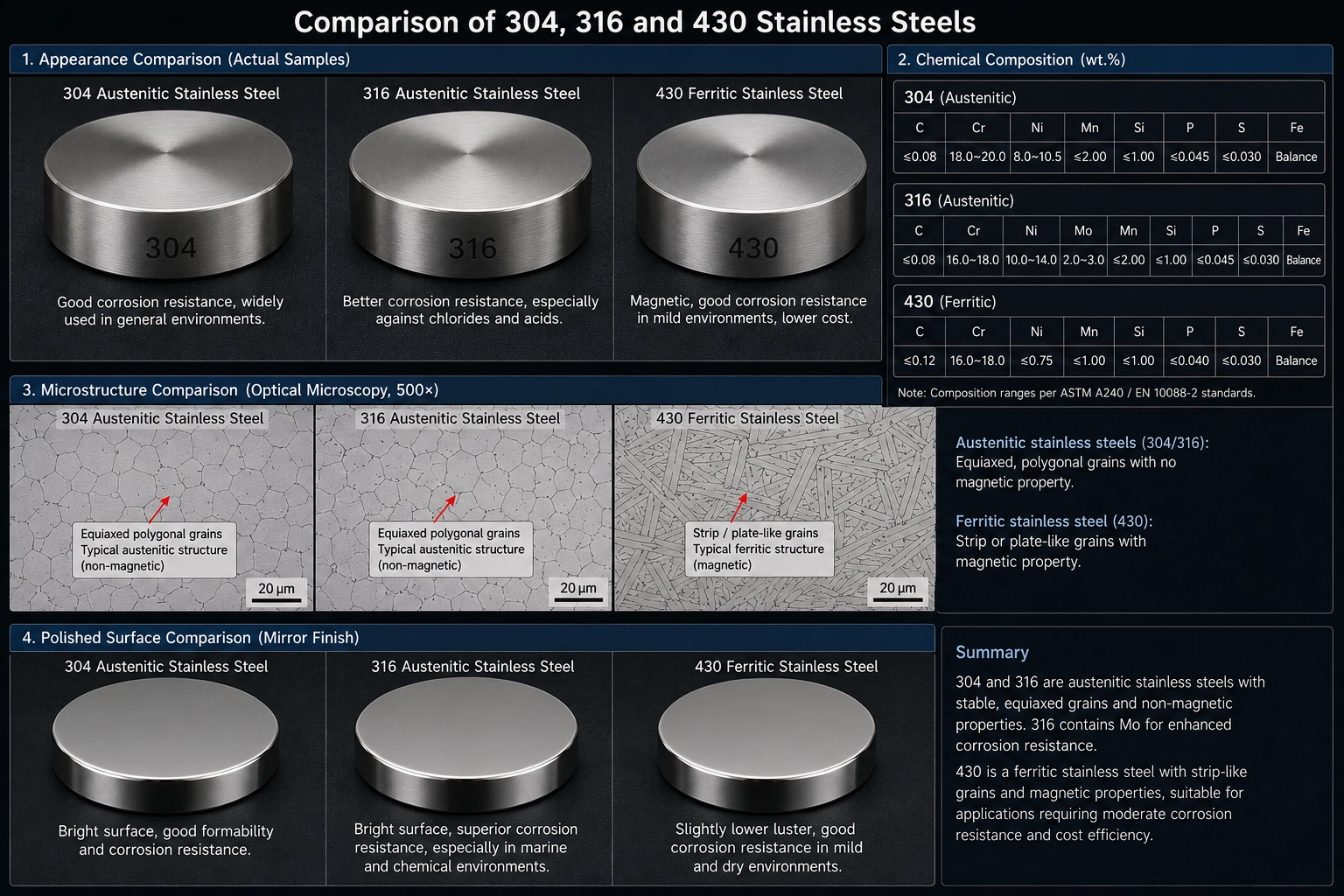
| Grade | Standard | Chromium | Nickel | Molybdenum | Common Marking |
| 304 | ASTM A240 / GB/T 4237 (06Cr19Ni10) | 18–20% | 8–10.5% | None | 18/10 or 18/8 |
| 316 | ASTM A240 / GB/T 4237 (06Cr17Ni12Mo2) | 16–18% | 10–14% | 2–3% | 18/10 (sometimes) |
| 430 | ASTM A240 / GB/T 4237 (10Cr17) | 16–18% | <0.75% | None | 18/0 |
The numbers in the ‘marketing names’ (18/10, 18/8, 18/0) refer to chromium and nickel percentages respectively. They’re not quality grades — they’re composition summaries.
304 Stainless Steel Cookware: The Production Standard
What 304 actually is
304 is an austenitic stainless steel. Austenitic means the crystal structure is face-centered cubic — which makes it non-magnetic in its base form, highly formable, and resistant to corrosion across a wide temperature range.
In cookware manufacturing, 304 is the default. It accounts for the majority of professional-grade stainless cookware produced globally, and for good reason: it’s corrosion-resistant enough for almost everything you’ll cook, tough enough for commercial kitchen use, and manufacturable at scale without excessive waste or tool wear.
Chemical composition — what matters for cookware
The 8–10.5% nickel in 304 is the key performance driver for food safety. Nickel contributes to the steel’s passivation stability — meaning the protective oxide layer reforms reliably even after mechanical abrasion, exposure to acidic foods, or thermal cycling.
The 18–20% chromium handles the basic corrosion resistance. Together, they produce a steel that passes food-contact safety standards in every major market: FDA (US), LFGB (EU/Germany), GB 9684 (China), and JIS standard (Japan).
What 304 handles well
From production data and returned product analysis, 304 fails in predictable patterns:
Performs reliably:
- Sautéing, frying, searing at normal cooking temperatures (up to ~300°C surface)
- Boiling water, stock, and neutral liquids
- Contact with most foods — proteins, vegetables, grains, dairy
- Regular dishwasher exposure
- Commercial kitchen cycling (high-heat, rapid cooling, industrial detergents)
Requires attention:
- Long-duration (4+ hour) simmering of highly acidic foods (tomato sauce, wine reductions, citrus-based braises)
- Chloride-rich environments (salt brines, seawater) — 304 is not specifically molybdenum-hardened
The 304 ‘weakness’ is usually misunderstood
In over 20 years of manufacturing, the majority of 304 cookware corrosion complaints we see are not grade failures — they’re caused by:
- Poor surface finish (Ra value too high, micro-pits trap food particles and moisture)
- Improper cleaning (leaving salt water to sit, using chloride-based cleaners)
- Thin base construction (cheap single-layer 304 ≠ the same as 3-ply 304)
Grade alone doesn’t determine corrosion performance. Construction quality does. A properly manufactured 3-ply 304 cookware set will outlast a poorly finished 316 single-ply pan in most kitchen environments.
316 Stainless Steel Cookware: Where Molybdenum Changes the Equation
What 316 adds — and why it matters
316 adds 2–3% molybdenum to the 304 base composition. Molybdenum strengthens the passive oxide layer in chloride environments — specifically, it prevents the localized pitting corrosion that chlorides cause by attacking weak points in the chromium oxide surface.
This is the actual engineering reason 316 is called ‘marine-grade’: in actual marine applications — ship fittings, dock hardware, offshore equipment — constant saltwater exposure makes molybdenum the critical differentiator. In those contexts, 316 meaningfully outperforms 304.
The question for cookware buyers is whether a kitchen environment replicates marine conditions. In most cases, it doesn’t.
When 316 provides real value in cookware
Genuine benefit:
- Sustained high-acid cooking (professional kitchens running 6–8 hours of tomato-based sauce production daily)
- Coastal restaurant environments with salt-laden air and very high humidity
- Medical-grade foodservice equipment (316 is specified in some hospital kitchen standards)
- High-end cookware lines where premium positioning justifies the material cost premium
Diminishing return:
- Home cooking, even with frequent acidic dishes
- Standard commercial kitchens with normal cleaning protocols
- Export markets where 316 costs are passed through without demonstrating value
The cost reality
316 costs approximately 20–40% more per kilogram than 304 at mill price. For a finished cookware set, this translates to 10–25% higher production cost depending on construction complexity.
In practice, most buyers who specify 316 for standard commercial cookware are paying for corrosion protection beyond what the use environment actually requires. The 316 specification makes sense as a deliberate positioning choice — if your brand wants to credibly claim ‘marine-grade steel’ — but the functional performance improvement in a typical kitchen is marginal.
316 marking: a procurement warning
Not all cookware marketed as 316 is actually 316. Because 316 commands a premium and is visually indistinguishable from 304, substitution by lower-tier suppliers is common.
Verification requires XRF (X-ray fluorescence) spectrometry — a handheld device that reads elemental composition in seconds. The test is non-destructive and gives you chromium, nickel, and molybdenum percentages directly. If a supplier claims 316 but refuses to allow XRF testing or provide mill test certificates, treat the specification as unverified.
We use XRF testing on incoming steel coils from all new suppliers and on audit cycles with existing ones. The test costs less than a good meal and prevents expensive specification disputes later.
430 Stainless Steel Cookware: The Ferritic Grade
A fundamentally different material
430 is not an austenitic grade — it’s ferritic. Ferritic stainless steels have a body-centered cubic crystal structure, no nickel content (or trace amounts only), and are magnetic by nature.
This is why 430 handles induction cooking natively. Induction cooktops require a magnetic base material — the electromagnetic field induces eddy currents in the pan, generating heat directly in the metal. 304 and 316 are generally non-magnetic and don’t work on induction alone. 430 is inherently magnetic.
430 in cookware construction
430 appears in cookware in two main ways:
- Single-layer 430 pans — lower cost, induction-compatible, lower corrosion resistance than 304. Common in entry-level retail cookware and high-volume foodservice markets.
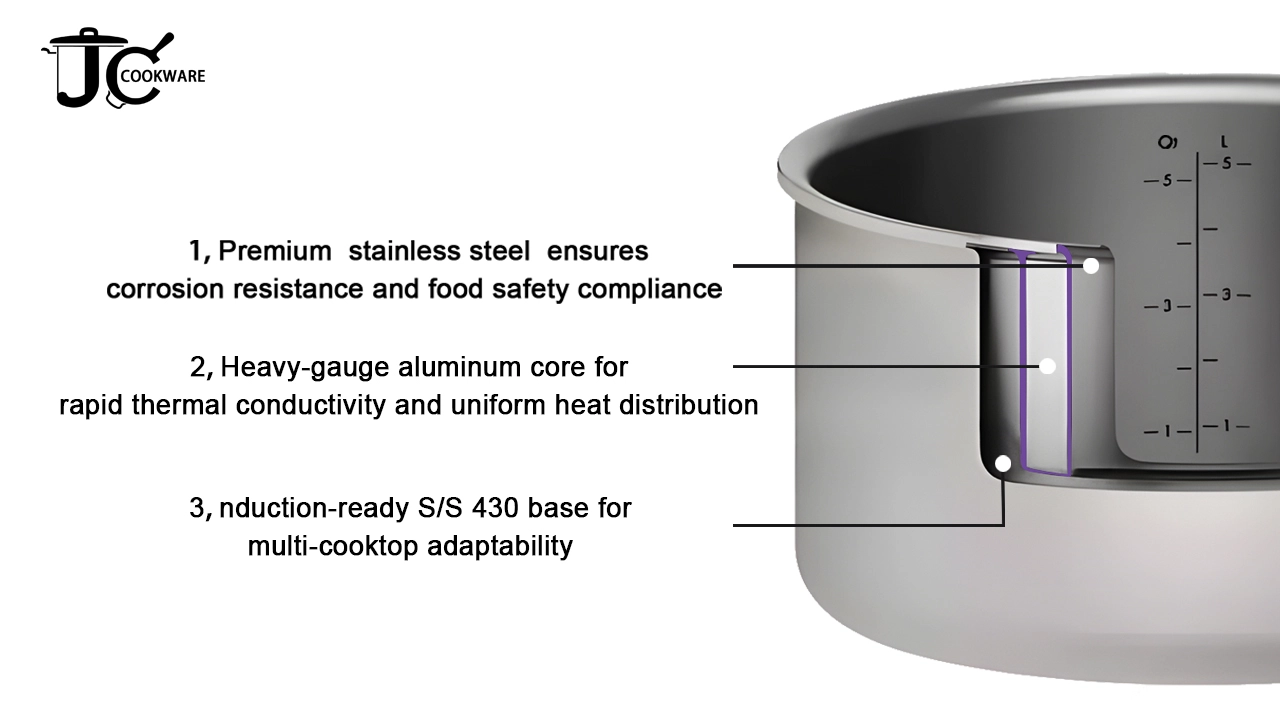
- 430 as the outer layer in multi-ply construction — the most common premium application. A tri-ply or 5-ply pan with an 18/10 (304) cooking surface and a 430 magnetic outer base gets you the corrosion-resistant cooking surface of 304 plus induction compatibility from the 430 exterior.
This is the construction used in virtually all high-end induction-compatible stainless cookware. The marketing often says ‘induction-compatible 18/10 cookware’ — which is technically accurate, because the cooking surface is 18/10 and the outer layer handles induction.
430 corrosion limitations
430’s chromium content (16–18%) provides moderate corrosion resistance, significantly below 304. The absence of nickel means the passive oxide layer is less stable under aggressive conditions.
Practical implications:
- 430 single-layer pans should not be soaked in salt water or left wet
- Dishwasher use over time can cause surface dulling and minor corrosion on 430 single-layer pieces
- 430 outer layers in multi-ply construction are usually fine — they’re not in contact with food
For B2B buyers, understanding which layer is 430 matters. A pan described as ‘tri-ply with 430 exterior’ has a fundamentally different corrosion profile from a single-layer 430 pan, even though both technically ‘contain 430 stainless steel.’
The 18/10 vs 18/8 vs 18/0 Label System
| Label | Chromium | Nickel | Typical Grade | What It Tells You |
| 18/10 | 18% | 10% | 304 (high-nickel) or 316Ti | Higher-end 304, or specialty grades |
| 18/8 | 18% | 8% | 304 (standard) | Standard 304 specification |
| 18/0 | 18% | ~0% | 430 | Ferritic, induction-native, no nickel |
What these labels don’t tell you: wall thickness, base construction method, surface finish quality (Ra value), or whether the stated composition is accurate. The 18/10 label is applied loosely across genuinely excellent cookware and poorly constructed pieces alike.
Comparing All Three: A Manufacturer’s Summary
| 304 (18/8 or 18/10) | 316 (Marine Grade) | 430 (18/0) | |
| Corrosion Resistance | High | Very High | Moderate |
| Nickel Content | 8–10.5% | 10–14% | <0.75% |
| Molybdenum | None | 2–3% | None |
| Magnetic | No (austenitic) | No (austenitic) | Yes (ferritic) |
| Induction Compatible | Not natively | Not natively | Yes |
| Dishwasher Safe | Yes | Yes | Limited |
| Food Safety Rating | FDA/LFGB/GB 9684 | FDA/LFGB/GB 9684 | FDA/LFGB/GB 9684 |
| Nickel-Free | No | No | Effectively yes |
| Cost vs 304 | Baseline | +20–40% material | -10–15% material |
| Best Application | Universal cookware | High-acid professional / coastal | Induction outer layer, entry-level |
What Grade Does B2B Buyers Actually Need?
For importers and brand buyers sourcing from manufacturers, the grade decision affects cost, positioning, and spec sheets — but it’s rarely the single most important specification.
For standard commercial cookware lines
304 in a 3-ply or 5-ply construction. The construction quality — specifically the base bonding method (whole-clad vs brazed vs impact), the aluminum core thickness, and the surface Ra value — will have more impact on end-user satisfaction than grade alone.
For premium positioning
316 or 316Ti cooking surface, clearly documented with mill test certificates and XRF test option. This supports ‘marine-grade’ or ‘surgical-grade’ marketing claims and differentiates the line from standard 304 competitors.
For induction-focused markets
304 cooking surface with 430 magnetic base in multi-ply construction. This is the standard solution for markets where induction is dominant (much of Europe, parts of East Asia). The 430 outer layer doesn’t compromise cooking surface quality.
For nickel-sensitive customer segments
430 single-layer or 430-only construction. Be honest with buyers about the corrosion resistance trade-off — 430 is fine for most cooking uses, but not ideal for extended salt or acid exposure.
The Procurement Verification Checklist
If you’re sourcing from a new manufacturer and they’re specifying a particular grade, here’s what to ask for:
- Mill test certificate (MTC): The steel mill’s report on the specific coil or sheet used, showing actual chemical composition. Not a generic spec sheet — the actual batch certificate.
- XRF verification option: Will the supplier allow a third-party XRF test on production samples? If not, ask why.
- GB standard cross-reference: Chinese standard equivalent for 304 is 06Cr19Ni10; for 316, 06Cr17Ni12Mo2; for 430, 10Cr17.
- Surface finish spec: Ask for Ra value on the cooking surface. A food-grade cooking surface should be Ra ≤ 0.8μm.
These aren’t unusual requests for a serious manufacturer. If a supplier struggles to provide any of them, that tells you more than the grade specification does.
For B2B Buyers: What to Specify vs What to Leave Flexible
Lock down:
- Cooking surface grade (304 minimum; 316 if premium positioning requires it)
- Base construction method (whole-clad, brazed, impact — each has different performance and cost implications)
- Surface finish Ra value on cooking contact surfaces
- Third-party certification requirements (LFGB, FDA, etc.)
Leave flexible:
- Outer layer composition (as long as cooking surface meets spec, outer layer can flex for induction or cost)
- Exact nickel percentage within 304 range (18/8 vs 18/10 is not a meaningful functional difference for most applications)
Ask specifically:
- If the spec says ‘316,’ request MTC and XRF access
- If the spec says ’18/10,’ ask for confirmation whether this refers to 304 or a different grade
- If the pan is described as ‘induction compatible,’ ask which layer provides the magnetic response
Frequently Asked Questions
Is 316 stainless steel actually safer than 304 for cooking?
Both are food-safe by international standards (FDA, LFGB, GB 9684). 316 is not safer in the food-contact sense — it’s more corrosion-resistant, particularly in chloride-heavy environments. For standard home or commercial cooking, 304 meets the safety threshold. 316 adds corrosion protection, not a food-safety upgrade.
Will stainless steel cookware leach nickel into food?
Research shows that nickel migration from passivated stainless steel cookware is minimal under normal cooking conditions — generally below levels considered significant by food safety authorities. New cookware, or cookware with a damaged cooking surface, can show higher migration. Passivating a new pan (boiling water or diluted vinegar in the pan for 10–15 minutes before first use) establishes the protective oxide layer and minimizes migration.
Can I use a magnet to verify stainless steel grade?
A magnet tells you whether the steel is ferritic (magnetic — 430) or austenitic (non-magnetic — 304 and 316). It does not tell you whether you have 304 or 316, and it does not tell you anything about nickel content within austenitic grades. Definitive grade verification requires XRF spectrometry or chemical analysis of a mill test certificate.
Why does some ’18/10′ cookware stick or discolor faster than other ’18/10′ cookware?
Because 18/10 is a composition label, not a manufacturing quality standard. Two pans can both carry the 18/10 label and have radically different surface finish quality, base thickness, and construction methods. The surface Ra value, passivation treatment, and multi-ply construction are the variables that affect real-world cooking performance — not the nickel percentage alone.
Is 430 stainless steel safe for cooking?
Yes — 430 is a food-safe grade approved for direct food contact by major regulatory bodies. Its limitation is corrosion resistance relative to 304, not safety. It’s appropriate for cooking surfaces in low-acid applications and for the exterior magnetic layer in multi-ply induction-compatible cookware.
About JC Cookware
JC Cookware has manufactured stainless steel cookware since 2003 in Xinhui, Jiangmen. SUS 304 is the primary material for all our core product lines, and mill test certificates are available upon request. We cooperate with importers and brand buyers for material specification verification and cookware structure consultation.