Color is the cheapest way to differentiate a stainless range and the most expensive way to get returns. Two pans can leave the same factory with the same body, the same base and the same handle, differing only in the shade of sage green on the outside — and one comes back at a two percent rate while the other comes back at fifteen. The paint is rarely the difference. The preparation underneath it is.
Colored stainless steel cookware is a coating business sitting on top of a metal business, and the two have to be specified together. A brand that treats colored stainless steel cookware as a last-minute merchandising decision, added to an existing SKU two weeks before the container books, is buying a durability problem it will discover in someone else’s kitchen nine months later. A brand that specifies the finish at the same time as the body gets a color range that survives dishwashers, stacking and retail handling.
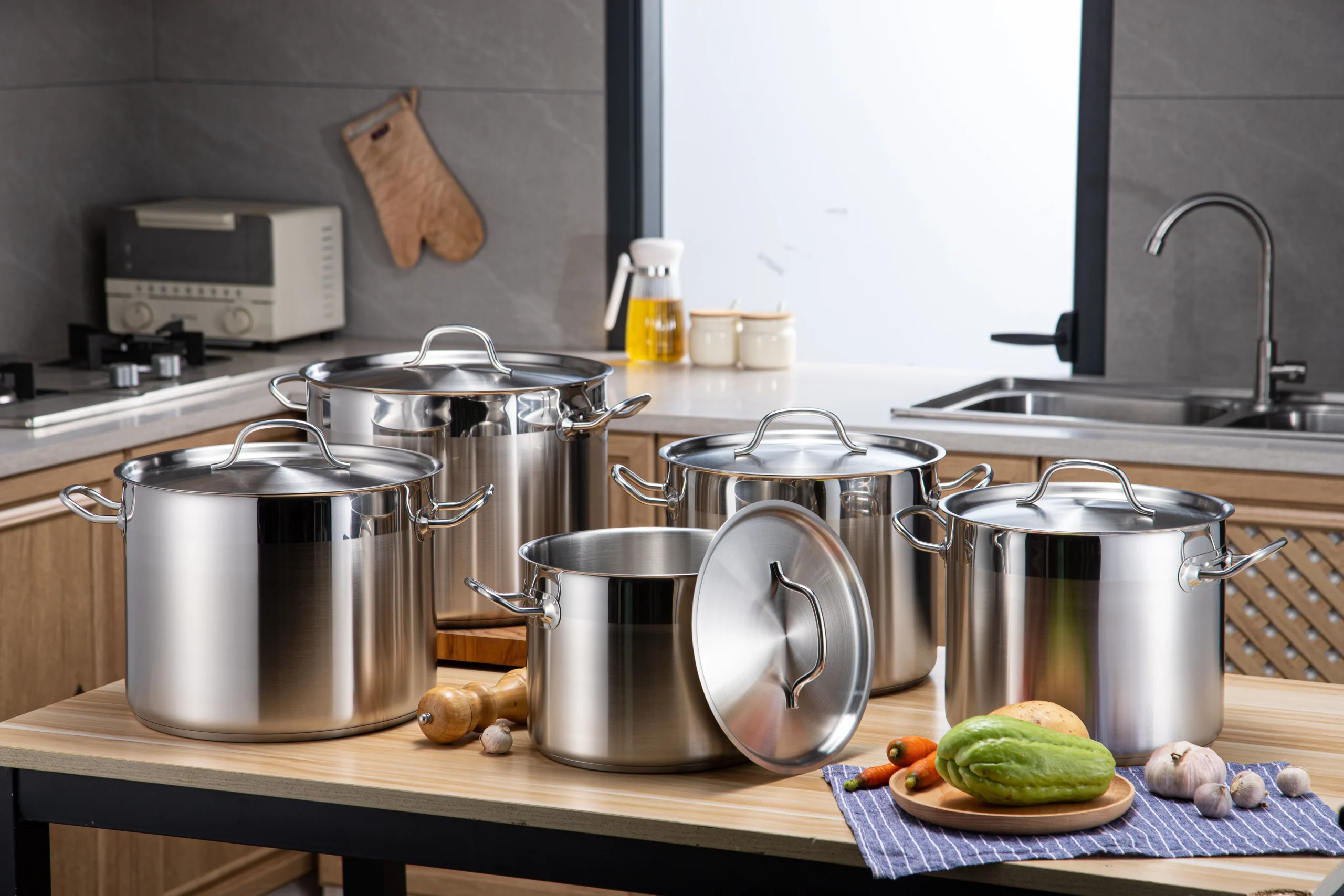
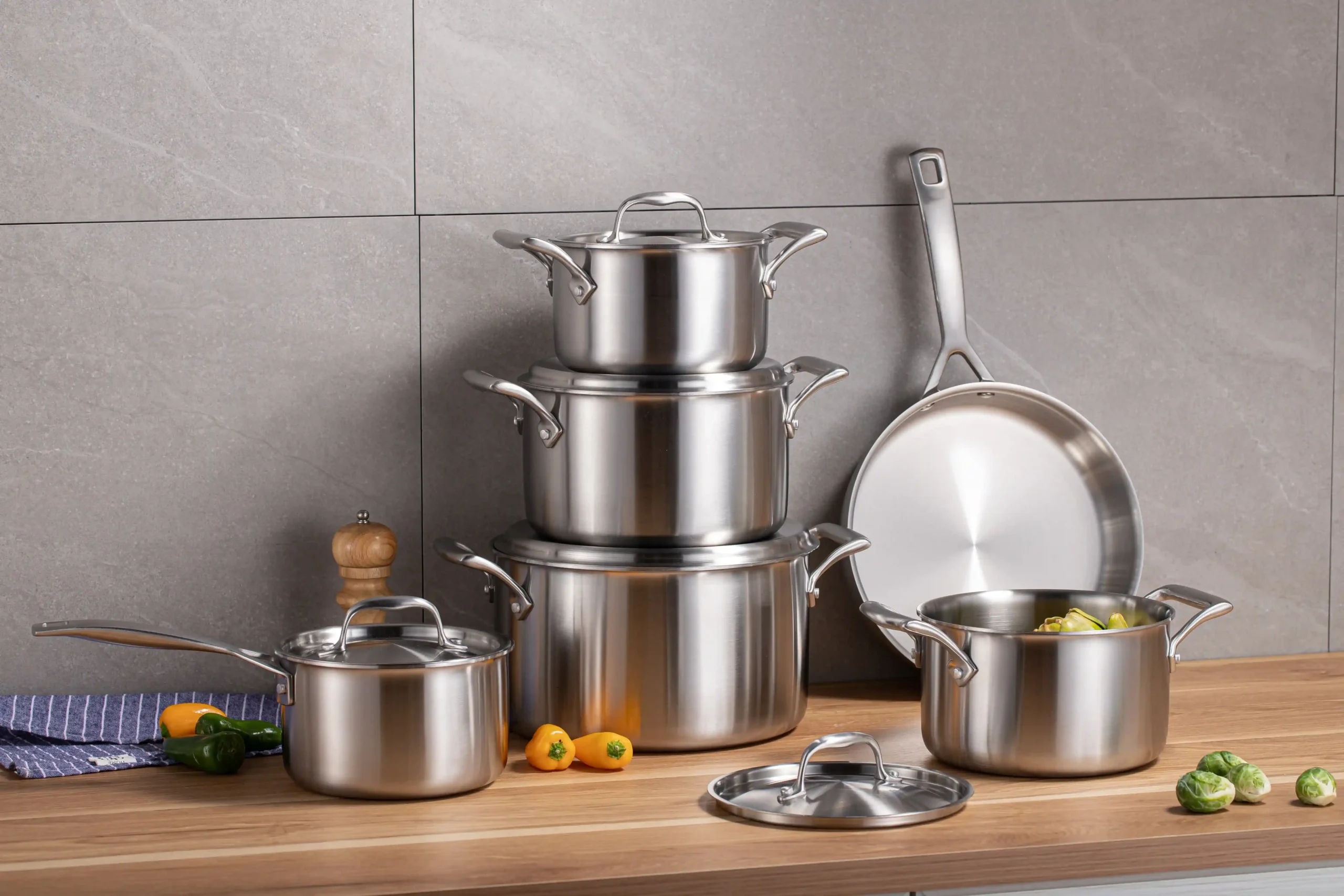
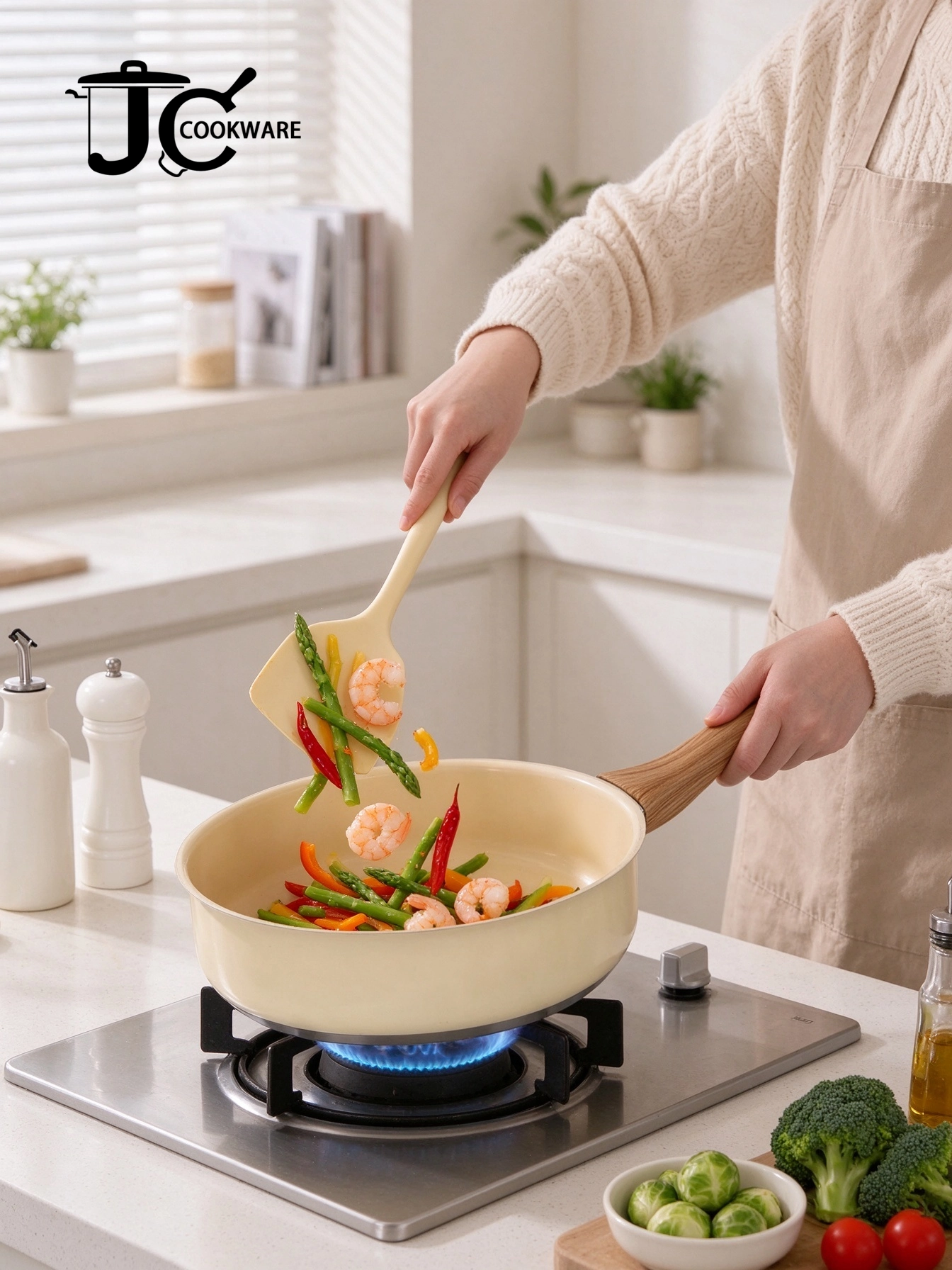
We build stainless cookware in Jiangmen, Guangdong — Encapsulated Bottom Stainless Steel Cookware Sets and 3-ply Whole-Clad Stainless Steel Cookware Sets — and our painted exteriors are done in high-temperature paint (JC-8210A), in two proven shades — cream yellow and sky blue — available across both. BSCI and ISO 9001 audited, supplying cookware brands worldwide since 2003, with our largest volumes going to Europe and the Middle East. Painted color programs are a regular request, and the questions buyers ask about them are usually the wrong ones: what shade, how many SKUs, and how fast. The questions that decide whether the program works are further down this page.
Table of Contents
- What Colored Stainless Steel Cookware Actually Means
- How Colored Stainless Steel Cookware Is Actually Built
- Fact 1: Paint Fails at the Interface, Not in the Color
- Fact 2: Cure Temperature Sets Your Assembly Order
- Fact 3: The Dishwasher Is the Real Test
- Fact 4: Color Matching Is a Batch Problem, Not a Pantone Problem
- Fact 5: Edges and Rims Fail First
- Fact 6: Decorative Paint Is Not a Food-Contact Coating
- Fact 7: Color Changes Your Returns Math, Not Just Your Margin
- How to Specify a Colored Stainless Steel Cookware Program
- Colored Stainless Steel Cookware vs Bare Stainless vs PVD
- Six Questions for a Colored Stainless Steel Cookware Supplier
- FAQ: Colored Stainless Steel Cookware
What Colored Stainless Steel Cookware Actually Means
The word “colored” covers four different industrial processes, and they are not interchangeable in cost, durability or compliance.
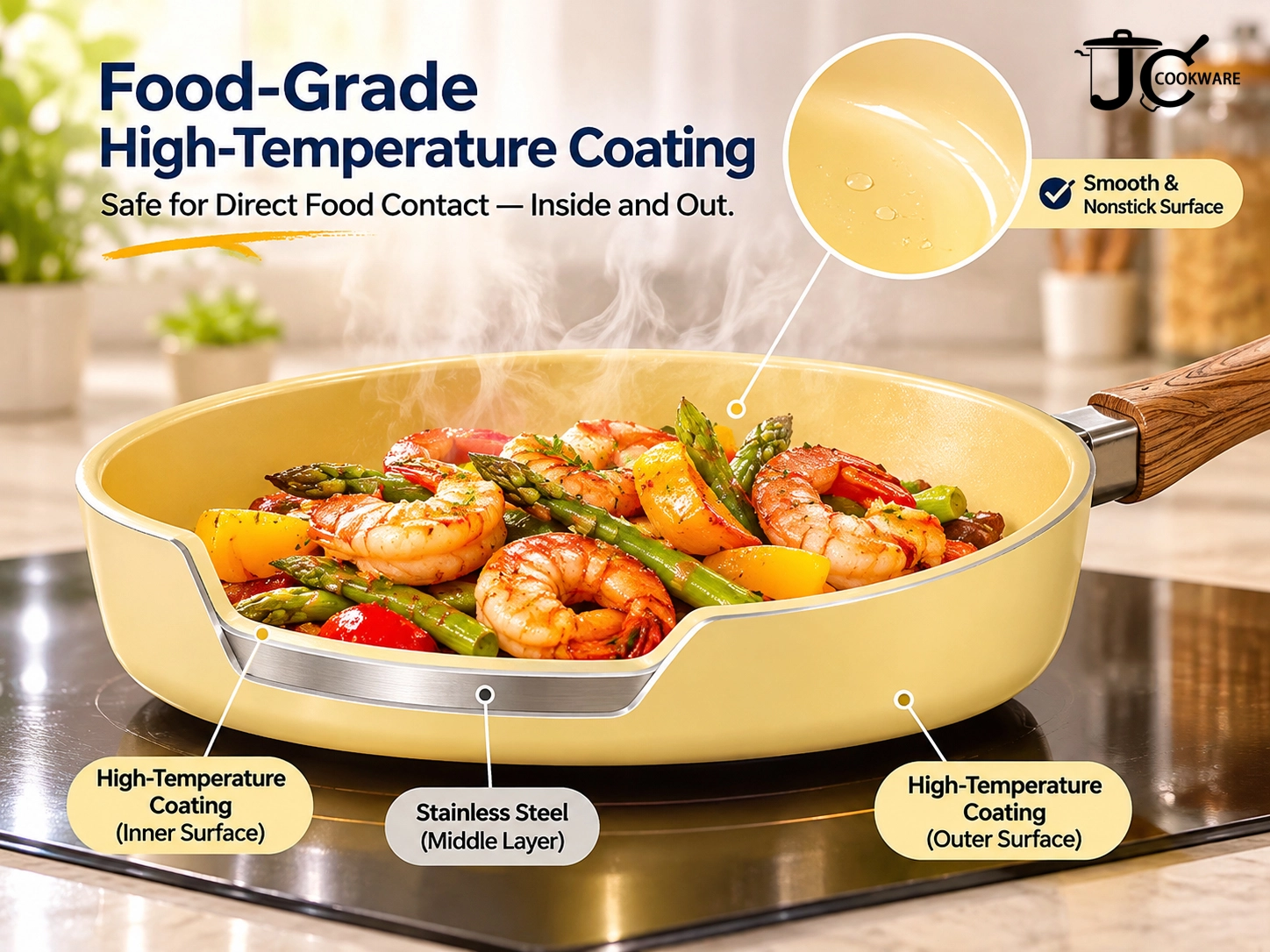
Painted exterior. A liquid coating applied over a prepared stainless surface, then cured. This is the route most mid-market color ranges use, and it’s the one we run in-house — specifically a high-temperature paint system, cured at heat so the film tolerates hob-side temperatures. Our own color program is deliberately narrow: cream yellow and sky blue, the two shades we run in volume with a stable process. Paint offers the lowest tooling cost of any color route, and finish quality depends almost entirely on surface preparation and cure control.
Powder coating. Powder coated cookware uses a dry polymer sprayed electrostatically and baked into a film. Thicker and generally more resistant to chipping than thin liquid paint, with a slightly different hand-feel and a narrower range of metallic or pearlescent effects. Different line, different curing profile.
PVD (physical vapor deposition). A vacuum process, described in general terms on Wikipedia’s PVD page: https://en.wikipedia.org/wiki/Physical_vapor_deposition, that deposits a thin metallic layer — often titanium- or chromium-based — onto the stainless surface. It produces the brushed metallic colors (gold, copper, black) that have driven a lot of premium demand, and it’s a genuinely different durability class. It’s also a different capital investment and a different supply chain, so it belongs in the brief at the beginning, not as a late substitution for paint.
Enamel. Vitreous enamel fired at high temperature. Durable and chemically inert, but a different product category with different weight, different chip behaviour and a much higher energy cost per piece.
The practical consequence for a buyer: never compare a paint quote with a PVD quote. They are not the same product, and the price gap reflects a real difference rather than a supplier marking up. Decide which route fits your price band and your market first; the rest of this article is about the painted route, because that’s where most color programs live and where most of them go wrong.
How Colored Stainless Steel Cookware Is Actually Built
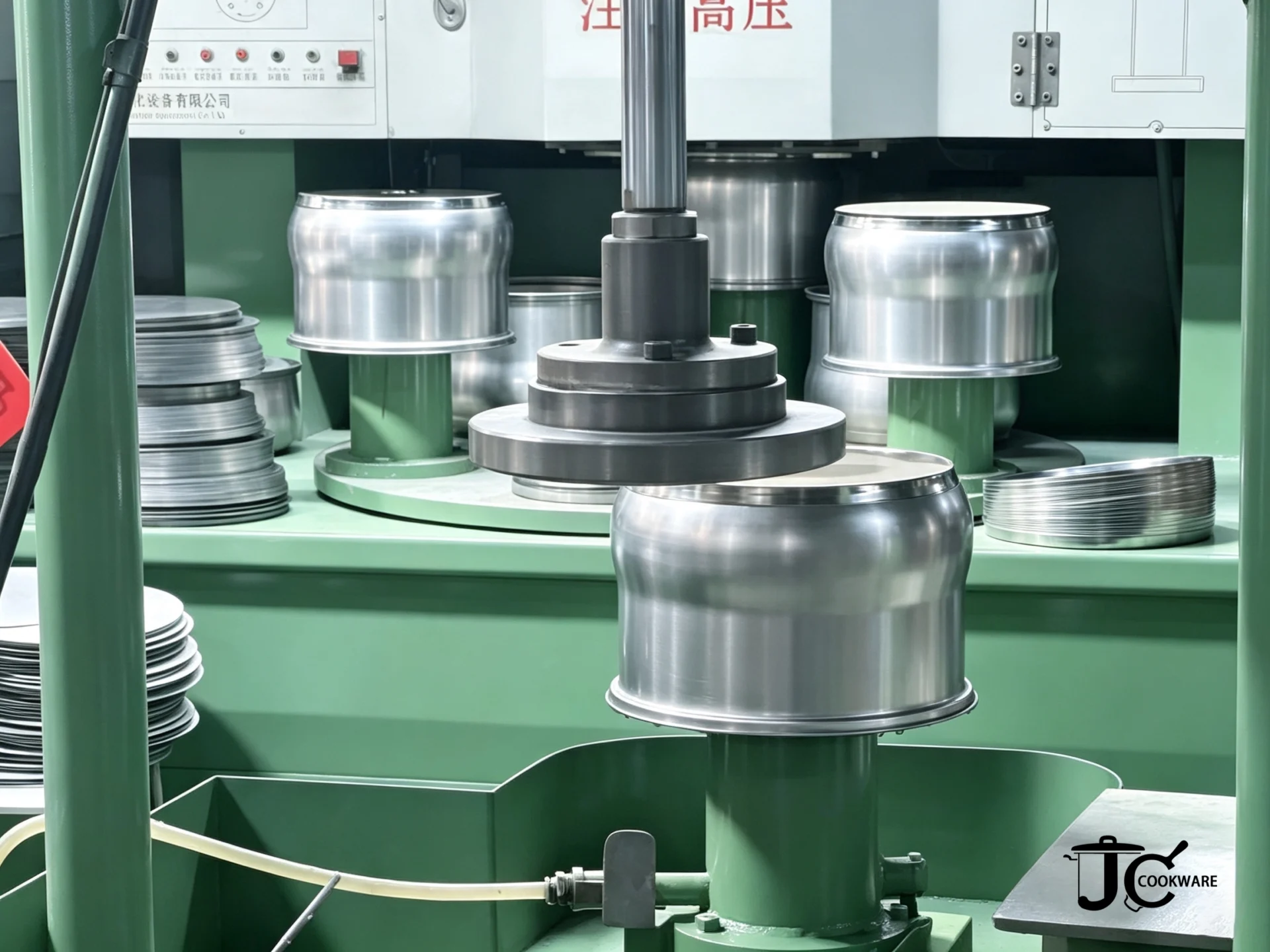
The sequence matters more than the chemistry. A painted stainless pan goes through roughly these steps:
| Step | What happens | What it decides |
| 1. Forming | Body is drawn and trimmed | The surface the coating must cover, including the geometry at the rim |
| 2. Degreasing | Oils and drawing lubricants removed | Whether anything can bond at all |
| 3. Pretreatment | Surface converted — typically a phosphate or similar conversion layer, sometimes mechanical preparation | Adhesion and corrosion protection under the film |
| 4. Primer | Base layer for color and adhesion | Chip resistance, color holdout |
| 5. Topcoat | Color layer | Appearance, coverage, chemical resistance |
| 6. Cure | Baked at a controlled temperature and time | Final film properties; under-cure is invisible at inspection |
| 7. Assembly | Handle, lid, rivets, base finishing | Whether the cured film survives handling |
Two observations from running this line. First, steps 2 and 3 are where the money is saved or lost, and they’re invisible in the finished pan — which is exactly why buyers can’t audit them from a sample. Second, step 6 is where cheap programs fail silently: an under-cured film looks perfect on the bench and starts failing after a few dishwasher cycles, long after the container has shipped.
Fact 1: Paint Fails at the Interface, Not in the Color
When colored stainless steel cookware peels, the instinct is to blame the paint brand. In practice, the failure is nearly always at the boundary between the stainless surface and the first layer of coating, and the causes are unglamorous:
- Residual drawing lubricant that survived degreasing, especially in the grain of a brushed surface.
- Incomplete conversion coating — patchy pretreatment leaves areas with no chemical key.
- Surface contamination from handling between pretreatment and primer.
- Over-polished substrate — a mirror finish gives the coating very little mechanical key, so a painted exterior generally wants a prepared, slightly textured surface rather than a mirror.
This is why a color sample is a weak test: it tells you what the pan looks like, not what the interface looks like. Cookware paint adhesion is decided at pretreatment, long before anyone sees a color. The useful buying question isn’t “which paint do you use” but “what is your pretreatment sequence, and how do you verify it”. A supplier who can describe the conversion step, the rinse stages and the dry-off has a process. A supplier who says “we use good paint” has a purchase order. Colored cookware durability is a process outcome, not a paint specification.
Fact 2: Cure Temperature Sets Your Assembly Order
Coating cure happens at a temperature that the rest of the pan may not enjoy. Bakelite and phenolic handles, some lid knobs, silicone seals and certain decorative trims have temperature ceilings well below a cure oven. That forces a sequencing decision on every colored stainless steel cookware program:
- Coat before assembly — the cleanest coating result, because the whole body goes through the oven with nothing attached. Costs an extra handling step and requires the assembly line to run after coating.
- Coat after partial assembly — faster, but the attached parts must survive the cure, which limits handle material choice and can discolor or distort cheaper components.
- Cure at lower temperature with a longer cycle — a compromise that protects components but demands more precise oven control, and is where under-cure creeps in.
For a brand, this is not a factory detail — it decides which handles you can offer in a color range. If your design calls for a pale handle with a specific finish, confirm early that it survives the cure schedule, or plan for post-cure assembly. Discovering this after tooling is a schedule problem; discovering it after the first container is a recall conversation.
Fact 3: The Dishwasher Is the Real Test
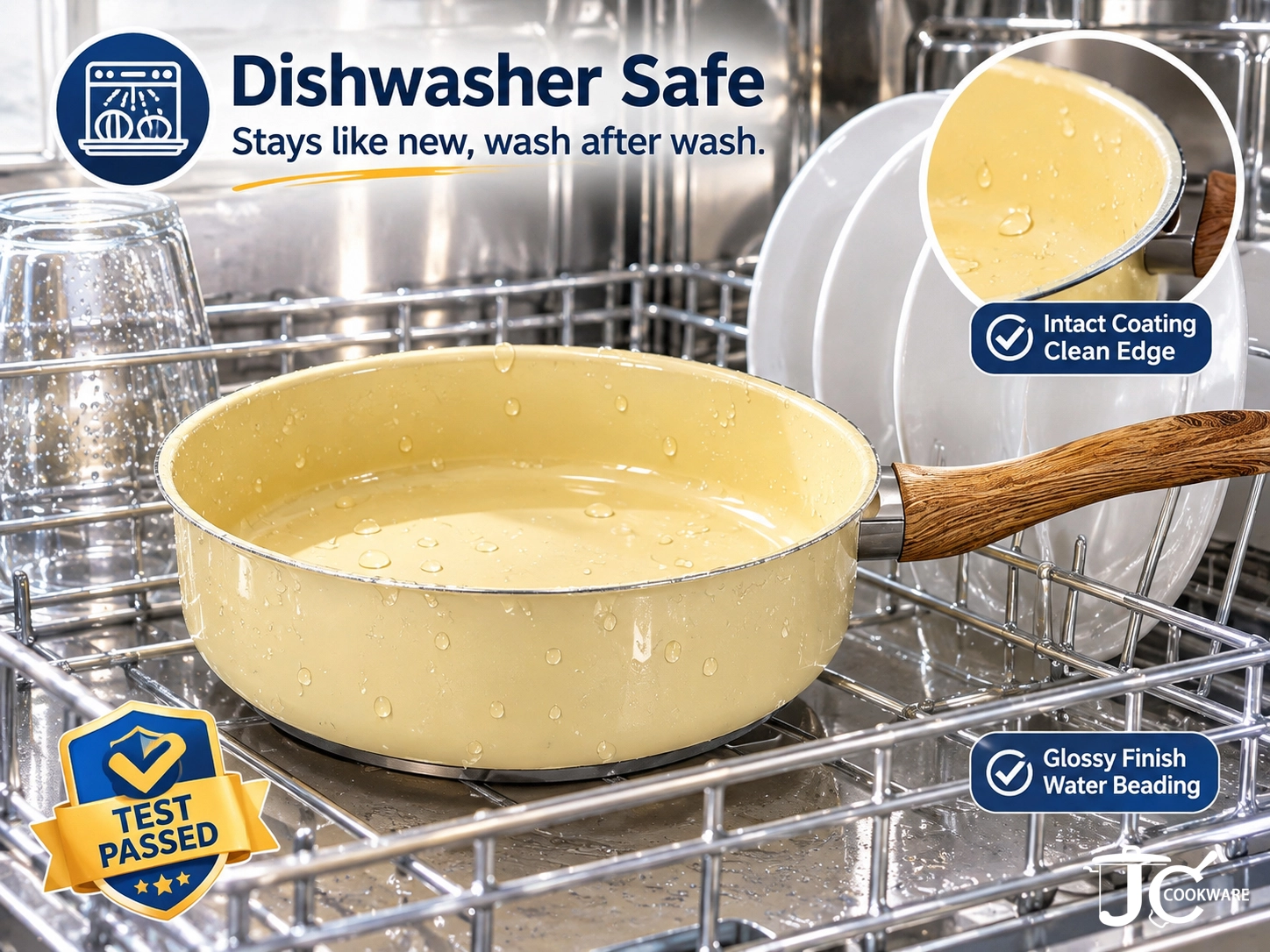
For colored stainless steel cookware, working life is defined by what happens in a dishwasher: hot water, alkaline detergent, long wet dwell times and mechanical impingement from other items. That combination attacks a coating film in ways a hand-washed pan never experiences.
Three practical implications:
Detergent chemistry matters more than cycle count. Alkaline detergents attack under-cured films and weak primer bonds. A coating that survives five hundred gentle cycles can fail in fifty aggressive ones, so a “dishwasher safe” claim without a defined detergent and temperature is not a specification.
Rims and masked areas are the entry points. Where coating stops at the rim, water sits at the boundary. A well-designed pan has a clean, fully coated edge or a deliberate bare-stainless band that can be dried — not a ragged paint line.
Hand washing extends life, but isn’t a marketing answer. Telling consumers to hand wash a pan marketed as dishwasher safe undermines the claim. Better to specify a coating system that genuinely tolerates the dishwasher, and to keep the care instruction honest about what shortens life — abrasive pads, stacking while wet, and soaking.
If your market is dishwasher-heavy — Northern Europe, North America, much of the Gulf expat market — this is the spec that should drive the coating choice, not the color card. The care regime that goes with it is covered in our guide to cleaning stainless steel cookware: https://jincui.com/clean-stainless-steel-cookware-10-honest-steps/.
Fact 4: Color Matching Is a Batch Problem, Not a Pantone Problem
Every colored stainless steel cookware program starts with a target and ends with a stack of slightly different pans. The reason is that color on a coated metal surface is a system, not a swatch:
- Substrate variation. Different steel lots have slightly different surface topography and reflectivity, which shifts the apparent color under a thin film.
- Film thickness variation. A few microns of difference changes the depth of a solid color and noticeably shifts a metallic or pearlescent one.
- Cure variation. Over-cure darkens and yellows; under-cure can leave a shade lighter and softer.
- Light source. Two pans that match under factory lighting can diverge under retail LEDs or daylight.
The fix is procedural, not artistic: a signed master standard held by both sides, a defined light source and viewing geometry for approval, a stated tolerance in color-difference terms, and an agreed procedure for what happens when a batch sits at the edge of tolerance. Without a master standard, every shipment becomes a negotiation, and the argument always happens in front of the buyer’s customer rather than in the factory.
One more point that surprises brands launching a range: different colors in the same family are not equally difficult. Whites and pale creams show film defects and dirt pickup; deep blacks show scratches and handling marks; metallics show thickness variation. A color range should be tested as a range, not color by color. This is also why our own painted line sticks to two proven shades — cream yellow and sky blue — rather than an open palette: a color you run every week is a process; a color you run twice a year is an experiment the buyer pays for.
Fact 5: Edges and Rims Fail First
Coating is a film under tension, and films fail where geometry concentrates stress. On colored stainless steel cookware that means:
- The rim, where the coating terminates and the substrate is exposed.
- Rivet heads and handle mounts, where assembly creates a penetration and a stress point.
- The base-to-wall transition, where forming has already worked the metal.
- Any laser-cut or stamped edge with a burr or a sharp corner.
Good programs handle this at design stage: coating wraps a defined distance over the rim, edges are deburred before coating, and assembly operations are sequenced to avoid crushing cured film. Cheap programs leave a thin, ragged paint line at the rim, and that’s the first place a customer notices failure — usually within months, in a photograph, in a review.
For buyers, there’s a quick check on any sample: look at the rim, not the middle of the pan. Run a fingernail along the coating edge. If it lifts or feels ragged, the process is marginal regardless of how good the color looks.
Fact 6: Decorative Paint Is Not a Food-Contact Coating
This is a compliance distinction that trips up brands moving fast.
The exterior of colored stainless steel cookware is decorative. It sits on the outside of the pan, where it contacts hands, dish racks and shelves — not food. That changes which regulatory framework applies, and it means the exterior coating should be specified for adhesion, heat and chemical resistance rather than for food-contact migration.
The interior is a different story. If the inside is bare stainless, the compliance story is about the alloy in contact with food. If the inside is coated — a non-stick or ceramic interior — that coating is a food-contact material and needs its own documentation, its own migration or extraction testing, and its own declaration for the destination market.
Two mistakes follow from mixing these up. The first is assuming that a compliance certificate for the exterior paint covers the interior coating. The second is assuming a food-contact approval for the interior covers the exterior’s durability — it doesn’t; they answer different questions.
A practical rule for the brief: specify interior and exterior separately, with separate documentation, even when the same supplier handles both. Destination-market requirements differ, and the paperwork has to name the actual material in the actual product.
Fact 7: Color Changes Your Returns Math, Not Just Your Margin
Colored stainless steel cookware sells, and colored stainless steel cookware returns. The difference between a color range that works and one that bleeds margin is usually visible in the return reasons:
| Color direction | What shows first | Effect on returns |
| Deep black / dark navy | Scratches, handling marks, dust | Higher — every mark reads as damage |
| White / cream | Dirt pickup, film defects, shade variation | Higher — defects are unforgiving |
| Mid-tone muted (sage, terracotta, sand) | Even wear | Lower — hides handling well |
| Metallic / pearlescent | Thickness variation, batch mismatch | Mixed — high perceived value, high scrutiny |
Then there’s the mismatch problem: colored cookware sets are judged as a set, not pan by pan. One pan that reads a shade off makes the whole set look wrong, and that’s a return or a discount, not a customer-service conversation.
The brand-side implication is that color should be costed as a total — coating cost, yield loss at the paint line, batch-matching risk, and expected returns — not as a per-unit upcharge on the price list. Color is one of the few features where a five-percent cost increase can produce a fifteen-percent return-rate increase, and the arithmetic only shows up two quarters later.
How to Specify a Colored Stainless Steel Cookware Program
A finished specification for colored stainless steel cookware covers both the metal and the film. The fields that matter:
| Field | What to write |
| Substrate | SS 304 or SS 201, body thickness, base construction |
| Surface preparation | Degrease sequence, conversion coating type, any mechanical prep |
| Coating system | Primer + topcoat chemistry, number of coats |
| Film build | Target dry film thickness in µm, with tolerance |
| Cure schedule | Temperature and time; confirm component temperature limits |
| Adhesion requirement | Test method and acceptance level, agreed in writing |
| Color standard | Signed master sample, light source, accepted tolerance |
| Durability claim | What “dishwasher safe” means for this SKU, and under what conditions |
| Coverage limits | How far over the rim the coating wraps; masked areas |
| Interior specification | Bare stainless grade, or coating system with its own documentation |
| Handle and lid | Material, attachment, and whether they survive the cure |
| Packaging | Protection against abrasion in carton and in transit |
Two of these are worth insisting on in writing: adhesion test method and the definition of the durability claim. Everything else can be negotiated later at modest cost. Those two determine whether you have a product or a complaint stream.
Colored Stainless Steel Cookware vs Bare Stainless vs PVD
| Bare mirror / satin | Painted exterior | PVD | |
| Color range | None (finish only) | Widest, including solid and soft tones | Metallic and dark tones |
| Tooling cost | Lowest | Low–medium | High |
| Durability | Highest — it’s the metal | Depends on pretreatment and cure | High, but chips differently |
| Repair | Polish out | Not repairable at home | Not repairable |
| Perceived value | Neutral to premium (mirror) | Design-led, mid-market | Premium |
| Best fit | Value and professional ranges | Design-led ranges, gift sets, color families | Premium ranges with a metallic story |
The honest framing: bare stainless — the same material described in our clad cookware explainer: https://jincui.com/what-is-clad-cookware-7-key-facts-every-buyer-must-know/ — is the most durable option and always will be, because there’s no film to fail. Paint buys you color and a design story at a mid-market cost, and it can be genuinely durable when the process is right. PVD buys a metallic finish at a premium price with its own failure mode. None of these is “better” in the abstract — the mistake is buying one and expecting another’s behaviour.
Six Questions for a Colored Stainless Steel Cookware Supplier
1. What is the pretreatment sequence, and how is it verified? This is the question that separates a coating line from a spray booth. If the base construction is still open, start with what clad cookware means: https://jincui.com/what-is-clad-cookware-7-key-facts-every-buyer-must-know/ before choosing a finish.
2. What is your cure schedule, and which handle materials survive it? Answers here determine your design options, not just your color.
3. How do you approve color — master sample, light source, tolerance? A supplier without a master-standard process will produce drift.
4. What does your dishwasher claim actually mean? Ask for the detergent class, temperature and cycle count behind it.
5. Where does the coating stop at the rim, and how is that edge finished? The rim is where the customer will see failure first.
6. Can you show the interior and exterior compliance documentation separately? If they’re bundled into one certificate, the paperwork won’t survive a retailer’s compliance review.
QC: What to Check on a Colored Batch
- Film thickness on a defined sample per batch, at the rim and the base.
- Adhesion per the agreed method, including at the rim and around rivets.
- Color against the master standard, under the agreed light source.
- Coverage at the rim and masked areas — no ragged edge, no bare patch inside the coated zone.
- Cure verification by the method agreed at specification stage.
- Assembly damage — no crushed or scuffed film from handle fitting.
- Carton protection — coated pans abrade against each other in transit if the packing isn’t designed for it.
- Set consistency — the whole set assessed together, not piece by piece.
Bare stainless QC is mostly about metal and geometry — the wider nine-check sequence is in our cookware quality standards: https://jincui.com/cookware-quality-standards-9-checks-before-you-ship/ article. Colored stainless steel cookware QC is about metal, geometry and a film, and the film is the part that has no second chance once the container sails.
FAQ: Colored Stainless Steel Cookware
Is colored stainless steel cookware durable?
It can be, and its durability is decided before the paint is applied. A properly degreased, conversion-coated surface with a correctly cured film survives years of normal use. A film applied over marginal preparation looks identical on day one and fails at the rim within months.
Does the color come off in the dishwasher?
A well-specified coating system tolerates dishwasher use. Failures usually trace back to under-cure or weak adhesion rather than the dishwasher itself. Ask what the dishwasher claim is based on — detergent class, temperature and cycle count — before accepting it.
Is painted cookware the same as non-stick?
No. A painted exterior is decorative and sits on the outside of the pan. Non-stick is an interior food-contact coating with its own chemistry and compliance route. A pan can have both, and they should be specified as two separate items.
What’s the difference between painted and PVD colored cookware?
Paint is a polymer film applied over a prepared surface and cured; PVD is a thin metallic layer deposited in a vacuum. PVD gives metallic and dark finishes with a different durability profile and a much higher capital cost. They’re different products at different price points, not upgrades of each other.
Can you match a specific brand color?
Custom color matching exists in the industry, but we keep our painted program deliberately narrow: high-temperature paint in two proven shades, cream yellow and sky blue. Those two run consistently on our line, which is what keeps adhesion and batch color stable. If your range needs a shade outside those two, treat it as a new coating program — master standard, tolerance band and cure verification from scratch — rather than a shade swap, and ask any supplier exactly that question.
Why do the pans in a set sometimes look slightly different?
Substrate variation, film thickness variation and cure variation all shift apparent color, and thin films amplify the effect. A supplier with a master standard and a tolerance band controls this; a supplier without one discovers it at the customer’s kitchen.
Which colors hide wear best?
Mid-tone muted shades generally hide handling marks and even wear best. Deep blacks show scratches and dust, whites and creams show film defects, and metallics show thickness variation most clearly.
JC Cookware runs two stainless lines side by side in Jiangmen, Guangdong — Encapsulated Bottom Stainless Steel Cookware Sets and 3-ply Whole-Clad Stainless Steel Cookware Sets — with high-temperature painted exteriors in cream yellow and sky blue (JC-8110B) available across both, and takes on non-stick and coated cookware orders to customer specification. BSCI and ISO 9001 audited, shipping to brand owners worldwide since 2003, with our largest volumes going to Europe and the Middle East. FOB Shenzhen. If you’re building a color range and want a straight conversation about pretreatment, cure schedule and what the finish will actually survive, get in touch: https://jincui.com/contact-us/.