Cookware thickness is one of those specifications that shows up on every product page but rarely gets explained. 2.5mm. 18 gauge. “Heavy-duty.” What does any of it actually mean — and how much does it matter?
After two decades of pressing, forming, and testing stainless steel in our factory, here’s what we’ve learned: thickness matters, but not in the way most marketing copy suggests. It’s not a simple “thicker is better” equation. It’s a trade-off between heat response, durability, weight, and cost — and the right answer depends on what the pan is supposed to do.
This guide covers thickness from the manufacturing side. What the numbers mean. Where they matter. And where they’re being used to sell you something that doesn’t hold up.
How Thickness Is Measured: mm vs Gauge
The millimeter system
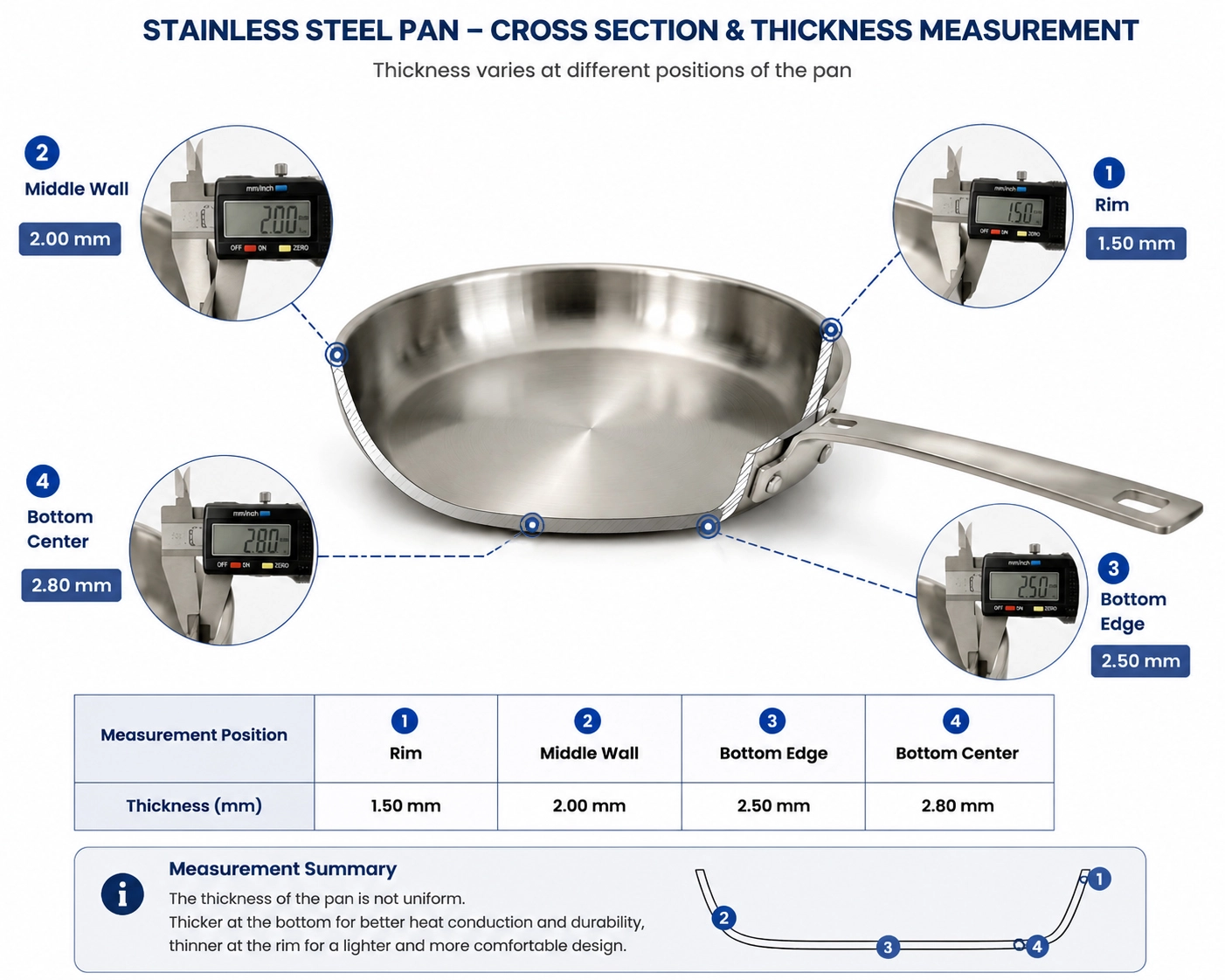
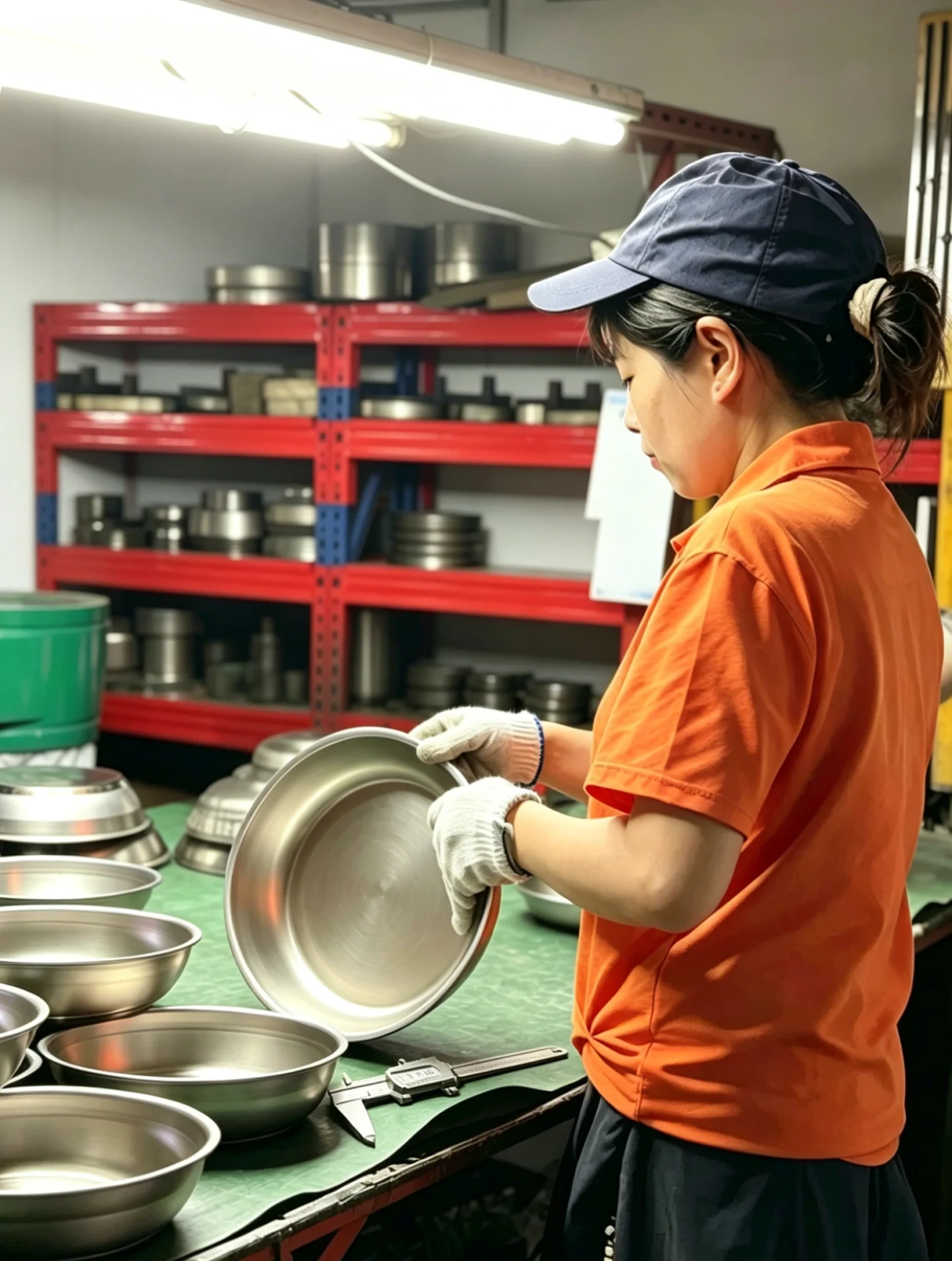
In manufacturing, cookware thickness is measured in millimeters (mm) — the actual distance between the inner cooking surface and the outer surface of the pan. This is what’s on the spec sheet, what the QC team checks with calipers during production, and what determines how the pan performs.
Millimeter measurements are direct. If a pan is spec’d at 2.5mm, the caliper reads 2.5mm. No conversion needed.
The gauge system — and why it’s confusing
Gauge is an older measurement system inherited from sheet metal industries. The critical thing to understand: gauge numbers run in reverse. A lower gauge number means thicker steel. An 18-gauge pan is thinner than a 10-gauge pan.
The second source of confusion: gauge values are different for different metals. A 16-gauge stainless steel sheet is not the same thickness as a 16-gauge aluminum sheet. If a product page says “16 gauge” without specifying the metal, the number is meaningless.
Stainless steel gauge-to-mm conversion
| Gauge | Stainless Steel (mm) | What You’d Find It In |
| 10 gauge | 3.57 mm | Heavy-duty stockpot bases, commercial cookware |
| 12 gauge | 2.78 mm | Premium frying pans, high-end sauté pans |
| 14 gauge | 1.98 mm | Standard multi-ply cookware bodies |
| 16 gauge | 1.59 mm | Mid-range cookware bodies, saucepans |
| 18 gauge | 1.27 mm | Entry-level cookware, lightweight pieces |
| 20 gauge | 0.95 mm | Thin stockpot bodies, budget cookware |
| 22 gauge | 0.79 mm | Lid bodies, very thin utility pieces |
This conversion table is one of the most useful things you can keep when evaluating cookware specs. Most consumer guides mention gauge without ever giving the actual numbers. Now you have them.
Base Thickness vs Wall Thickness: They’re Not the Same
This is one of the most common misconceptions in cookware buying — and one that manufacturers rarely clarify on product pages.
The base does the heavy lifting
The base (bottom) of a pan is where heat enters. It needs mass to absorb energy from the burner, distribute it evenly across the cooking surface, and hold it steady when food hits the pan and drops the surface temperature.
In quality cookware, the base is almost always thicker than the walls. This is deliberate engineering, not cost-cutting. The base needs thermal mass. The walls need to be lighter so the pan is manageable and responds to heat adjustments.
Wall thickness: a different job
The walls of a pan don’t need the same thermal mass as the base. Their job is containment — holding food and liquid — and contributing to overall pan rigidity. Wall thickness affects denting resistance, warp resistance, and weight.
Typical thickness ratios in production
| Construction Type | Base Thickness | Wall Thickness | Ratio |
| Whole-Clad 3-Ply (Premium) | 2.5–3.0 mm | 2.0–2.5 mm | ~1.2:1 |
| Brazed Base 3-Ply (Mid-Range) | 3.5–5.0 mm | 0.6–1.0 mm | ~5:1 |
| Impact-Bonded Base (Budget) | 4.0–6.0 mm | 0.5–0.8 mm | ~7:1 |
| Single-Ply 304 (Minimalist) | 1.0–1.5 mm | 1.0–1.5 mm | 1:1 |
The pattern is clear: premium whole-clad cookware has a moderate base-to-wall ratio because the entire pan is built from the same multi-layer sheet. Budget constructions pile thickness into the base while keeping walls thin to control cost. Both approaches work — but they produce very different cooking experiences.
What Thickness Actually Affects (and What It Doesn’t)
What thickness directly controls
- Heat distribution: A thicker base spreads heat more evenly because it has more metal mass to conduct thermal energy laterally. This reduces hot spots.
- Heat retention: More mass means more stored thermal energy. When you drop a cold steak into a thick pan, the surface temperature drops less than it would in a thin pan.
- Warp resistance: Thin pans warp. When metal heats unevenly, the hotter areas expand more than the cooler areas. If the metal is thin, this differential expansion bends the pan.
- Dent resistance: A dropped pan with 0.6mm walls will dent. One with 2.0mm walls might get a scratch.
What thickness doesn’t control
- Food sticking: Sticking is about surface texture (Ra value) and temperature at the food-metal interface. A poorly finished 3mm pan will stick worse than a properly finished 1.5mm pan.
- Corrosion resistance: The stainless steel grade (304, 316, 430) determines corrosion resistance, not thickness.
- Induction compatibility: Induction works by magnetic response, which depends on the steel grade, not thickness.
- Non-stick performance: No relationship whatsoever. Thickness has zero effect on whether eggs slide off the surface.
Multi-Ply Thickness: Breaking Down the Layers
Multi-ply (clad) cookware adds a layer of complexity — literally. The total thickness number on the spec sheet is the sum of multiple metal layers, and the composition of those layers matters more than the total.
Typical 3-ply construction
| Layer | Material | Typical Thickness | Function |
| Interior (cooking surface) | 304 Stainless | 0.4–0.6 mm | Food contact, corrosion resistance |
| Core | Aluminum (3003 or 1050) | 1.0–1.8 mm | Heat conduction, thermal distribution |
| Exterior | 430 Stainless or 304 | 0.4–0.6 mm | Induction compatibility, durability |
Total: 1.8–3.0 mm
Typical 5-ply construction
Common structure: Stainless Steel – Aluminum – Stainless Steel/Iron – Aluminum – Stainless Steel. Some models add a copper layer at the center for enhanced thermal conductivity.
| Layer | Material | Typical Thickness | Function |
| Interior | 304 Stainless | 0.4–0.5 mm | Food contact |
| Core 1 | Aluminum | 0.6–1.0 mm | Heat conduction |
| Center | Stainless Steel / Iron (some models: + Copper) | 0.3–0.8 mm | Structural rigidity; copper variant adds heat spreading |
| Core 2 | Aluminum | 0.6–1.0 mm | Heat conduction |
| Exterior | 430 Stainless | 0.4–0.5 mm | Induction, durability |
Total: 2.3–3.8 mm
The aluminum core is the real thickness story
In a typical 3-ply pan, the aluminum core is 2–3 times thicker than either stainless layer. This is because aluminum conducts heat roughly 15 times better than stainless steel. The aluminum layer is the thermal engine — the stainless layers are protective cladding.
A 2.5mm “thick” pan with a 0.8mm aluminum core will perform worse than a 2.0mm pan with a 1.4mm aluminum core. Total thickness alone doesn’t tell you the thermal story — you need the layer breakdown.
What to ask your supplier about multi-ply
- Total thickness
- Number of layers
- Material and thickness of each layer
- Whether the construction is whole-clad (layers extend up the walls) or base-only
If a supplier can’t give you the layer-by-layer breakdown, you’re buying a total thickness number without knowing what’s inside it.
How Thickness Affects Different Pan Types
Not every pan needs the same thickness. A stockpot and a frying pan have fundamentally different jobs.
| Pan Type | Recommended Base | Recommended Wall | Why |
| Frying pan / Skillet | 2.5–3.5 mm | 1.8–2.5 mm | Needs high heat retention for searing |
| Sauté pan | 2.5–3.5 mm | 1.8–2.5 mm | Similar to frying pan; larger surface area |
| Saucepan (1–3 qt) | 2.0–3.0 mm | 1.0–1.5 mm | Heats liquids; extreme thickness adds weight |
| Stockpot (6+ qt) | 3.0–5.0 mm | 0.8–1.2 mm | Thick base for even heating; thinner walls save weight |
| Dutch oven / Casserole | 3.0–4.0 mm | 1.5–2.5 mm | Slow cooking benefits from even heat |
| Sautéuse / Chef’s pan | 2.5–3.0 mm | 1.8–2.5 mm | Curved sides need enough thickness to resist warping |
| Lid | N/A | 0.6–0.8 mm | Light enough to lift; no direct heat exposure |
The pattern: pans that sear need thickness. Pans that boil water don’t. Pans with large flat bottoms need more thickness to resist warping than pans with small bases.
For B2B Buyers: Thickness as a Sourcing Specification
When you’re specifying thickness in a purchase order or OEM agreement, precision matters. Here’s what to include — and what to watch for.
What to specify
- Base thickness at center and edge: Measure at the center of the base (thickest point) and 10mm from the edge (thinnest point).
- Wall thickness at mid-height: The wall thins slightly from base to rim during forming. Specify mid-height as the measurement point.
- Tolerance range: Typically ±0.2mm for base thickness and ±0.15mm for wall thickness in quality production.
- Layer breakdown for multi-ply: Total thickness alone is not enough. Specify individual layer thicknesses and materials.
What to watch for
- “Heavy-gauge” without numbers: A marketing term, not a specification. If the spec sheet doesn’t have a number, ask for one.
- Total thickness without layer breakdown: A 3mm pan could be excellent or poor depending on layer composition.
- Thickness claims without measurement position: “2.5mm thick” — where? Base center? Base edge? Wall?
- Gauge numbers without the metal type: “16 gauge” means different things for different metals.
The Minimum Thickness Rule: What’s Too Thin
From our production experience and returned product analysis, here’s where thin becomes a problem:
| Pan Type | Too Thin If Base Is Under | Too Thin If Wall Is Under |
| Frying pan | 1.8 mm | 0.8 mm |
| Sauté pan | 2.0 mm | 0.8 mm |
| Saucepan | 1.5 mm | 0.6 mm |
| Stockpot | 2.5 mm | 0.6 mm |
Below these thresholds, you start seeing systematic issues: warping within the first year, denting from normal handling, hot spots that burn food, and the lightweight feel that signals “budget” to a customer who picks up the pan.
This isn’t to say thinner pans are unsafe or unusable. They’re just built to a different price point — and both the retailer and the end customer should understand what they’re getting.
Frequently Asked Questions
Is thicker cookware always better?
No. Thickness improves heat retention and warp resistance, but it also increases weight, slows heat-up time, and raises cost. A 3.5mm frying pan is excellent for searing. A 3.5mm stockpot is unnecessarily heavy and slow to boil water. The right thickness depends on what the pan is for — and who’s using it.
What’s the difference between 3-ply and 5-ply in terms of thickness?
5-ply typically adds 0.5–1.0mm of total thickness compared to 3-ply, with the extra layers usually being additional aluminum or a thin copper core. Whether this is worth it depends on the layer composition. A well-designed 3-ply pan with a thick aluminum core will outperform a 5-ply pan with multiple thin aluminum layers.
How can I check cookware thickness without special tools?
You can’t measure thickness precisely without calipers or a micrometer, but you can assess it roughly by weight relative to pan size. A 10-inch (25cm) frying pan that weighs under 1.5 kg is almost certainly on the thin side. One that weighs 2.0–2.5 kg is likely in the 2.5–3.0mm range.
Does the thickness of stainless steel affect how quickly it heats up?
Yes — and this is where the trade-off lives. A thicker pan takes longer to reach cooking temperature because it has more metal mass to heat. But once hot, it holds temperature more steadily. Professional cooks generally prefer the thicker option because temperature stability matters more than heat-up speed.
Why do some expensive pans feel thinner than cheaper ones?
Because they’re designed differently. Premium whole-clad cookware often has uniform thickness from base to rim (around 2.0–2.5mm throughout), which can feel “thinner” than a budget pan with a massive 5mm impact-bonded base and paper-thin 0.6mm walls. Judge by performance, not by how thick the base looks.
About JC Cookware
JC Cookware has manufactured stainless steel cookware since 2003 in Xinhui, Jiangmen. Our production covers whole-clad 3-ply, brazed-base, and impact-bonded constructions across frying pans, saucepans, stockpots, and cookware sets. We provide full layer-by-layer thickness specifications with every OEM/ODM order. Contact us through our contact page for sourcing inquiries or to request thickness samples.