Food Sticking Stainless Steel Pan: Causes & Prevention Guide
Stainless steel is the preferred cooking surface in professional kitchens worldwide. It’s also the cookware that frustrates home cooks most consistently — because food sticks to it, and nobody explains why.
This guide covers the actual metallurgical and thermal reasons food sticking stainless steel pan is such a common complaint, what prevents it, and what it means for buyers evaluating cookware quality. Whether you’re a home cook trying to fix your technique or a B2B buyer assessing a supplier’s manufacturing standards, the root cause is the same.
Key Takeaways
- Food sticks to stainless steel primarily because of thermal expansion gaps in the steel surface at the microscopic level — gaps that close when the pan reaches the right temperature
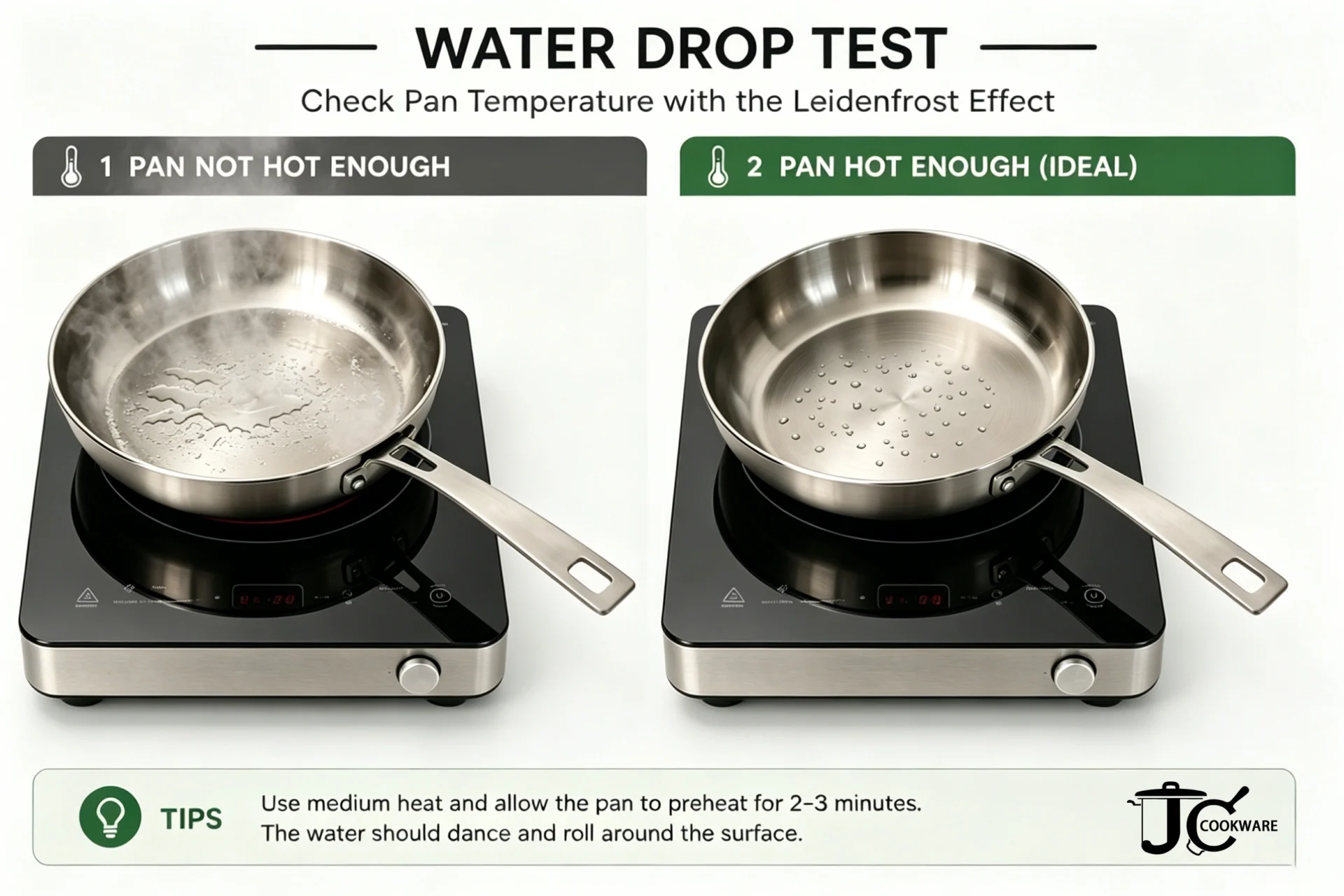
- The “water droplet test” is a reliable, zero-equipment method for determining when a stainless steel pan is properly preheated
- Pan surface quality — particularly interior finish — directly affects sticking behavior; a factory’s polishing standards are a measurable variable
- Non-stick coatings solve the sticking problem by substitution, not correction — and introduce their own trade-offs in durability and temperature limits
- Whole-clad construction reduces sticking by eliminating hot spots; impact-bonded pans require more careful heat management
JC Cookware: Built to Perform at Temperature
Before getting into the physics, it’s worth noting that sticking behavior in stainless steel cookware is partly a design problem — not just a user technique problem.
JC Cookware (Jiangmen Xinhui Jincui Metalware Co., Ltd.), founded in 2003, produces stainless steel cookware across five base construction technologies. The interior surface specification — polish grade, surface roughness (Ra value), and finish consistency — is a formal QC parameter at JC Cookware’s facility, not an afterthought. Every production batch is inspected under high-intensity lighting after each polishing pass.
The manufacturing walkthrough below describes why this matters.
Why Food Sticking Stainless Steel Pan Happens: The Surface Microstructure
Stainless steel looks smooth. Under a microscope, it isn’t.
The surface of any stainless steel pan — even a well-polished one — is covered in microscopic peaks and valleys. When you place cold food on a cold or under-heated pan, two things happen:
- The steel contracts slightly, enlarging those microscopic gaps in the surface texture
- Proteins in the food (especially meat and egg) fill those gaps almost immediately upon contact, forming a mechanical bond with the steel surface
This is the primary cause of food sticking stainless steel pan surfaces: a protein bond in a cold or insufficiently preheated pan.
When the pan is properly preheated, thermal expansion closes those surface gaps. Food contacts a surface that’s effectively smoother at the microscopic level — less physical area to bond to. The protein bond still forms, but it’s weaker and shorter-lived. Once the exterior of the food sets (the Maillard reaction creates a crust), it releases naturally.
This is why professional cooks say “hot pan, cold oil” — and why it actually works.
The Leidenfrost Effect: Why Food Sticking Stainless Steel Pan Is a Temperature Problem
There’s a second mechanism at work: the Leidenfrost effect.
When a drop of water hits a pan that’s above ~180°C (the Leidenfrost point for water), a thin layer of vapor forms instantly between the water and the pan surface. This vapor cushion causes the drop to bead up and skitter across the surface rather than evaporate immediately.
This is the basis of the water droplet test — the most reliable non-equipment method for determining whether a stainless steel pan is ready to cook:
- 1. Heat the pan over medium heat for 1–3 minutes
- 2. Flick a few drops of water into the pan
- 3. If the water sizzles and evaporates quickly → pan is not hot enough
- 4. If the water forms one or more firm, rolling beads that move around the pan without evaporating → pan is at the right temperature
- 5. Add oil, let it heat for 15–20 seconds, then add food
The Leidenfrost effect is also why oil behaves differently in a properly preheated pan: the thin vapor barrier from residual moisture keeps the oil from immediately polymerizing onto the pan surface before food is added.
Stainless Steel Pan Surface Finish: The Manufacturing Variable That Affects Food Sticking
Not all stainless steel pans stick equally — and the difference isn’t only technique.
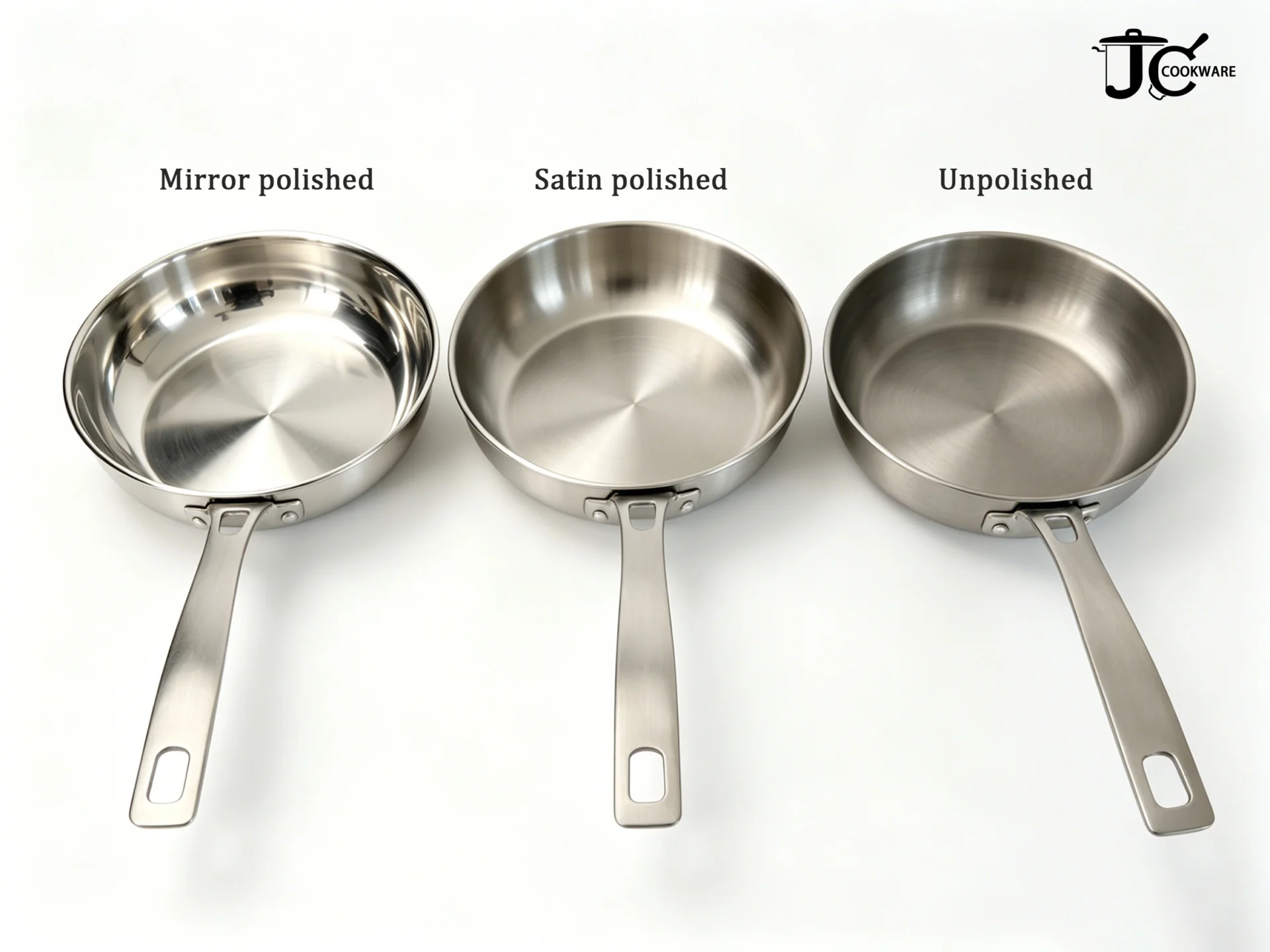
Interior surface finish (Ra value) is a measurable manufacturing variable. Ra (roughness average) is the arithmetic mean of surface profile deviations from the centerline, measured in micrometers (μm).
| Surface Finish | Ra Value | Sticking Tendency | Notes |
| Mirror polish | Ra ≤ 0.4 μm | Lowest | Most demanding to maintain in production |
| Brushed / satin | Ra 0.4–1.6 μm | Low–moderate | Most common on commercial cookware |
| Machine finish | Ra 1.6–3.2 μm | Moderate | Entry-level or value-tier pans |
| Unpolished | Ra > 3.2 μm | High | Not suitable for cookware interior |
A pan with a rougher interior surface has more microscopic area for protein bonding, regardless of how well it’s preheated. This is why two pans of the same steel grade can have significantly different real-world sticking behavior — the surface finish specification matters.
At JC Cookware, mirror-polish interior pans go through a minimum of 4–5 progressive polishing passes, with inspection under high-intensity lighting after each pass. The Ra value of finished interiors is part of the product specification, not an implied outcome.
Base Construction and Hot Spots: The Even Heat Problem
A second manufacturing variable directly affects sticking: heat distribution uniformity.
A pan that heats unevenly creates hot spots — localized areas where the temperature exceeds the rest of the cooking surface. Food in contact with a hot spot gets exposed to much higher temperatures than food elsewhere in the pan, causing:
- Protein over-bonding in the hot zone (severe sticking)
- Uneven Maillard reaction (some areas over-browned, others under-cooked)
- Oil breakdown in hot zones before food is even added
The base construction method determines how evenly heat distributes across the cooking surface:
Whole-Clad Construction (Best Even Heating)
In a whole-clad (tri-ply or multi-ply) pan, the aluminum core runs continuously from the base through the sidewalls. Heat conducted through the bottom travels laterally through the aluminum layer before reaching the cooking surface. The result is a cooking surface that’s very close to uniform temperature across its full area.
This is the primary practical advantage of whole-clad over disc-base designs — not just performance, but specifically the reduction of hot spots and the sticking that comes with them.
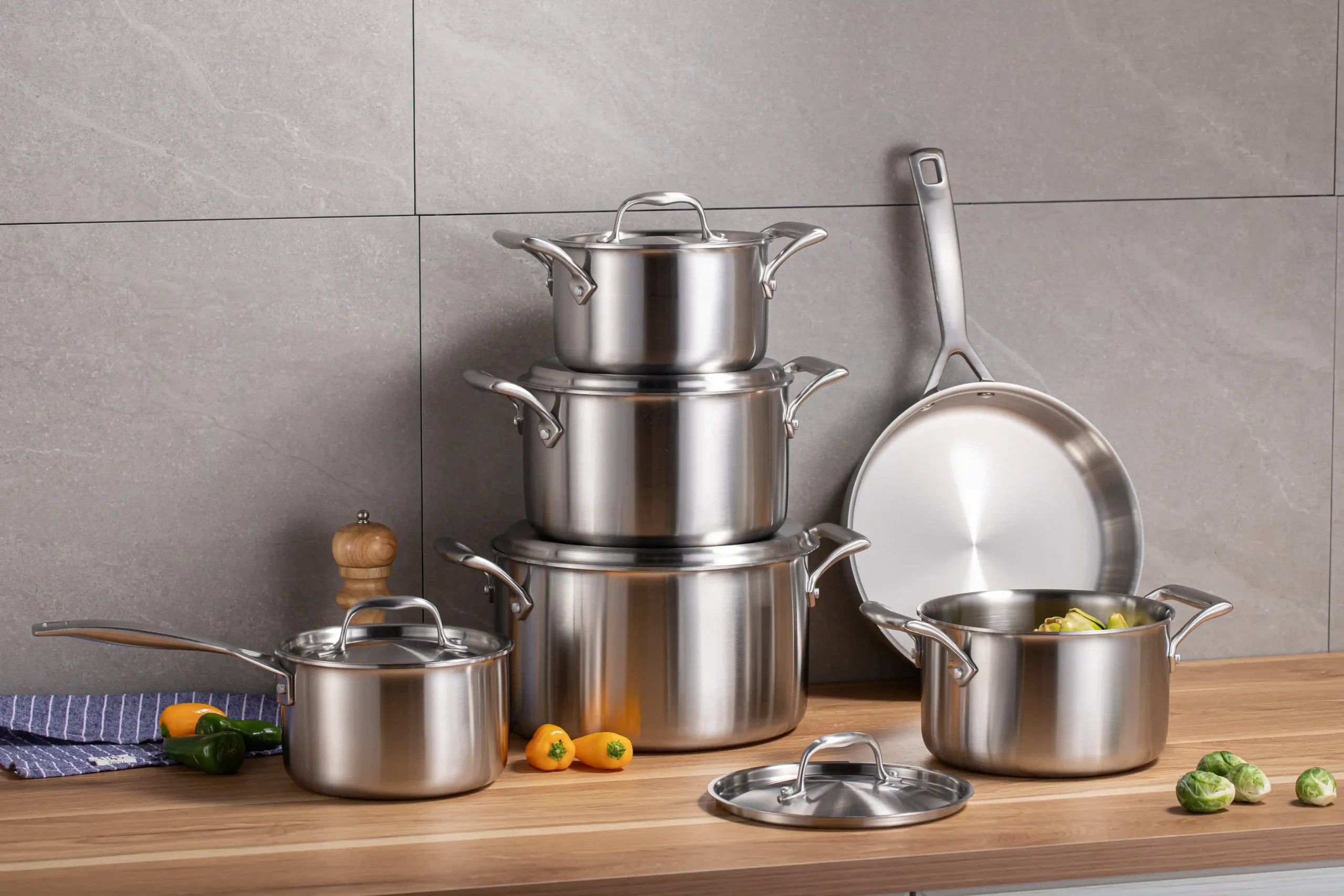
Representative product: JC-8020A — 3-ply whole-clad construction with polished interior.
Impact-Bonded Base (Good at the Base, Less So at the Sides)
In an impact-bonded pan, the aluminum core is contained within the base disc. Heat distributes very evenly across the bottom, but the sidewalls are single-ply stainless — which conducts heat poorly. The sides of the pan can be significantly cooler than the base, which matters when food is piled above the base level.
For most flat-surface cooking (searing, sautéing), impact bonding performs well. For cooking that requires heat at the sidewalls (braising, reducing sauces), whole-clad has a measurable advantage.
Representative product: JC-8410A — impact-bonded stockpot with heavy encapsulated base.
Brazing-Base Construction (Hot Spot Risk at the Edge)
Brazed-disc base pans are the most common in the value segment. The aluminum disc is bonded to the steel base with a thin brazing layer. If the braze layer is uneven — a quality control issue — there will be zones where the aluminum disc has partial contact with the pot base. Those zones overheat relative to the rest of the pan.
This is why brazing-base pans from lower-quality manufacturers often show uneven browning patterns and worse sticking behavior than their specs would suggest.
| Base Construction | Hot Spot Risk | Sticking Tendency | Where It Matters |
| Whole-Clad (Tri-Ply) | Very low | Lowest | All cooking styles |
| 5-Ply Brazed Composite | Very low | Lowest | High-performance induction |
| Impact Bonding | Low at base | Low at base | Flat surface cooking |
| Braze Welding (disc) | Moderate | Moderate | Quality-dependent |
5 Common Causes of Food Sticking Stainless Steel Pan — and How to Prevent Each
For end users, here’s the practical breakdown:
1. Pan Not Preheated Enough
What happens: The steel surface is contracted; protein bonds form in the gaps.
Fix: Use the water droplet test. Don’t add food until water beads and rolls. On induction, this typically takes 1.5–2.5 minutes at medium power.
2. Oil Added Too Early (Before Pan Is Hot)
What happens: Cold oil spread onto a cool pan polymerizes onto the surface under heat and becomes sticky — effectively creating an adhesive layer before food is added.
Fix: Heat the pan first (water test), then add oil, then add food within 15–20 seconds of adding oil.
3. Food Added Straight from the Refrigerator
What happens: Cold food dramatically drops the pan surface temperature, recreating the conditions for protein bonding even in a properly preheated pan.
Fix: Let proteins (especially steak, chicken breast, fish) sit at room temperature for 20–30 minutes before cooking. Pat dry with paper towels — surface moisture is a major contributor to sticking.
4. Moving Food Before It’s Ready to Release
What happens: The protein bond hasn’t broken yet. Forcing the food off the surface tears it.
Fix: Leave it alone. Properly cooked proteins release naturally when the Maillard crust forms. If it’s resisting, it’s not ready. Wait 30–60 more seconds.
5. Cooking Acidic Foods in Worn or Damaged Pans
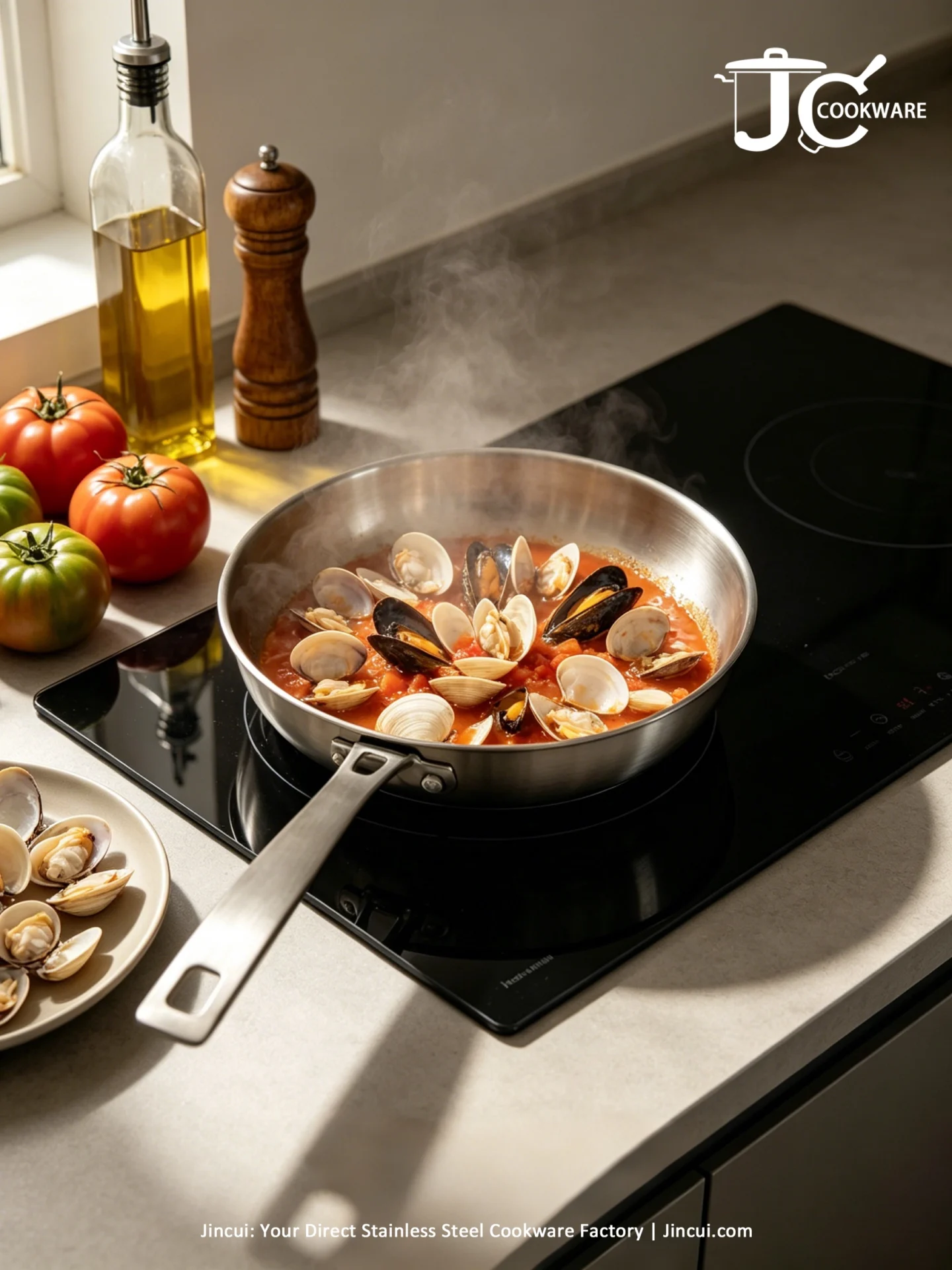
What happens: Acidic foods (tomatoes, citrus, wine reductions) react with the passive oxide layer on stainless steel. In undamaged pans with good passive layer formation, this is minimal. In pans that have been improperly cleaned or damaged, the oxide layer is compromised and the surface becomes more reactive.
Fix: Use well-maintained pans; avoid harsh abrasives on the interior. For tomato-heavy sauces, enamel-coated or non-reactive cookware is often more practical.
What This Means for B2B Buyers
If you’re sourcing stainless steel cookware, the sticking question is a quality signal with several actionable implications:
Ask about interior Ra specification. A supplier that has documented Ra values for their finished interior surfaces is a supplier that treats surface quality as an engineering variable, not a visual outcome.
Request polishing process documentation. How many polishing passes? What grit sequence? What’s the inspection protocol? Answers to these questions reveal whether quality is managed or assumed.
Evaluate base construction honestly. If you’re selling to markets where cooking technique varies widely, whole-clad or impact-bonded products will perform more consistently in the field than disc-base designs. Fewer returns, fewer complaints.
Check for even heat distribution testing. Serious manufacturers test finished cookware for temperature distribution, not just visual inspection. Ask whether their QC process includes infrared thermometry or equivalent methods.
Why does food stick to stainless steel but not to non-stick pans?
Non-stick coatings (PTFE/Teflon and ceramic variants) are hydrophobic surfaces — they don’t form chemical bonds with proteins or carbohydrates. Stainless steel is hydrophilic; its passive oxide surface can interact with food molecules. The Leidenfrost effect and proper technique achieve a similar result to non-stick without the coating — the difference is that stainless requires correct temperature management and non-stick doesn’t.
Is a more expensive stainless steel pan less likely to stick?
Partially — but the correlation runs through specific quality variables. A well-polished interior and whole-clad construction reduce sticking tendency. “Expensive” as a category includes many other factors (handle design, lid quality, brand margin). The specific variables that reduce sticking are interior Ra value and base construction uniformity.
Can I use metal utensils on stainless steel without affecting sticking?
Yes — stainless steel is mechanically durable enough for metal utensils without creating the kind of surface damage that would meaningfully affect sticking. The concern with metal utensils is more relevant to non-stick coatings.
Does stainless steel cookware become less sticky with use?
To some extent — regular use and proper seasoning (thin oil film at high temperature) builds a microscopic polymerized oil layer in the surface texture, which reduces the effective surface area for protein bonding. This is why a “broken-in” stainless steel pan often feels better than a new one. It’s not seasoning in the cast iron sense; it’s a thin, natural oil polymerization.
What’s the best way to clean stainless steel cookware without damaging the interior finish?
For routine cleaning: warm water, mild dish soap, soft sponge. For stuck food: deglaze with water while the pan is still warm (proteins release easily at temperature), then wash normally. For mineral deposits (white spots from hard water): a small amount of white vinegar dissolves calcium buildup without damaging the surface. Avoid steel wool or chlorine bleach — these can damage the passive oxide layer.
Conclusion: Sticking Is a Physics Problem With an Engineering Solution
Food sticking stainless steel pan surfaces is a thermal mechanics problem at the microscopic level. Proper preheating solves most of it. Quality manufacturing — interior surface finish and base construction — handles the rest.
For buyers, this means sticking performance is a verifiable quality variable, not just a matter of end-user technique. A pan with a documented interior Ra specification and proper base construction will outperform one that doesn’t on this metric — regardless of what the brand says about it.
JC Cookware’s technical team is available to discuss interior surface specifications, base construction options, and QC protocols for any sourcing inquiry.
Visit (https://jincui.com/) to connect with the production team.