Open any premium stainless steel pan and you’ll find a hidden decision buried in its base: the core material. The aluminum vs copper core cookware question is one we hear constantly from brand buyers — and the answer is more nuanced than “copper is expensive, so it must be better.”
Since 2003, our factory in Jiangmen, Guangdong has bonded both aluminum and copper cores into stainless steel cookware every production day, supplying cookware brands across the EU and Middle East markets. We’ve built both core types at volume and seen how each one plays out in FOB cost, production yield and long-term durability. This guide settles the aluminum vs copper core cookware debate with engineering fundamentals, not marketing copy.
Table of Contents
1. What the Core Layer Actually Does
2. Aluminum vs Copper Core Cookware: Head-to-Head Data
3. Real Cooking Differences You Can Actually Taste
4. Cost: Why Copper Core Cookware Costs 30–50% More
5. Durability, Weight and Maintenance
6. How We Build Both Cores: 3-Ply and 5-Ply
7. B2B Sourcing Guide: What to Ask Your Factory
8. FAQ: Aluminum vs Copper Core Cookware
What the Core Layer Actually Does
Stainless steel is a terrible heat conductor. It’s food-safe, corrosion-resistant and durable — but heat moves through 304 stainless steel slowly and unevenly. That’s why no serious cookware is made of stainless steel alone: there is always a conductive metal core doing the real thermal work.
The core is the engine of the pan. When you place a pan on a gas burner, the flame ring creates a hot circle directly above the burner. The core’s job is to pull that heat sideways and spread it across the entire cooking surface — the wider and faster it spreads, the fewer hot spots you get.
Two metals do this job commercially: aluminum and copper. Everything in the aluminum vs copper core cookware comparison flows from one physical property — thermal conductivity — plus three practical realities: cost, weight, and reactivity. Understand those four factors and you can answer the aluminum vs copper core cookware question for any SKU in under a minute.
Aluminum vs Copper Core Cookware: Head-to-Head Data
Here’s the raw engineering comparison, using thermal conductivity data from The Engineering Toolbox (https://www.engineeringtoolbox.com/thermal-conductivity-d_429.html):
| Property | Aluminum Core | Copper Core |
| Thermal conductivity | 237 W/(m·K) | 401 W/(m·K) |
| Relative heat-spreading speed | Baseline | ~1.7x faster |
| Density | Light (2.7 g/cm³) | Heavy (8.9 g/cm³) |
| Reactivity with food | Reactive — must be fully enclosed | Reactive — must be lined or clad |
| Raw material cost | Baseline | ~3x aluminum |
| Melting point | 660°C | 1,085°C |
| Magnetic (induction-ready) | No — needs steel exterior | No — needs steel exterior |
Reading the aluminum vs copper core cookware table honestly: copper wins on thermal conductivity, but by 1.7x, not the “2x” or “twice the performance” claims you’ll see in retail copy. Aluminum wins on weight and cost by a landslide. Neither metal can touch food directly, which is why both are always sandwiched inside stainless steel.
One point buyers often miss: in a thin core layer (0.3–0.8 mm), the practical performance gap between the two metals shrinks dramatically. The physics advantage of copper is real, but at these thicknesses, the cooking difference is measurable with instruments, not necessarily noticeable with a spatula.
Real Cooking Differences You Can Actually Taste
Spec sheets don’t cook dinner. Here’s where the aluminum vs copper core cookware difference actually shows up on the stove:
Heat-Up Speed
Copper core pans reach cooking temperature faster. All else equal, copper’s 1.7x conductivity advantage means a copper-core 5-ply saucepan warms to cooking temperature roughly 15–20% ahead of an identical aluminum-core build. If your market values speed — busy home cooks, professional lines — this matters.
Temperature Responsiveness
This is copper’s real superpower. Copper core cookware responds to burner changes almost instantly: turn the dial down and the pan cools within seconds. Aluminum core pans lag a few seconds longer. For delicate work — sauces, chocolate, sugar work, fish — that responsiveness is why chefs historically paid for copper.
Hot Spot Control
Both cores do this job well. What determines evenness is not the core metal but whether the core is thick enough and properly bonded: a well-made multi-layer pan spreads heat far more evenly than any stainless-only sheet, and the gap between aluminum and copper cores is small by comparison.
Heat Retention
Aluminum core pans hold slightly more even temperatures across a large base because aluminum’s lower density lets us use a thicker core for the same weight. Copper core builds are usually thinner to control cost and weight, which narrows copper’s theoretical advantage in big pots.
The practical verdict: for frying, searing, boiling and everyday cooking, a well-made aluminum core does 95% of what a copper core does. For precision sauce work and premium professional positioning, copper earns its badge.
Cost: Why Copper Core Cookware Costs 30–50% More
Copper is roughly three times more expensive than aluminum on the commodities market, and that gap flows straight into your FOB price. But raw material is only part of the story. Adding a copper core (or a copper center layer in 5-ply) adds cost through four channels:
- Raw material premium — copper trades around 3x aluminum prices, and it’s more volatile.
- Bonding complexity — copper bonds well to stainless steel, but the rolling/brazing parameters need tightening, and yield rates drop slightly.
- Thinner tolerances — copper cores are usually rolled thinner to control weight and cost, which demands tighter process control.
- Finishing — if any copper is exposed (decorative copper exterior bands, rivets), extra polishing and anti-tarnish treatment is required.
Indicative FOB impact from our 2026 pricing:
| Product | Aluminum Core (3-Ply) | Copper-Enhanced 5-Ply |
| 10″ Fry Pan | $6.80–10.00 | $11.00–16.00 |
| 2QT Saucepan | $7.50–11.00 | $12.00–17.50 |
| 5QT Casserole | $10.00–15.00 | $16.00–23.00 |
| 10pc Set | $38.00–58.00 | $60.00–90.00 |
Indicative FOB China ranges, MOQ 1,000–3,000 units. Exact pricing depends on specifications.
The B2B math: copper core cookware only pays back if your retail positioning supports it. Below roughly $60–70 retail per pan, consumers can’t perceive the difference and the margin gets eaten. Above that price point — or in the professional chef segment — the copper story justifies itself.
For a full breakdown of how construction choices affect pricing, see our cookware manufacturer guide (https://jincui.com/stainless-steel-cookware-manufacturer-guide/).
Durability, Weight and Maintenance
Durability: Enclosed Cores Are Equal
When the core is fully clad inside stainless steel — as it is in every properly made multi-layer pan — both aluminum and copper cores last decades. The aluminum vs copper core cookware durability contest is, in practice, a tie. The failure mode that matters is delamination: layers separating because of poor bonding. That’s a manufacturing quality issue, not a core-material issue. A well-bonded aluminum core pan and a well-bonded copper core pan have essentially the same service life.
Weight: Aluminum Wins for Everyday Cooking
Copper is 3.3x denser than aluminum. A fully copper-core 12-inch pan becomes noticeably heavy — which professional chefs tolerate, but home consumers complain about in reviews. Aluminum core cookware keeps large pans manageable. This is a bigger factor than most buyers expect when they’re deciding the aluminum vs copper core cookware question for a mass-market product line.
Maintenance: Identical When Clad
Neither core needs any maintenance as long as it’s fully enclosed in stainless steel. Exposed copper (traditional French copper pans) requires polishing — but that’s a different product category entirely, and one we’d advise most B2B brands to avoid due to consumer upkeep complaints.
How We Build Both Cores: 3-Ply and 5-Ply
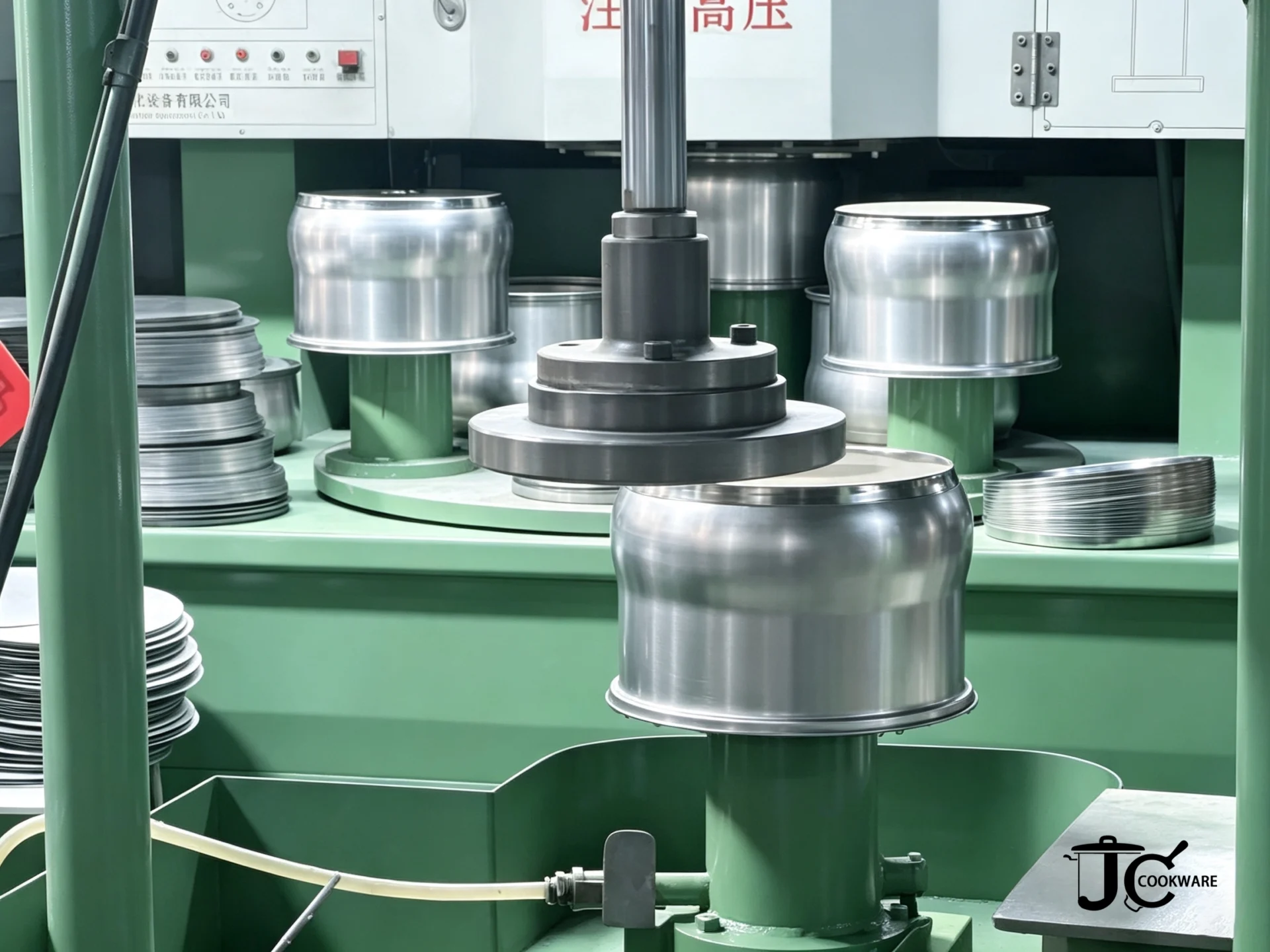
At JC Cookware, our own production lines build both core configurations across two construction families:
3-Ply: The Aluminum Workhorse
Stainless steel – aluminum core – stainless steel. The aluminum layer runs 1.5–3.0 mm depending on pan diameter. This is the correct choice for about 80% of products — everyday fry pans, saucepans and casseroles where reliability and value matter most. The full tri-ply vs 5-ply core comparison is covered in detail in our 3-ply vs 5-ply guide (https://jincui.com/3-ply-vs-5-ply-cookware-whats-the-difference-and-which-should-you-buy/).
5-Ply: Where Copper Enters
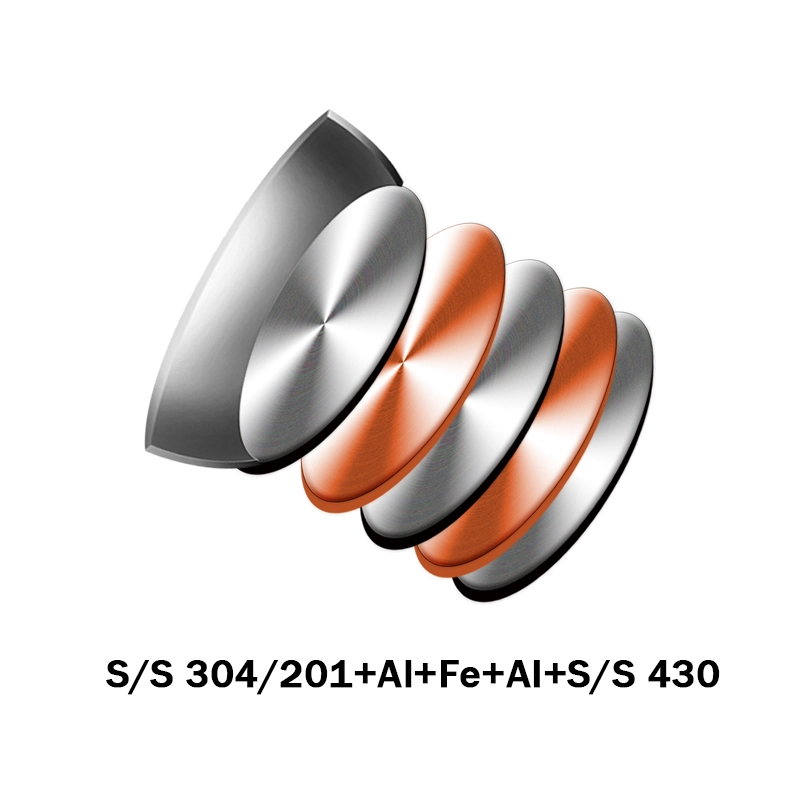
Our standard 5-ply structure: Stainless Steel – Aluminum – Stainless Steel/Iron – Aluminum – Stainless Steel. Selected premium models add a copper layer at the center — effectively a 5-ply copper core — for enhanced thermal conductivity. This is the aluminum vs copper core cookware question answered with engineering rather than ideology: aluminum does the volume work, and copper is added surgically where its responsiveness helps — not swapped in wholesale.
Brazing and Impact Bonding Options
For encapsulated-base lines, our impact bonding and brazing base constructions can include an aluminum disk with an optional copper layer. If you’re deciding between full-clad and disk-bottom, start with what clad cookware actually means (https://jincui.com/what-is-clad-cookware/) — the core-material decision comes second to the construction decision.
B2B Sourcing Guide: What to Ask Your Factory
If you’re quoting a line and weighing aluminum vs copper core cookware, ask these five questions before comparing prices:
- “What is the exact layer structure and thickness of each layer?” Vague answers like “5-ply” tell you nothing. Demand the ply-by-ply spec — core thickness drives both performance and price.
- “Is the core fully encapsulated in stainless steel?” Any exposed aluminum or copper at the rim is a food-safety and corrosion red flag.
- “What bond integrity testing do you run?” Delamination is the killer failure. Ask for bond shear strength data and their thermal cycling protocol.
- “Can you quote the same SKU with aluminum-only and copper-enhanced cores?” A capable factory quotes both, so you can compare margin at each retail tier.
- “What core thickness do you recommend for this pan diameter?” Large pans need thicker cores to resist warping — a factory that quotes the same core thickness across all diameters is cutting corners.
Before you compare quotes, verify the factory itself. Our own 204-worker operation in Jiangmen has been audited to BSCI (social compliance) and ISO 9001 (quality management) — both carry requestable audit reports, so buyers can check rather than trust. That paperwork, combined with on-site process reviews, is what separates a real manufacturer from a trading company re-selling another plant’s pans.
A note on stainless grades while you’re specifying: the food-contact layer should be 304 (or 316 for premium lines). Our 304 vs 316 vs 430 guide (https://jincui.com/304-vs-316-vs-430-stainless-steel-cookware/) explains exactly which grade belongs where.
FAQ:Aluminum vs Copper Core Cookware
Is copper core cookware worth the extra cost?
For professional and premium retail segments, yes — copper’s temperature responsiveness is genuinely superior and supports a higher price story. For mid-market everyday cookware, no: in the aluminum vs copper core cookware cost-benefit balance, a quality aluminum core delivers nearly identical cooking results at 30–50% lower cost.
Which is the best heat conductor cookware material?
Copper, at 401 W/(m·K) versus aluminum’s 237 W/(m·K) — a 1.7x advantage. But in thin bonded core layers, the real-world cooking difference is much smaller than the raw numbers suggest.
Can a pan have both aluminum and copper cores?
Yes — this is exactly how premium 5-ply is built. Our 5-ply uses aluminum as the primary conduction layer with an optional copper center layer in selected models. You get most of copper’s responsiveness at a fraction of the cost of full copper-core construction.
Does the core material affect induction compatibility?
No. Induction works through the magnetic stainless steel exterior layer, not the core. Both aluminum core and copper core cookware are induction-compatible when clad with a magnetic outer layer such as 430 stainless steel.
Why not just buy solid copper cookware?
Solid copper must be lined with tin or stainless steel, costs several times more than clad construction, tarnishes if exposed, and is heavy. Clad construction captures most of copper’s benefit at a fraction of the cost and none of the upkeep.
Conclusion: Which Core Should Your Product Line Use?
After building both core constructions for more than two decades for brand owners across the EU and Middle East, our recommendation is straightforward:
| Retail Segment | Recommended Core | Construction |
| Value ($15–35 retail) | Aluminum | Encapsulated base, 3-ply disk |
| Mid-range ($35–70) | Aluminum | 3-ply or 5-ply full-clad |
| Premium ($70–150) | Aluminum + copper center layer | 5-ply full-clad |
| Professional | Copper-enhanced | 5-ply full-clad |
The aluminum vs copper core cookware decision isn’t about which metal is “better” — it’s about matching core engineering to your retail price point. Aluminum cores win the mass market on cost, weight and reliability. Copper earns its place surgically: as a center layer in premium 5-ply builds, where it adds responsiveness exactly where it matters without tripling your material bill.
Browse how we apply both cores across our frypans (https://jincui.com/frypan/), saucepans (https://jincui.com/saucepan/), and casseroles (https://jincui.com/casserole/), or contact our engineering team (https://jincui.com/contact-us/) for a quote on your next line.