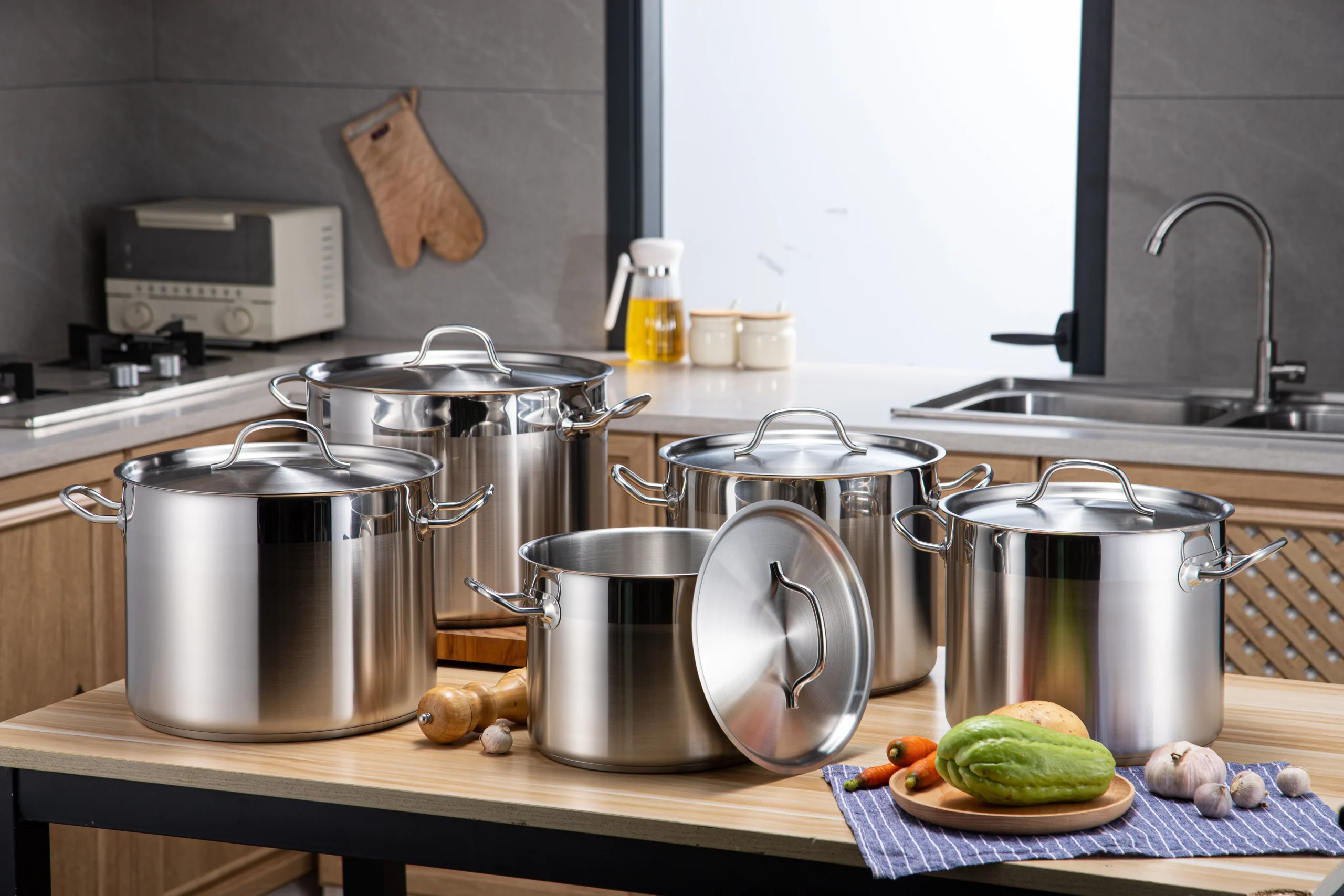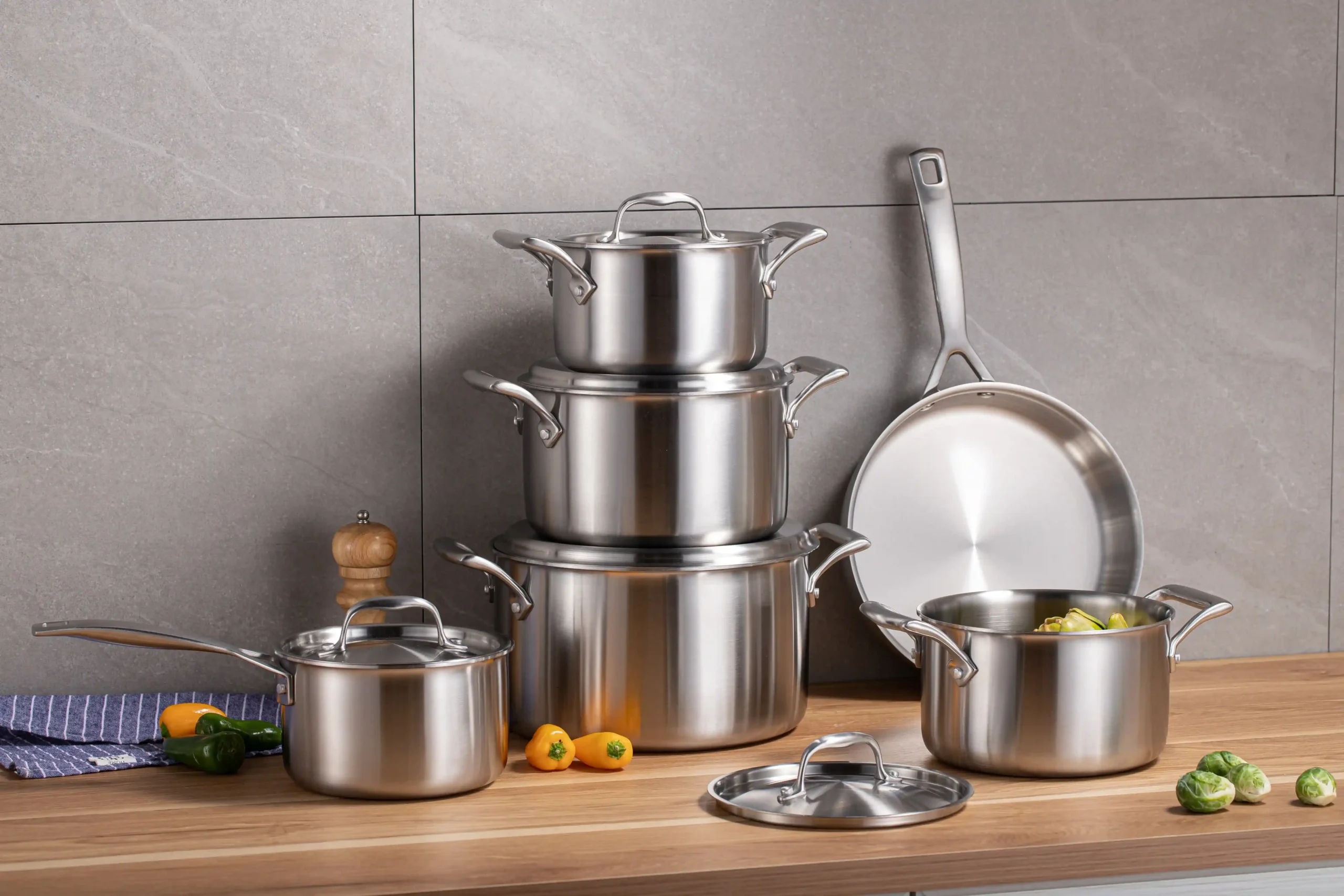
Most first orders in this industry fail for reasons that have nothing to do with the factory’s skill. They fail because the buyer sent a photo of a pan and a target price, the factory quoted against an assumption, and eleven weeks later a container arrives with a product nobody actually specified. The steel is fine. The polishing is fine. The pan is simply It is not the pan in the buyer’s head. The gap is almost always a specification gap, and closing it is the real work of OEM cookware manufacturing.
OEM cookware manufacturing is a specification business before it is a manufacturing business. The factory’s job is to hit a target; the buyer’s job is to define the target precisely enough that hitting it is possible. This article walks through the ten steps between a first enquiry and a loaded container, in the order they actually happen on our side of the table. Some of them are commercial, some are technical, and one or two are the kind of thing nobody explains until it has already cost you money.
We’ve been building stainless steel cookware in Jiangmen, Guangdong since 2003, running two product lines side by side — Encapsulated Bottom Stainless Steel Cookware Sets and Whole-Clad Stainless Steel Cookware Sets — and shipping to brand owners worldwide under BSCI and ISO 9001 audits, with our largest volumes going to Europe and the Middle East. We also take on non-stick and coated cookware orders to customer specification. What follows is the version of this process we’d want a new buyer to hear before the first call, not after the third sample.
Table of Contents
- OEM Cookware Manufacturing: The Short Version
- Step 1: Decide Which Model You’re Actually Buying
- Step 2: Write a Brief a Factory Can Quote From
- Step 3: Tooling — Who Pays, Who Owns It
- Step 4: MOQ and the Economics of a Small Run
- Step 5: Sampling Without Endless Rounds
- Step 6: Material and Construction — Where the Cost Lives
- Step 7: Branding, Handles and Exterior Finish
- Step 8: Read the Unit Cost Like a Buyer
- Step 9: Compliance by Destination Market
- Step 10: Production Calendar, QC and Shipment
- How to Vet an OEM Cookware Manufacturing Partner: 8 Questions
- FAQ: OEM Cookware Manufacturing
OEM Cookware Manufacturing: The Short Version
If you’re about to send your first enquiry, this table is the whole article compressed into one screen.
| # | Step | What you must decide | What goes wrong if you skip it |
| 1 | Model | OEM, ODM or private label | You pay for custom tooling on a stock pan |
| 2 | Brief | Sizes, construction, grade, finish, packing, volume | Factory quotes against its own assumption |
| 3 | Tooling | Who pays, who owns, expected die life | You fund dies you can’t take to another factory |
| 4 | MOQ | Real minimum from steel, polish and print setup | Unit price jumps 20–40% at quotation stage |
| 5 | Sampling | Prototype → counter sample → signed golden sample | Dispute at inspection with no reference |
| 6 | Materials | Alloy per part, base thickness, layer count | 201 arrives where you paid for 304 |
| 7 | Branding | Handles, logo method, exterior finish, packaging | Logo method that can’t survive the dishwasher |
| 8 | Costing | BOM, labour minutes, tooling amortisation, packing | You compare quotes that aren’t comparable |
| 9 | Compliance | Destination market and the report that proves it | Container held at customs for a missing DoC |
| 10 | Schedule | PO date, deposit, ETD, inspection window | Air freight to protect a launch date |
Ten steps sounds like a lot. In practice a repeat order runs through them in a week. A first order with new tooling takes six to ten weeks before the production line even starts.
Step 1: Decide Which Model You’re Actually Buying
In OEM cookware manufacturing, the word “OEM” gets used for three different commercial arrangements, and the price difference between them is not small.
OEM (original equipment manufacturing) means you bring the design and the specification, and the factory builds to it. You control the shape, the wall thickness, the base construction, the handle, the logo placement and the packaging. You also carry the tooling cost and the development time. This is the model brands use when the product needs to be genuinely theirs.
The cookware OEM vs ODM distinction comes down to one question: who holds the design file. ODM (original design manufacturing) means the factory already has the design and you put your brand on it, with limited changes — a different handle colour, a different exterior finish, your logo. Development cost drops close to zero because the tooling already exists and has been amortised across previous buyers. The trade-off is that your competitor two aisles over may be selling the same pan in a different colour.
Private label — the arrangement most buyers mean when they search for cookware private label — is the lightest version: a stock item, your logo, your packaging. It’s the right answer when you’re testing a market or filling a range gap, and the wrong answer when the product is meant to carry your brand’s identity.
| Model | Who owns the design | Tooling cost | Development time | Differentiation |
| OEM | You | Usually you | 4–8 weeks | High |
| ODM | Factory | Factory | 0–2 weeks | Low–medium |
| Private label | Factory | Factory | 0–1 week | Low |
A practical pattern we see with brand owners: launch the category with private label or ODM to learn what sells, then move the two or three best-performing SKUs into full OEM once the volumes justify the tooling. Doing it the other way round — full OEM cookware manufacturing on an unproven shape — is how development budgets disappear.
Step 2: Write a Brief a Factory Can Quote From
A quote is only as good as the brief behind it, and in OEM cookware manufacturing the brief is the buyer’s deliverable, not the factory’s. When an enquiry arrives as a photograph and “how much for this in 24 cm”, the factory has to invent roughly a dozen variables, and every one of them is a place where the final price can move.
A brief that gets an accurate quote on the first pass covers:
- SKU list with sizes — diameter, height, capacity in litres, and whether the set nests. Typical formats sit in the casserole: https://jincui.com/casserole/ and frypan: https://jincui.com/frypan/ ranges.
- Construction — Encapsulated Bottom (multi-layer base, single-layer walls) or Whole-Clad (multi-layer from base to rim). These are different production routes with different costs and different tooling.
- Material grade per part — body, base plate, lid, handle. “Stainless steel” is not a specification.
- Base thickness and wall thickness in millimetres, with a tolerance — the cookware thickness guide: https://jincui.com/cookware-thickness-guide/ explains how gauge choices move cost.
- Interior and exterior finish — mirror, satin, brushed, painted, coated.
- Handle type and attachment — riveted, welded, bakelite, stainless, wood.
- Lid type — stainless, tempered glass, vented, or no lid.
- Cooktop compatibility — gas, electric, ceramic, induction. Induction changes the base build.
- Packaging — polybag, colour box, master carton, pallet or container load, and any retail-ready requirement.
- Destination market, because compliance follows the market, not the product.
- Forecast volume for the first order and the following twelve months.
- Target ship date and Incoterm.
- Target FOB price, if you have one — it’s more useful to say it than to hide it.
That last point is worth expanding. Buyers often withhold the target price to “get an honest number”. What actually happens is that the factory quotes its standard build, you say it’s too expensive, and now both sides spend two weeks discovering which features to remove. Naming the target is the single most useful sentence in OEM cookware manufacturing, because it lets the factory tell you immediately whether the gap is 5% — a packaging change — or 35%, which means a different construction entirely.
Step 3: Tooling — Who Pays, Who Owns It
Tooling is where first-time buyers in OEM cookware manufacturing most often get surprised, and not because the number is large. Stamping dies for a cookware body are a normal capital cost, and they’re amortised across the life of the program. The surprise is ownership.
The default in Chinese OEM cookware manufacturing has historically been that the factory pays for standard tooling and owns it, while the buyer pays for dedicated tooling — a custom shape, a custom handle mould, a custom lid — and should own it. Ownership should be written into the PO, not agreed verbally.
What to put in writing:
- Which tools are dedicated to your SKU and which are shared.
- Who paid for each tool and the amortisation arrangement — charged upfront, or absorbed into unit price across an agreed quantity.
- Ownership at the end of the program, and whether the tool can be transferred to another factory.
- Expected die life. Stamping dies wear. A die that produces a cosmetic panel may need refurbishment after a defined number of hits; that refurbishment cost belongs somewhere.
- Storage. If your tool sits idle for two years, who stores it, and for how long.
One nuance specific to cookware: even when you own a dedicated body die, the *process* around it — the polish sequence, the brazing jig, the handle fixture — usually stays with the factory. A die transferred to a new supplier will not reproduce the same pan without the process knowledge that went with it. Ownership of tooling is a negotiating position; it is not a full technology transfer.
Step 4: MOQ and the Economics of a Small Run
Minimum order quantity in OEM cookware manufacturing is not an arbitrary sales gate. A cookware MOQ comes from four physical constraints:
Steel sourcing. Mills sell stainless coil in standard widths and weights. A small order means the factory either buys a full coil and carries the balance, or pays a cut-length premium. Either way the material cost per kilo rises.
Stamping setup. A press line running one SKU for a day is efficient. The same line running six SKUs in small batches spends its time on die changes.
Polishing and finishing. Hand polishing is labour minutes per piece. A batch of 200 and a batch of 2,000 use the same setup but very different labour efficiency.
Packaging and print. Colour boxes have a minimum print run. If your carton is custom-printed, the carton MOQ will often set the product MOQ, not the other way round.
The practical consequence: a first order below the factory’s stated MOQ is usually possible, at a higher unit price, and sometimes only with a stock carton. If your launch quantity is genuinely small, the cheapest route is often to accept a stock or semi-custom carton for the first run and spend the packaging budget on the second.
In OEM cookware manufacturing, ask the factory to quote two tiers — the MOQ and a volume break above it. The ratio between those two numbers tells you more about the factory’s cost structure than any single quote will.
Step 5: Sampling Without Endless Rounds
Sample rounds are where OEM cookware manufacturing schedules die. Three rounds is normal. Six rounds means the brief was wrong.
A disciplined sampling sequence looks like this:
- Prototype / concept sample. Confirms shape and proportion. Often handmade or from existing tooling. Not a production reference.
- Counter sample. Made from production tooling and production material. This is the first sample that tells you what the pan will actually feel like — weight, balance, handle angle, rim thickness.
- Golden sample (also called PP sample or signed sample). The approved reference. Signed and dated by both sides, one copy held by the factory, one by you. Every later dispute is resolved against this object.
Two rules make the system work. First, the golden sample must be produced from the same tooling, the same material grade and the same finishing sequence as mass production — otherwise it’s decoration. Second, changes after golden sample approval should be treated as a new project with a new sample, not as a favour.
Sample cost is normally charged and then credited against the first PO. If a factory offers free samples on a custom item, ask what it’s cutting to make that work.
Step 6: Material and Construction — Where the Cost Lives
Two decisions account for most of the price spread between quotes on the same-looking pan in OEM cookware manufacturing: the alloy and the base construction.
Alloy. SS 304 and SS 201 are both austenitic stainless steels and both are legitimately used in cookware. 304 carries more nickel and more chromium, and holds up better against corrosion and staining over years of use. 201 substitutes manganese for part of the nickel; it’s harder, cheaper, and more sensitive to prolonged exposure to salt, acid and damp storage. A factory that tells you everything is 304 without telling you which parts is either simplifying or hiding something.
The honest structure, and the one we use: premium lines in SS 304, value lines in SS 201, declared per part in writing. There is nothing wrong with 201 in a value line. There is something wrong with 201 sold as 304.
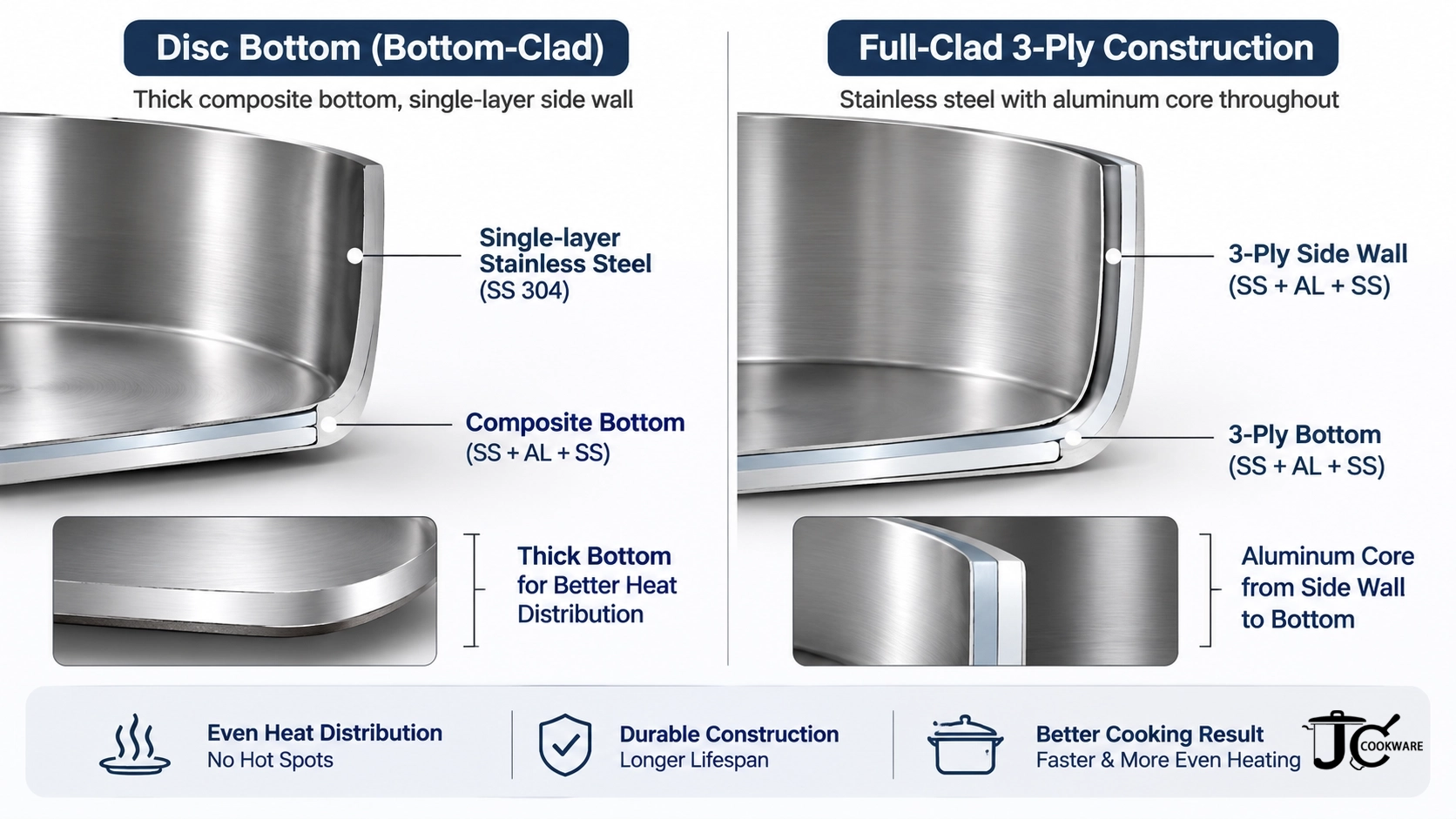
Construction. Encapsulated Bottom cookware: https://jincui.com/encapsulated-bottom-stainless-steel-cookware-sets/ bonds a disc of aluminium — sometimes with a copper layer — into a stainless base plate, leaving the walls as a single layer of stainless. Whole-Clad cookware: https://jincui.com/what-is-clad-cookware/ bonds the full multi-layer sandwich and forms the entire body from it, typically 3-ply or 5-ply.
| Encapsulated Bottom | Whole-Clad | |
| Layer structure | Multi-layer base, single-layer wall | Multi-layer base to rim |
| Material consumption | Lower | Higher |
| Heat spread | Excellent on the base, less even up the wall | Even from base to rim |
| Weight | Lighter for the same base thickness | Heavier |
| Tooling and press tonnage | Lower | Higher |
| Typical positioning | Volume and value ranges | Premium ranges |
Both are real products with real buyers. The mistake in OEM cookware manufacturing is quoting one and expecting the other’s performance — or costing a Whole-Clad program against Encapsulated Bottom material consumption and wondering why the margin evaporates.
Step 7: Branding, Handles and Exterior Finish
In OEM cookware manufacturing, branding decisions interact with durability more than most buyers expect.
Logo method. Laser marking is permanent and sits in the surface. Etched marking is deeper and survives polishing better. Silk-screen printing is cheap and wears off first. On a pan that goes through a dishwasher weekly, a printed logo has a defined lifespan — which is fine for a promotional item and wrong for a flagship SKU.
Exterior finish. Mirror polish hides nothing: every handling mark shows. Satin and brushed finishes are more forgiving in retail and in the kitchen. Painted exteriors add a colour story and a layer that must be specified for adhesion and heat resistance; the paint is also the first thing to fail if the pretreatment is skipped.
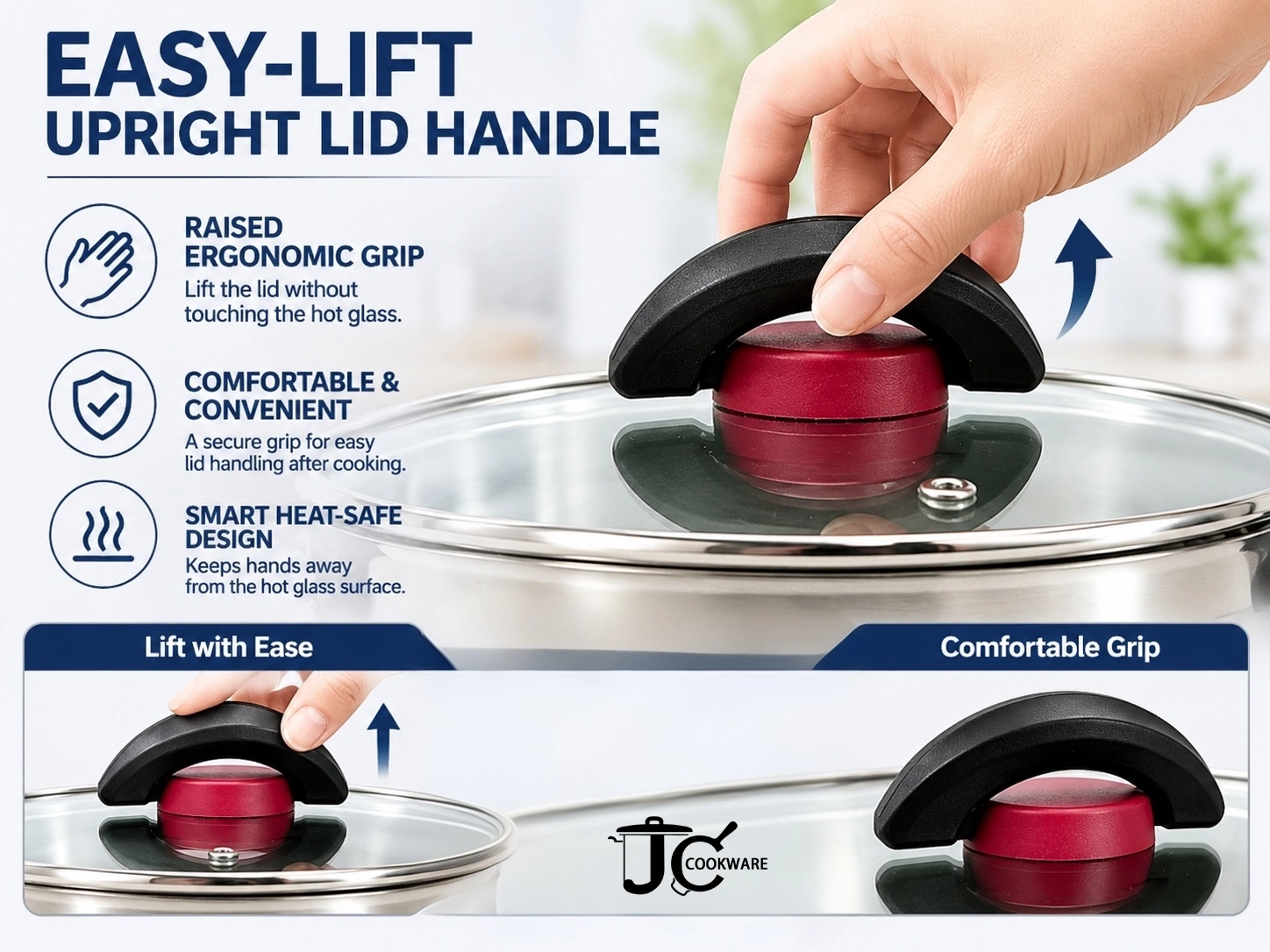
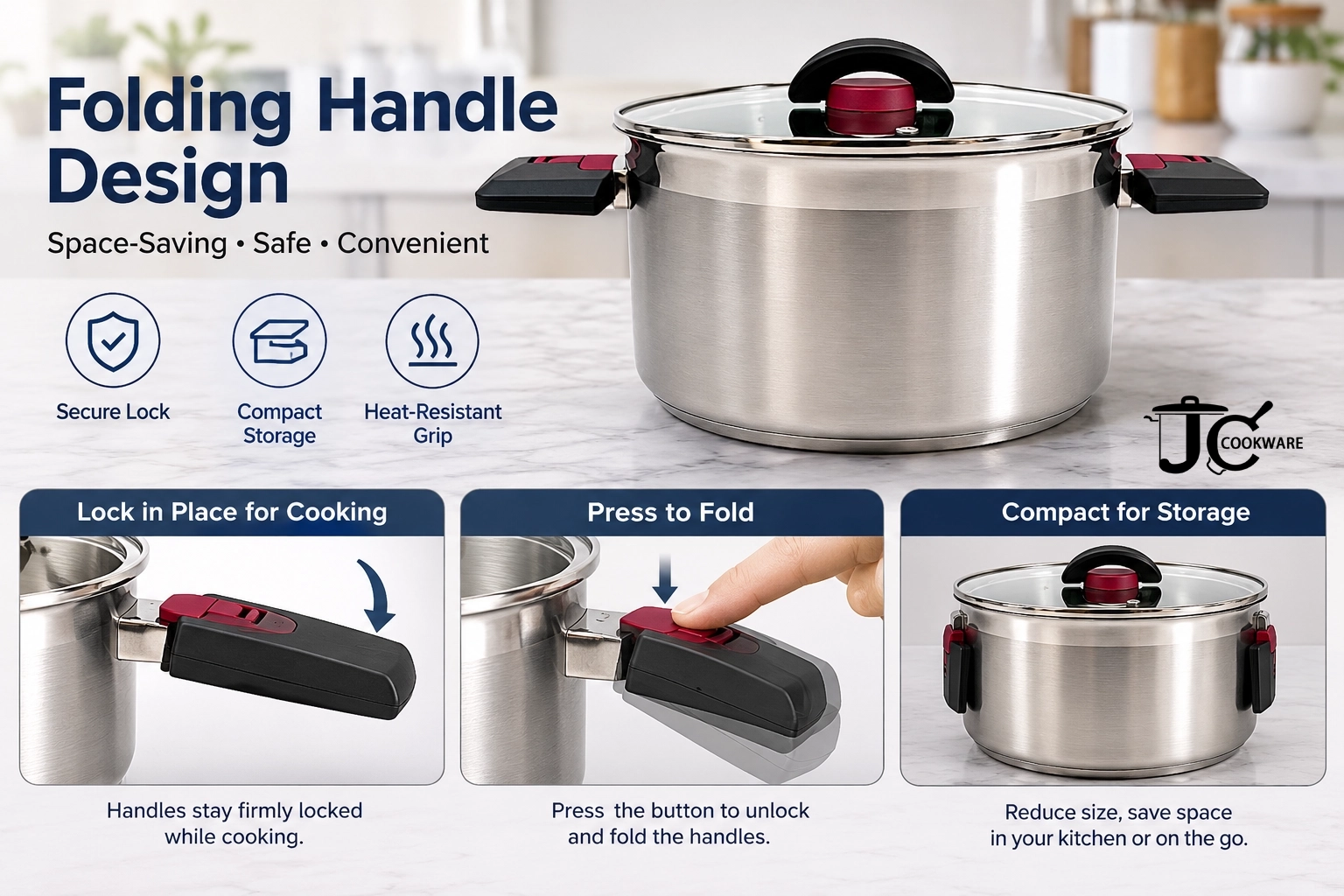
Handles. Bakelite and similar phenolic handles stay cool but have a temperature ceiling. Stainless handles are durable and get hot — which is a design choice, not a defect, but it needs to be a decision rather than a discovery. Riveted handles are the conventional build; welded handles remove the interior rivet heads and make cleaning easier, at a different cost and a different QC check.
Induction compatibility. If the pan must work on induction, the base needs a ferromagnetic layer — usually 430 stainless as the outer ply or the base plate. That’s a material decision made at the construction stage, not something that can be added at packing.
Step 8: Read the Unit Cost Like a Buyer
Two quotes 30% apart on the same drawing are rarely a case of one factory being greedy — but in OEM cookware manufacturing they are almost always a case of two different products. They are usually a case of two different products.
A cookware unit cost breaks into five blocks:
- Bill of materials — steel by grade and weight, aluminium or copper core, handle, lid, glass, rivets, coating if any. Steel is a commodity; nickel and chromium prices move, and a quote is only valid for the period stated on it.
- Labour minutes — stamping, trimming, brazing or impact bonding, polishing, assembly, packing. Polishing is the labour-heavy step and the one most sensitive to finish choice.
- Tooling amortisation — spread across the ordered quantity, or charged once.
- Packaging — carton, inner box, polybag, printing plates, and the labour to pack.
- Overhead and margin — factory overhead, QC, documentation, and the factory’s profit.
When you compare quotes, compare the inputs, not the total. Ask each supplier for the material grade per part, the base thickness, the layer count, the finish, the carton specification and the tooling treatment. Two quotes that agree on all six are genuinely comparable. Two that don’t are two different pans.
A useful sanity check: ask what happens to the price if steel moves 10%. A factory that can answer precisely understands its own cost structure. A factory that says “we’ll let you know” is quoting from a template, and template pricing is how OEM cookware manufacturing budgets quietly go wrong.
Step 9: Compliance by Destination Market
Compliance is destination-specific. In OEM cookware manufacturing it is the buyer’s legal responsibility even when the factory supplies the paperwork. The factory’s role is to provide accurate declarations and test reports for the exact materials in the exact product.
The common frameworks buyers ask about:
- EU — Framework Regulation (EC) No 1935/2004, plus GMP Regulation (EC) No 2023/2006. Stainless steel food contact articles are also covered by national provisions in several member states, and buyers typically request a Declaration of Compliance plus migration testing for metals.
- Germany — LFGB recommendations, commonly requested in addition to the EU framework.
- United States — FDA 21 CFR, with 21 CFR 175.300 covering resinous and polymeric coatings where a non-stick or painted surface is involved.
- Gulf markets — SASO / GSO standards, often with an accompanying certificate of conformity.
- Other markets — each has its own scheme; confirm the requirement before the PO, not at the port.
Two practical points. First, a migration report is only valid for the alloy it was run on — a report for 304 does not cover a 201 body. Second, the report should name the product and the material, not just the factory. Generic certificates circulate widely in OEM cookware manufacturing and they are worth very little when a customs officer or a retailer’s compliance team asks a follow-up question.
Confirm the current version of any standard with your testing lab or your importer’s compliance advisor. Standards get revised, and a specification written from a five-year-old memory is a liability.
Step 10: Production Calendar, QC and Shipment
Once the PO and deposit are in, the OEM cookware manufacturing clock runs on a sequence that is fairly consistent across the industry.
| Stage | Typical duration | Notes |
| PO, deposit, spec lock | 0–3 days | Golden sample referenced in the PO |
| Material procurement | 5–15 days | Steel grade and thickness availability |
| Stamping and forming | 7–12 days | Longer for new tooling, first article check |
| Base bonding / brazing | 3–7 days | Bond integrity is checked here |
| Polishing and finishing | 5–10 days | The labour bottleneck |
| Assembly, coating, packing | 5–10 days | Coating adds a curing cycle if specified |
| Pre-shipment inspection | 1–2 days | AQL per the agreed plan |
| Booking, loading, ETD | 5–10 days | Space is tighter before major holidays |
For a repeat order, 35–50 days from deposit to ETD is the normal rhythm of OEM cookware manufacturing. For a first order with new tooling, add four to six weeks in front of that for tooling and samples.
Two calendar realities worth building into your plan: Chinese New Year, when most of the supply chain in Guangdong closes for two to four weeks, and the National Day holiday in early October. Factories will tell you their cut-off dates; the useful question is when the *sub-suppliers* — carton printers, coating lines, hardware suppliers — stop, because that is usually earlier.
Inspection should follow a written AQL plan with a defect classification, agreed before OEM cookware manufacturing starts. The article on cookware quality standards: https://jincui.com/cookware-quality-standards/ covers the nine checks in detail, including the ones that are easy to skip and expensive to skip.
On terms: FOB Shenzhen is our standard port, 30% deposit with 70% against the bill of lading is the common structure, and a letter of credit at sight is workable for larger programs. Ask for the shipping documents list at quotation stage so nothing is discovered at the bank.
How to Vet an OEM Cookware Manufacturing Partner: 8 Questions
Before you send a drawing, send these. Any serious custom cookware manufacturer will recognise the list. The answers — and the confidence behind them — tell you more than a catalogue, and a competent OEM cookware factory answers them without checking with anyone.
1. Which lines run in your own plant, and which are outsourced? Every factory outsources something: coating, glass lids, handles, packaging. The honest ones say which.
2. What alloy do you use per part, and will you declare it in the PO? Vague answers here predict every other vague answer.
3. Can you show a construction drawing with layer thicknesses? A factory that builds clad cookware has this on file.
4. What is your real MOQ, and what drives it? A specific answer — steel coil, carton print, polish batch — means they know their cost structure.
5. Who owns the tooling, and what is the expected die life? Ownership is negotiable; ignorance of the question is not a good sign.
6. Which markets do you already ship to, and which certifications do you hold? BSCI and ISO 9001: https://en.wikipedia.org/wiki/ISO_9001 are management-system audits, not product certifications. Both are useful; neither substitutes for a migration report.
7. Can we see the last three pre-shipment inspection reports? Redacted is fine. Absent is not.
8. Who is our contact after the order, and who signs the golden sample? The salesperson who wins the order and the person who runs it are often different people. Meet the second one.
FAQ: OEM Cookware Manufacturing
How long does OEM cookware manufacturing take for a first order?
Plan on 10 to 16 weeks from brief to ETD. Tooling and sampling consume four to six weeks, production 35 to 50 days, and shipping depends on destination. Repeat orders without new tooling typically run 35 to 50 days from deposit.
What is a realistic MOQ for custom stainless steel cookware?
It depends on construction and packaging more than on the pan itself. Encapsulated Bottom lines generally allow lower minimums than Whole-Clad because material consumption and press requirements are lower. Custom-printed cartons often set the real floor.
Do I own the tooling I pay for in OEM cookware manufacturing?
You should, and it should say so in the PO. In practice, ownership of a die does not transfer the process knowledge around it — the polishing sequence and jigs stay with the factory.
Can the same pan be made in 304 and 201?
Yes — this is routine in OEM cookware manufacturing, and many factories offer both as a value and premium tier. What matters is that the grade is declared per part and matched by the mill certificate and by the migration report.
Is Encapsulated Bottom lower quality than Whole-Clad?
No. They’re different constructions for different price points and different cooking patterns. Encapsulated Bottom concentrates the conductive layer where the heat source is; Whole-Clad spreads it through the walls as well. Neither is a defect, and both are standard options in OEM cookware manufacturing.
Can you produce non-stick versions of the same shape?
In many cases yes, with the coating specified at the OEM cookware manufacturing brief stage rather than added later. Coating choice affects pretreatment, curing and the compliance route, so it belongs in the original specification.
What payment terms are normal?
30% deposit with the balance against the bill of lading is the common structure for OEM cookware manufacturing. Letters of credit at sight are used for larger programs. Anything requiring full payment upfront before production deserves a conversation.
How do I protect my design?
Sign an NDA before sharing drawings, keep the golden sample signed and dated by both parties, treat the written spec as the contract in OEM cookware manufacturing, and register your design in your selling markets where the law allows. Tooling ownership helps commercially; it is not a legal shield on its own.
JC Cookware runs two stainless lines side by side in Jiangmen, Guangdong — Encapsulated Bottom Stainless Steel Cookware Sets and Whole-Clad Stainless Steel Cookware Sets — and takes on non-stick and coated cookware orders to customer specification. BSCI and ISO 9001 audited, shipping to brand owners worldwide since 2003, with our largest volumes going to Europe and the Middle East. FOB Shenzhen. If you’re scoping an OEM cookware manufacturing program and want a straight conversation about construction, tooling and MOQ, get in touch: https://jincui.com/contact/.