How to clean stainless steel cookware without damaging the surface or the base — a 10-step guide from a factory that has been making bonded and clad stainless steel pans since 2003.
The honest truth about clean stainless steel cookware care: most of what people think will damage a stainless pan actually won’t, and most of what people do to keep it shiny is unnecessary. A 304 stainless interior with a brushed or polished finish is tougher than it looks. A few wrong moves (steel wool on a polished exterior, oven cleaner left to soak overnight, the dishwasher every day for a decade) will dull the shine before they damage the metal. The goal of any clean stainless steel cookware routine is simple: remove food, remove mineral deposits, keep the exterior looking like the day it left the factory, and don’t use anything the manufacturer didn’t intend you to use.
We’ve been cooking with and shipping stainless steel cookware out of Jiangmen, Guangdong since 2003 — both our Encapsulated Bottom sets and our Whole-Clad sets run side by side, and what we talk about in this article applies to either construction. We’ve heard every cleaning horror story — the pan left on a burner until the food carbonised, the steel-wool scrub on a mirror-polished lid, the dishwashing cycle run daily for years. None of those destroyed the pan. Most of them only hurt the look. This guide covers the clean stainless steel cookware approach that brings a stainless pan back from the worst of those, plus the small daily habits that keep it there.
Table of Contents
- Clean Stainless Steel Cookware: The Short Verdict
- Step 1: Daily Wash (Soap, Warm Water, Soft Sponge)
- Step 2: Remove Burnt Food (Deglaze or Boil It Out)
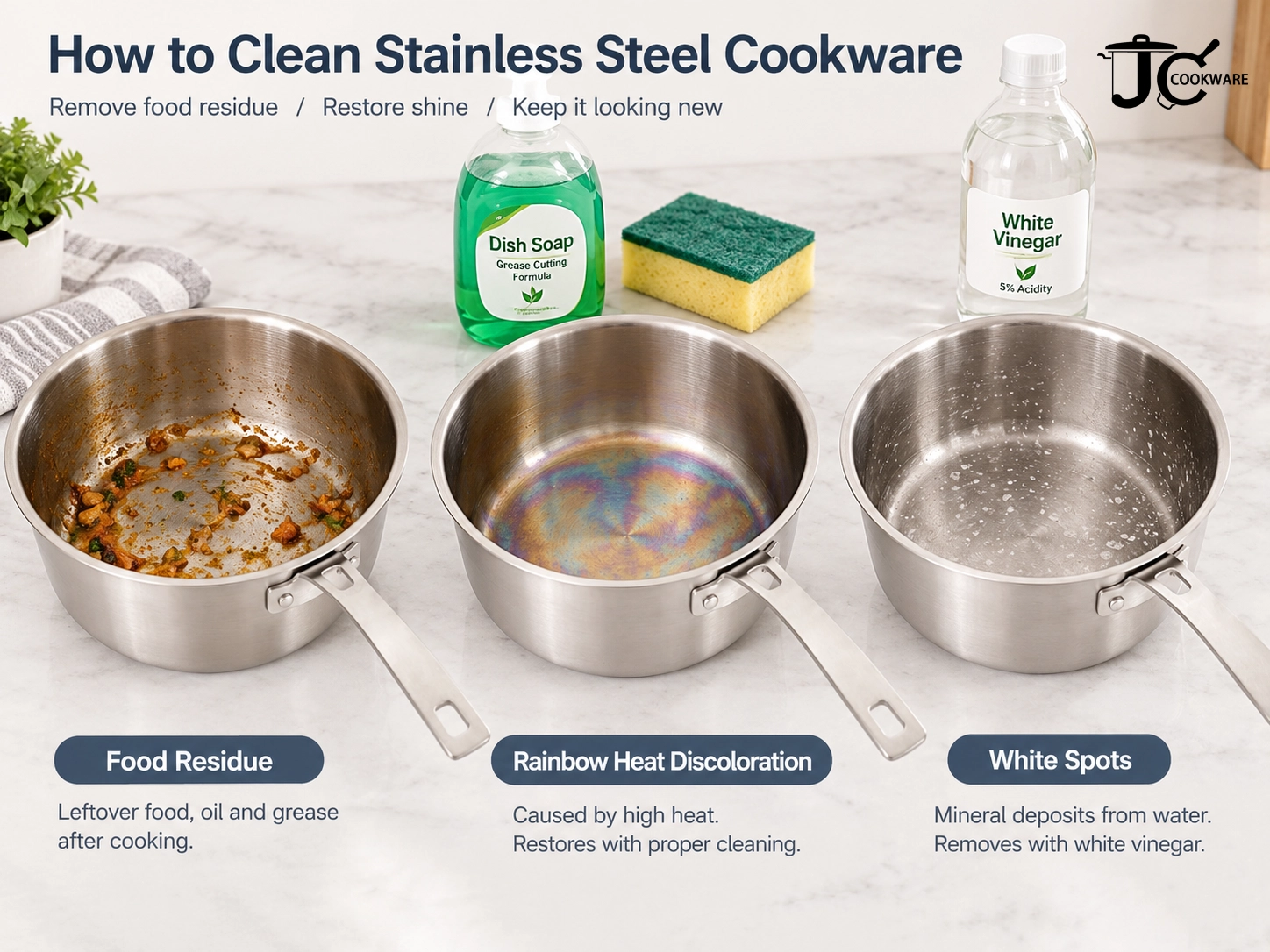
- Step 3: Remove Rainbow Heat Tint (Vinegar or Mild Abrasive)
- Step 4: Remove White Spots and Calcium Deposits
- Step 5: Cut Grease Film Inside and Out
- Step 6: Polish the Exterior (Mirror, Satin, or Brushed)
- Step 7: Dry Properly to Avoid Water Marks
- Step 8: Don’t Use These (Harsh Chemicals and the Wrong Scrubber)
- Step 9: Dishwasher — Yes or No, Honestly
- Step 10: A Note From the Factory on Finish and Construction
- FAQ: Clean Stainless Steel Cookware
Clean Stainless Steel Cookware: The Short Verdict
If you only have 60 seconds, this is the answer. The rest of the article is the reasoning behind every step.
| Problem | What Reaches for It | What to Use Instead |
| Daily food residue | Anything in the sink | Soft sponge + dish soap + warm water |
| Burnt or stuck-on food | Brute force, steel wool | Deglaze with water; boil baking soda; then soft sponge |
| Rainbow heat tint | Worry, ignore it | Vinegar wipe, or a baking-soda paste |
| White chalky spots | More soap | White vinegar solution (1:1 with warm water) |
| Greasy film inside or out | Stronger detergent | Hot water + dish soap, then a polish paste |
| Tarnish or dullness on the outside | Sandpaper | Bar Keeper’s Friend, then re-oil if it’s a polished finish |
| Sticky or burnt-on sugar | Soak in cold water first | Hot water, then baking soda boil |
The rest of this article walks through the clean stainless steel cookware method step by step, with the mistakes most people make and the factory view on what actually holds up over years of washing.
Step 1: Daily Wash (Soap, Warm Water, Soft Sponge)
This handles 90% of the work. Most of the time you spend cleaning stainless steel pans is wasted, because the daily version takes about 90 seconds.
What to do:
- Let the pan cool for a minute or two after cooking. Putting a screaming-hot pan under cold water warps bonded bases over time. A 30-second wait is enough.
- Run the pan under hot tap water and add a drop of dish soap.
- Use a soft sponge (the green-and-yellow side of a standard sponge is fine; nylon scrub pads are too), or a dish cloth, and wipe the interior in circular motions.
- Rinse under hot water.
- Shake off the water and move to Step 7 (dry).
That’s it. Most stainless steel cookware brands recommend dish soap and a soft sponge as the only daily clean stainless steel cookware routine, and they’re not being conservative — there really isn’t a need for more.
What not to do daily:
- Steel wool. Fine 0000 steel wool is occasionally the right tool for an exterior mirror finish, but it should never be the daily interior scrubber on a 304 surface. The steel particles can leave traces that rust.
- Abrasive powders every day. Barkeeper’s Friend and similar oxalic-acid-based cleaners are safe for occasional use, but daily use polishes the brushed or satin finish smooth and changes the look.
- The dishwasher as the default. The dishwasher is fine for most stainless cookware. The “as the default” part is the problem — see Step 9.
If you want a deeper walkthrough of how the surface behaves, our guide to how stainless steel cookware is made (https://jincui.com/how-stainless-steel-cookware-is-made/) covers what the brushed or polished finish is actually doing to the metal.
Step 2: Remove Burnt Food (Deglaze or Boil It Out)
The first instinct when something is burnt onto a pan is to scrub harder. That’s the wrong instinct. The right move is to deglaze or boil the residue loose, then use a soft sponge.
Method A: Deglaze (works for light-to-medium sticking)
- Put the pan back on a low burner.
- Add about half a cup of water (or, for flavour, stock, wine, or a splash of vinegar).
- Bring to a simmer and use a wooden spoon or flat-edged spatula to scrape the bottom. Most food will lift within a minute.
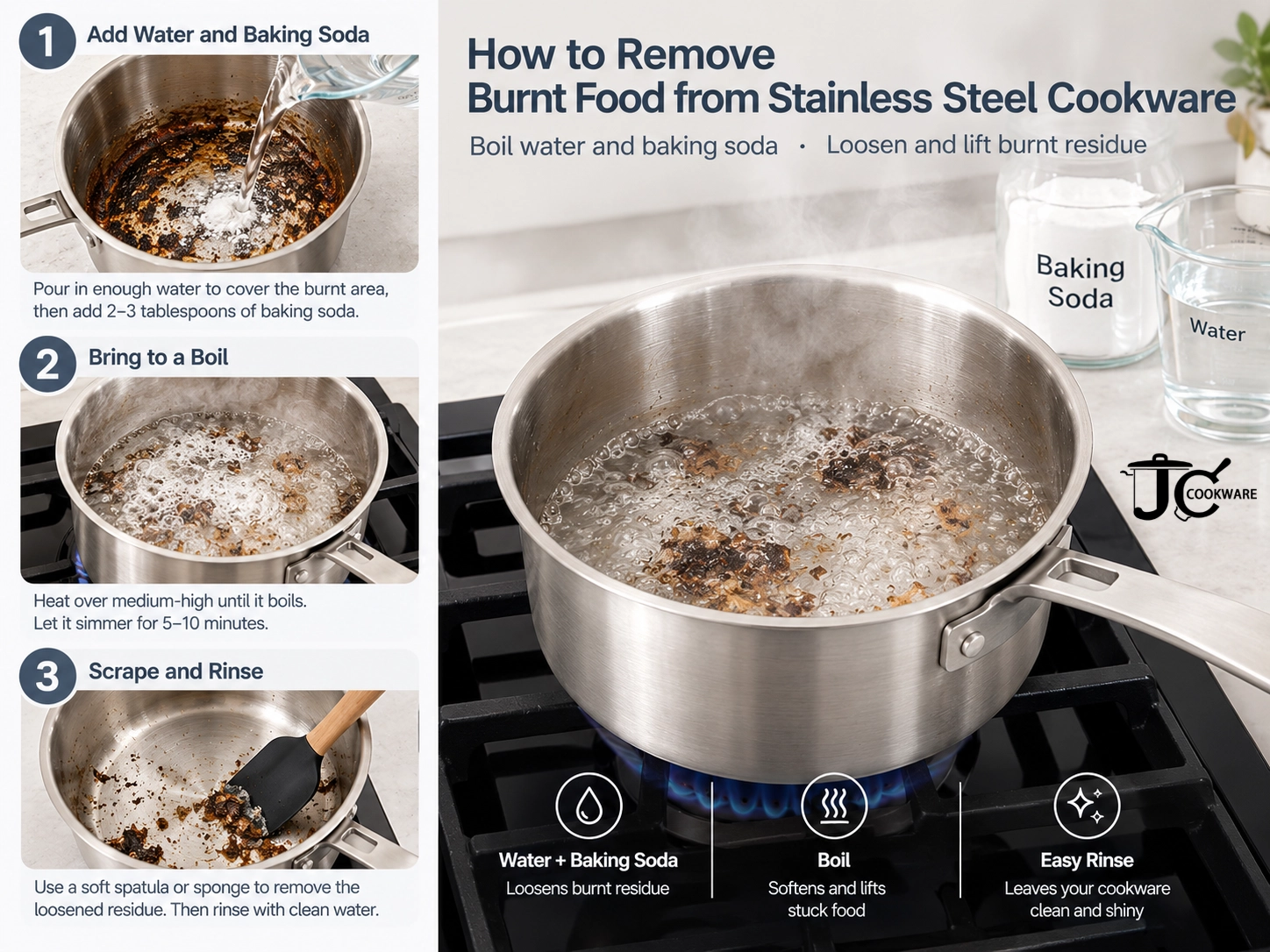
Method B: Baking soda boil (works for medium-to-heavy burning)
- Put the pan on the burner.
- Add water to cover the burnt area, about 1 cm deep.
- Add 1–2 tablespoons of baking soda.
- Bring to a boil, then reduce to a steady simmer for 5–10 minutes. The carbonised food will soften and lift.
- Let the water cool, then use a soft sponge to wipe. The burnt layer usually comes off in sheets.
Both methods are the core of any clean stainless steel cookware approach for burnt food. Boiling water is the most underrated cleaning tool in a kitchen — the heat, the agitation and the steam do the work that scrubbing cannot, and they do it without touching the surface.
What to skip:
- Vinegar boils. Vinegar (acetic acid) plus heat will strip seasoning from cast iron and can discolour some aluminium finishes. For a stainless pan, baking soda is the safer boiling agent.
- Oven cleaner in a sealed bag. It works, but it works by leaving caustic residue on the surface that you’ll need to wash several times before you can cook on it again. Not worth it for what baking soda handles in 10 minutes.
If you want a deeper look at the cooking technique that prevents most burnt food in the first place, our why food sticks to your stainless steel pan (https://jincui.com/why-food-sticks-stainless-steel-pan/) guide walks through the preheat and water-bead test.
Step 3: Remove Rainbow Heat Tint (Vinegar or Mild Abrasive)
Rainbow heat tint (also called heat tint or “the colours that look like oil on water”) is a thin oxide layer that forms when stainless steel is heated past a certain temperature, usually above 260 °C. It is not damage. It is not rust. It is not harmful. It is the steel doing exactly what steel does at temperature.
That said, most people don’t love the look, and the clean stainless steel cookware method to remove it is short:
Method A: Vinegar wipe (the simplest)
- Mix white vinegar and warm water 1:1 in a bowl.
- Dip a soft cloth in the solution and wipe the tinted area.
- Rinse and dry.
Method B: Baking soda paste (slightly more aggressive)
- Make a paste of baking soda and a little water.
- Apply with a soft cloth, rub gently along the brushed or polished direction.
- Rinse and dry.
Method C: Oxalic acid cleaner (Bar Keeper’s Friend, equivalent products)
For a stubborn tint on a satin or brushed exterior, a small amount of Bar Keeper’s Friend on a damp cloth removes the oxide quickly. Wipe with the grain, rinse, dry.
The rainbow tint does not affect cooking performance, food safety, or the lifespan of the pan. It is purely cosmetic. Once you understand that, you can ignore it on a pan you cook with every day and reserve the vinegar wipe for the pans you want to look new.
Step 4: Remove White Spots and Calcium Deposits
White chalky spots on a stainless surface are almost always mineral deposits left by hard water after the pan air-dries. They are calcium and magnesium carbonates from the water, not from the pan.
How to remove:
- Mix white vinegar and warm water 1:1.
- Either soak a cloth in the solution and lay it on the spots for 2–3 minutes, or fill the pan with the solution if the spots are on the interior.
- Wipe with a soft cloth.
- Rinse with clean water.
- Dry with a soft towel (this step matters — see Step 7).
For heavier calcium buildup, a paste of baking soda and water applied with a soft sponge, left for 5 minutes, and wiped off, will finish the job. The same chemistry is why a dishwasher rinse-aid helps — it reduces water-spotting by lowering the surface tension of the rinse water.
If you live in a very hard-water area, this step will become a regular part of your clean stainless steel cookware routine. A 30-second vinegar wipe every week is faster than letting the deposits build up and needing the full baking soda treatment later.
Step 5: Cut Grease Film Inside and Out
A greasy film on the outside of a stainless pan usually comes from cooking oil aerosolising in a hot pan and depositing on the cooler exterior over time. On the inside, it shows up as a thin oily layer that interferes with browning.
How to remove it:
- Wash the pan as in Step 1 with hot water and dish soap.
- For stubborn grease, make a paste of baking soda and dish soap (about 2:1 baking soda to soap).
- Apply with a soft sponge, working in circular motions.
- Rinse thoroughly with hot water — any soap film left behind is itself a problem when you next heat the pan.
- Dry.
The clean stainless steel cookware mistake most people make here is using a stronger degreaser from the garage or workshop. Most of those are designed for machine parts and contain solvents that should not be near food surfaces. Dish soap and baking soda cover every grease problem a kitchen pan will throw at you.
Step 6: Polish the Exterior (Mirror, Satin, or Brushed)
Polishing the exterior is the part of clean stainless steel cookware care that the owners’ manuals usually skip, and the part that makes the most visible difference.
Three exterior finishes behave differently:
- Mirror polish. Highest shine, shows every fingerprint and water spot, looks beautiful when clean. Use a stainless steel polish (we have had good results with the ones sold for kitchen appliances, applied sparingly with a microfibre cloth, buffed in the direction of the polish lines). Avoid abrasive powders on a mirror finish — they will leave a haze.
- Satin / brushed finish. The most forgiving finish, hides water spots and minor scratches well. A baking soda paste wiped with the grain is usually all this finish needs. Avoid polishing against the grain.
- Matte / bead-blasted. Hides everything, hard to make shiny. Don’t try to polish it. Just soap, water, dry.
Polishing products to consider: Bar Keeper’s Friend, Weiman Stainless Steel Polish, or a generic stainless cleaner. Avoid products that contain chlorine bleach (sodium hypochlorite) on stainless — they can pit the surface over time.
For pans shipped to retail, we polish and pack the exterior with a light protective film that washes off in the first wash. After that, the finish you see is the finish you keep.
Step 7: Dry Properly to Avoid Water Marks
This is the single step most people skip, and it’s the step that does the most to keep a pan looking new.
Why it matters: the minerals in tap water (calcium, magnesium, chlorides) deposit on a stainless surface as the water evaporates. A pan that air-dries upside down on a rack develops a constellation of water spots. A pan that is towel-dried after every wash doesn’t.
How to dry:
- After rinsing, shake the pan to remove most of the water.
- Wipe the interior and exterior with a clean, dry microfibre cloth or a soft dish towel.
- If you want a perfect finish, do a final wipe with a dry microfibre.
This is also why commercial kitchens towel-dry every pan before stacking — it is faster than dealing with the water spots later. The habit makes a clean stainless steel cookware routine that much more effective, because drying prevents the next round of cleaning.
Step 8: Don’t Use These (Harsh Chemicals and the Wrong Scrubber)
The clean stainless steel cookware “don’t” list is shorter than the “do” list, but the items on it cause the most lasting damage.
- Steel wool on a polished or satin exterior. Will scratch the finish. Use only on a heavy matte exterior, and only when other methods have failed.
- Oven cleaner (sodium hydroxide / lye). Works, but leaves caustic residue that needs extensive rinsing. Reserve for an absolute-last-resort de-grease of a cheap secondary pan, not a clad or bonded cookware piece.
- Chlorine bleach and bleach-based sprays. Will pit stainless over time. The pits are tiny but visible up close, and they make the surface harder to clean next time.
- Magic eraser on a mirror finish. It is a fine abrasive (melamine foam). Works, but dulls the shine. Use only on a satin or brushed exterior.
- Sandpaper. For a brushed finish, 600-grit wet-and-dry, used in the direction of the brush lines, can re-establish the grain on a damaged spot. Lower than 400-grit is a scratch, not a fix.
If in doubt, do the soapy-water-and-soft-sponge version. For most stains it works; for the rest, baking soda and vinegar cover what it can’t.
Step 9: Dishwasher — Yes or No, Honestly
The honest answer: most modern Encapsulated Bottom and Whole-Clad stainless steel cookware is dishwasher-safe. The “as the default” part is what wears the finish over time.
What the dishwasher does well:
- Daily wash, no effort, consistent results.
- Reaches the rivets and the inside of the handle where a sponge misses.
- Sanitises at high-temperature rinse cycles.
What the dishwasher does over years:
- The alkaline detergent gradually dulls a polished or satin exterior.
- Hard-water spotting inside and out becomes harder to avoid.
- The contact with other metal items (aluminium, cast iron) in the same rack can leave grey marks on a stainless surface.
- The high-temperature dry cycle, plus detergent residue, is the harshest environment a pan sees.
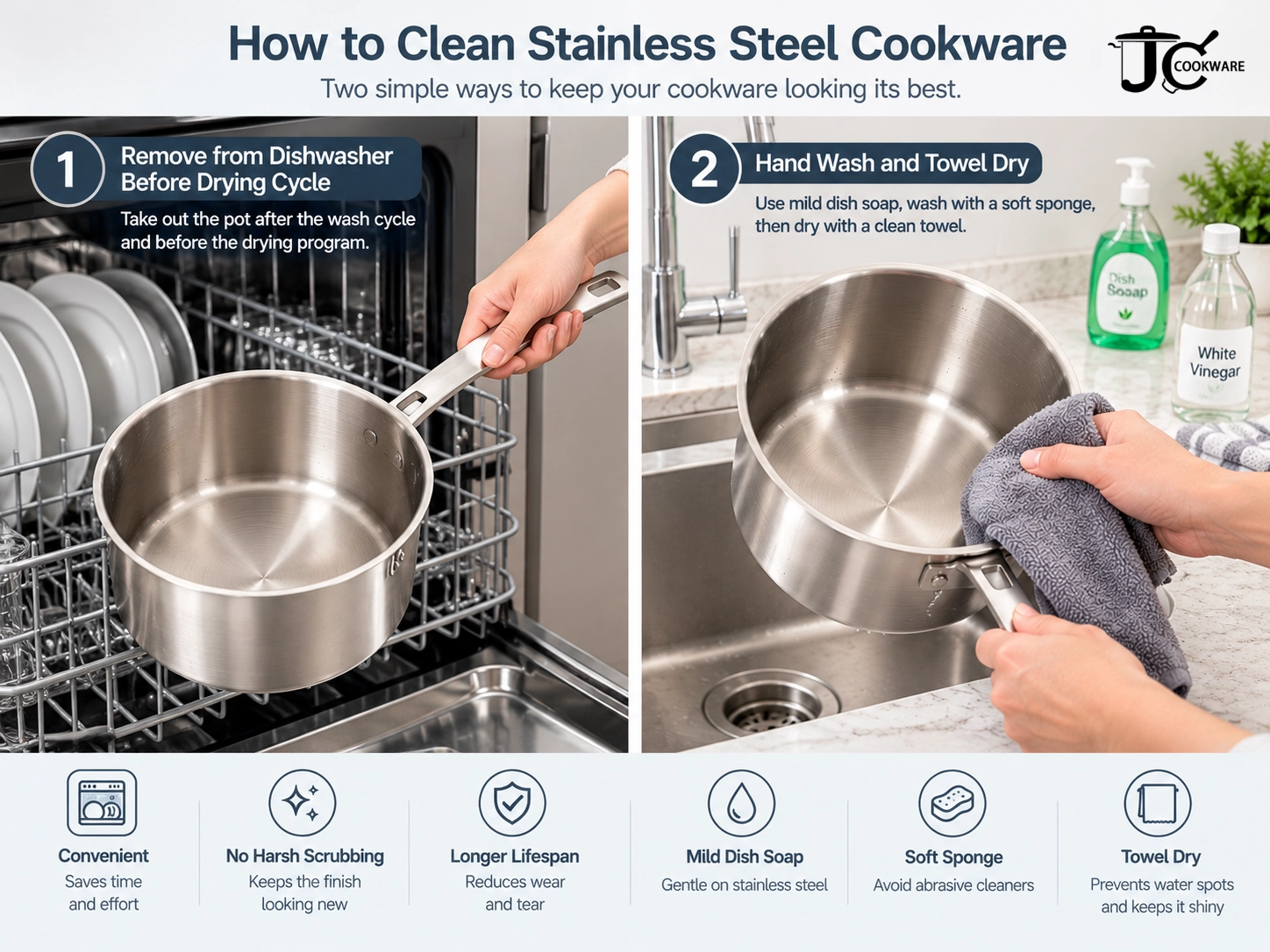
The practical clean stainless steel cookware recommendation: run the dishwasher for daily loads. Pull the stainless out before the dry cycle and towel-dry. Or, if you have time, hand-wash the stainless and let the dishwasher handle the rest of the kitchen. Either way, the dishwasher is a tool, not a substitute for the routine.
For a deeper look at how a bonded base handles repeated dishwashing, our cookware thickness guide (https://jincui.com/cookware-thickness-guide/) covers the relationship between base thickness, layer count, and how the pan survives daily use.
Step 10: A Note From the Factory on Finish and Construction
We make two stainless product lines side by side in Jiangmen, Guangdong: Encapsulated Bottom Stainless Steel Cookware Sets (a disc of aluminium or copper encapsulated in a stainless base plate, with single-layer stainless walls) and Whole-Clad Stainless Steel Cookware Sets (multi-layer construction from base to rim, typically 3-ply or 5-ply). Both lines are open to OEM specification, both run on the same BSCI and ISO 9001 audits, and both ship to brands across the EU and Middle East. We also take on non-stick and coated cookware orders when a buyer’s program calls for them, so a finished pan that leaves our facility could be an encapsulated-base frypan, a 3-ply or 5-ply whole-clad stockpot, or a coated pan built to a buyer’s spec.
For a clean stainless steel cookware article, the factory-side view on what lasts through years of washing is short:
- The interior 304 layer is the same metal all the way through. A scratch is a scratch — it doesn’t expose a coating that can peel. The interior can take a soft abrasive, a metal spatula, a knife, and decades of soap. None of those ruin the pan.
- The exterior finish is the part that ages. A mirror polish loses its mirror quality faster than a satin or brushed finish. A brushed finish hides wear better than any other finish. The choice of finish is the single biggest factor in how the pan looks after five years of washing.
- The bonded base is the part that’s hardest to repair. The aluminium or copper core inside a clad pan is encapsulated by stainless on both sides. Water and detergent do not reach it. The base delaminates only if the bond was poor in the first place, or if the pan was heated empty for an extended period. Neither is a cleaning problem.
- Coated pans, when we ship them, are coated to a customer specification. The cleaning approach for a coated pan is a different article — non-abrasive sponge, no metal utensils, no high-heat empty preheats. Most coated pans are dishwasher-safe at low temperatures; check the buyer’s spec.
That is the entire factory-side summary of clean stainless steel cookware care. Soap, water, a soft sponge, baking soda, vinegar, an occasional Bar Keeper’s Friend, and a towel at the end. No magic, no expensive products, no test methods, no special tools.
FAQ: Clean Stainless Steel Cookware
Can I use steel wool on a stainless pan?
On a heavy matte exterior, fine 0000 steel wool is fine. On a polished or satin exterior, no — it scratches the finish. Use a soft sponge or a baking soda paste instead.
What removes burnt food from a stainless pan?
Boil water and a tablespoon or two of baking soda in the pan for 5–10 minutes, then wipe with a soft sponge. The carbonised food will lift off in sheets. For lighter sticking, deglaze with a half cup of water on a low burner.
Why is my stainless pan rainbow-coloured?
Heat tint — a thin oxide layer that forms when stainless steel is heated past about 260 °C. It is cosmetic, not damage. Wipe with white vinegar (1:1 with warm water) and a soft cloth, or use a baking soda paste.
What are the white spots on my stainless pan?
Mineral deposits from hard water. Wipe with a 1:1 white vinegar and warm water solution, then rinse and towel-dry. A dishwasher rinse-aid reduces the same problem on automatic cycles.
Is Bar Keeper’s Friend safe for stainless steel?
Yes, used occasionally. It is an oxalic-acid-based mild abrasive. Avoid daily use on a brushed or satin finish — it polishes the texture flat over time. Wipe with the grain, rinse, dry.
Can stainless steel go in the dishwasher?
Most Encapsulated Bottom and Whole-Clad stainless pans are dishwasher-safe. The detergent and high-temperature dry will dull a polished exterior over years. For best long-term looks, hand-wash, or pull the stainless out before the dry cycle and towel-dry.
How do I make stainless steel shiny again?
Use a stainless steel polish (Weiman, Bar Keeper’s Friend, or a generic equivalent) on a microfibre cloth, applied sparingly and buffed with the grain. Do not use on a matte or bead-blasted finish.
Will vinegar damage stainless steel?
No. White vinegar (acetic acid, around 5%) is safe on stainless for routine cleaning. Don’t leave concentrated vinegar sitting on the surface for hours — at very long contact times it can affect the passive layer. A 1–5 minute wipe and rinse is the safe range.
Talk to the Factory
JC Cookware runs two stainless lines side by side in Jiangmen, Guangdong — Encapsulated Bottom Stainless Steel Cookware Sets and Whole-Clad Stainless Steel Cookware Sets — and takes on non-stick and coated cookware orders to customer specification. BSCI and ISO 9001 audited, shipping to brands across the EU and Middle East since 2003. If you’re sourcing either construction and want a conversation about base layers, layer count and OEM terms, get in touch: https://jincui.com/contact/
Further reading: How Stainless Steel Cookware Is Made (https://jincui.com/how-stainless-steel-cookware-is-made/) · Cookware Thickness Guide (https://jincui.com/cookware-thickness-guide/) · Why Food Sticks to Your Stainless Steel Pan (and How to Fix It) (https://jincui.com/why-food-sticks-stainless-steel-pan/) · What Is Clad Cookware? (https://jincui.com/what-is-clad-cookware/)
Reference: Stainless steel — Wikipedia (https://en.wikipedia.org/wiki/Stainless_steel)