Every importer says they want good quality. Almost none of them can describe what that means in a way a factory can act on. That gap is where most sourcing disputes are born: the buyer rejects a container for “poor quality”, the factory points at a sample that was approved six months ago, and neither side can name the standard that was breached.
Cookware quality standards exist to close that gap. Not the vague ones — the ones you can measure, photograph, and put into a purchase order. This article is written for brand owners, importers and sourcing teams who are buying stainless steel cookware from an OEM, and it lays out nine checks that turn “good quality” into something enforceable. Some are material checks, some are mechanical, some are paperwork. All of them are things a serious factory can answer in a day, and all of them are things a weak factory will try to talk around.
We’ve been manufacturing stainless steel cookware in Jiangmen, Guangdong since 2003, running two product lines side by side — Encapsulated Bottom Stainless Steel Cookware Sets and Whole-Clad Stainless Steel Cookware Sets — and shipping to brand owners worldwide under BSCI and ISO 9001 audits — our largest customer base is in Europe and the Middle East, but we build for whatever market a buyer sells into. We’ve been on the receiving end of every check below. That’s the perspective this article comes from: not what sounds good in a supplier questionnaire, but what actually separates a shipment you can sell from a shipment you’ll be discounting.
Table of Contents
- Cookware Quality Standards: The Short Version
- Check 1: Material Grade — What’s Declared vs What’s In The Pan
- Check 2: Construction Integrity in Clad and Encapsulated Bases
- Check 3: Base Thickness, Gauge and Flatness
- Check 4: Handle Attachment and Load Strength
- Check 5: Lid Fit, Glass and Steam Vent
- Check 6: Food Contact Compliance and Migration Reports
- Check 7: Surface Finish, Cosmetic Defects and AQL Sampling
- Check 8: Packaging, Drop Test and Container Loading
- Check 9: Documentation, Traceability and the Audit Trail
- What Cookware Quality Standards Look Like on a Factory Floor
- FAQ: Cookware Quality Standards
Cookware Quality Standards: The Short Version
If you have five minutes before a supplier call, this table is the whole article.
| # | Check | What you ask for | What “fails” looks like |
| 1 | Material grade | Mill certificate + PMI/XRF reading per batch | 201 supplied where 304 was quoted |
| 2 | Bond integrity | Construction drawing + delamination clause in the PO | Base disc lifting, hollow ring when tapped |
| 3 | Base thickness & flatness | Stated mm per SKU + feeler-gauge flatness limit | Pan rocks on a flat hob; thin base warps |
| 4 | Handle strength | Handle pull/torque requirement and test method | Rivets loosening, handle scorching |
| 5 | Lid fit & glass | Tempered-glass declaration + rim-gap tolerance | Lid rattles; glass cracks on thermal shock |
| 6 | Food contact | Migration test report matched to your market | No report, or a report for a different alloy |
| 7 | Finish & cosmetics | Written AQL + defect classification list | Scratches, weld marks, inconsistent polish |
| 8 | Packaging | Carton spec + drop-test method | Crushed corners, scuffed lids on arrival |
| 9 | Documentation | QMS certificate, social audit, batch traceability | No batch number, no way to trace a complaint |
The detail behind each row is below. None of it requires you to become a metallurgist — it requires you to ask the question before the deposit, not after the container.
Check 1: Material Grade — What’s Declared vs What’s In The Pan
The first of all cookware quality standards is honesty about the alloy, because almost every other property flows from it. Stainless steel is not one material. The grades that matter in cookware:
- 304 (18/8 or 18/10) — roughly 18% chromium, 8–10% nickel. Austenitic, non-magnetic, excellent corrosion resistance. The default choice for a food-contact interior on mid-to-premium cookware.
- 201 — a lower-nickel grade where manganese partially substitutes for nickel. Cheaper, still stainless, measurably less resistant to corrosion and pitting in salty or acidic conditions.
- 430 — ferritic, magnetic, lower corrosion resistance. It appears in cookware almost entirely as the outer layer of an induction-compatible base, where its magnetism is the point.
There is nothing dishonest about 201. There is something dishonest about quoting 304 and shipping 201, and it happens often enough that it should be your first question. The standard is not “only 304 is acceptable” — the standard is the grade on the purchase order is the grade inside the carton, and the supplier can prove it.
What to ask for:
- A mill certificate (also called a material test report or EN 10204 declaration) for the steel coil or circle used, tied to a batch number.
- A PMI reading — positive material identification, usually done with a handheld XRF analyser that gives the alloy composition in seconds. A factory with an XRF gun, or a third-party inspector who brings one, turns a two-week argument into a two-minute one.
- A written clause in the PO stating the grade per component — interior, exterior, base layers, handle — because a “304 pan” can still have a 430 outer base plate, and that’s legitimate if it’s declared.
This is also the point where an honest supplier will tell you about product tiering. In our own range, for example, premium lines are built in SS 304 while value lines use SS 201, and the specification sheet says which is which. A supplier who tells you everything is 304 at a price that doesn’t support it is telling you something else about how they handle cookware quality standards.
For a full breakdown of where each grade fits, see our comparison of 304 vs 316 vs 430 stainless steel cookware: https://jincui.com/304-vs-316-vs-430-stainless-steel-cookware/.
Check 2: Construction Integrity in Clad and Encapsulated Bases
The second check in any serious cookware quality standards list concerns the bond — the join between the aluminium or copper core and the stainless layers around it. This is the single most common cause of a cookware failure that isn’t cosmetic.
There are two constructions you’ll be quoted, and they fail differently:
Encapsulated Bottom Stainless Steel Cookware Sets — a disc of aluminium or copper is encapsulated inside a stainless base plate, bonded to the bottom of the pan. The walls remain single-layer stainless. Heat spreads well across the base, less so up the sidewall, and the construction is cost-efficient. The failure mode to watch for is delamination: if the bond is incomplete, you get a hollow ring when you tap the base, hot spots directly above the unbonded area, and eventually a base that lifts or rattles.
Whole-Clad Stainless Steel Cookware Sets — multi-layer sheet (typically 3-ply or 5-ply) formed into the whole pan, so the layers run from base to rim. Heat moves up the sidewall as well as across the base. The failure mode here is different: poor bonding shows up as edge delamination at the rim or a “peel” visible on the cut edge, and because the entire sheet is clad, a bad bond is expensive to hide.
What to ask for:
- A cross-section drawing in the specification, showing each layer, its thickness, and its alloy. If a supplier can’t draw it, they probably can’t control it.
- A bond integrity requirement written into the PO or inspection protocol — what happens on delamination, who pays, and what the acceptable-defect rate is.
- A destructive sample check at the approval stage: cut a sample pan in half and look at the bond line. It costs one pan. It prevents a container.
If you’re comparing the two constructions for your range, our what is clad cookware: https://jincui.com/what-is-clad-cookware/ article covers the structural difference in detail, and how stainless steel cookware is made: https://jincui.com/how-stainless-steel-cookware-is-made/ walks through the bonding processes themselves.
Check 3: Base Thickness, Gauge and Flatness
Thickness is the most-quoted and least-verified number in cookware sourcing. Suppliers quote “0.6 mm” or “2.5 mm base” freely, and buyers rarely measure it.
Two separate things are being discussed and they must be specified separately:
- Body gauge — the thickness of the stainless sheet forming the walls. Thicker walls resist denting and hold heat, but add weight and cost. Thin walls feel cheap and dent in transit.
- Base thickness — the total thickness of the bottom, including the encapsulated disc or the clad layers. This drives heat distribution and resistance to warping.
Then there’s flatness, which matters more than either. A pan that doesn’t sit flat on a hob or, critically, on an induction hob, is functionally defective even if every other dimension is perfect.
What to ask for:
- A stated mm figure for body gauge and base thickness per SKU, in the specification, with a tolerance (e.g. ±0.05 mm).
- A flatness limit — commonly expressed as the maximum gap under a straightedge across the base, measured with a feeler gauge. Flatness should be measured both at room temperature and — this matters — after the pan has been heated, because a base that’s flat cold can dish when hot.
- A warping clause: what happens if a base permanently deforms.
Material grading by thickness is covered in our cookware thickness guide: https://jincui.com/cookware-thickness-guide/, which explains why “thicker is always better” is a misleading rule. Put the numbers in the specification anyway — an unmeasured dimension is not a cookware quality standards requirement, it’s a preference.
Check 4: Handle Attachment and Load Strength
Handles are where a cookware complaint stops being cosmetic and starts being a liability. A handle that loosens is a burn risk, and in most markets a product-safety issue, not a quality issue.
The two attachment methods:
- Riveted — the standard for stainless cookware. Robust, repairable, and the rivets are visible, so you can inspect them. Watch for rivets that sit proud, spin, or show gaps around the shank.
- Welded — cleaner look, no crevices to trap food, but the weld quality is harder to inspect visually and a bad weld is invisible until it fails.
What to require:
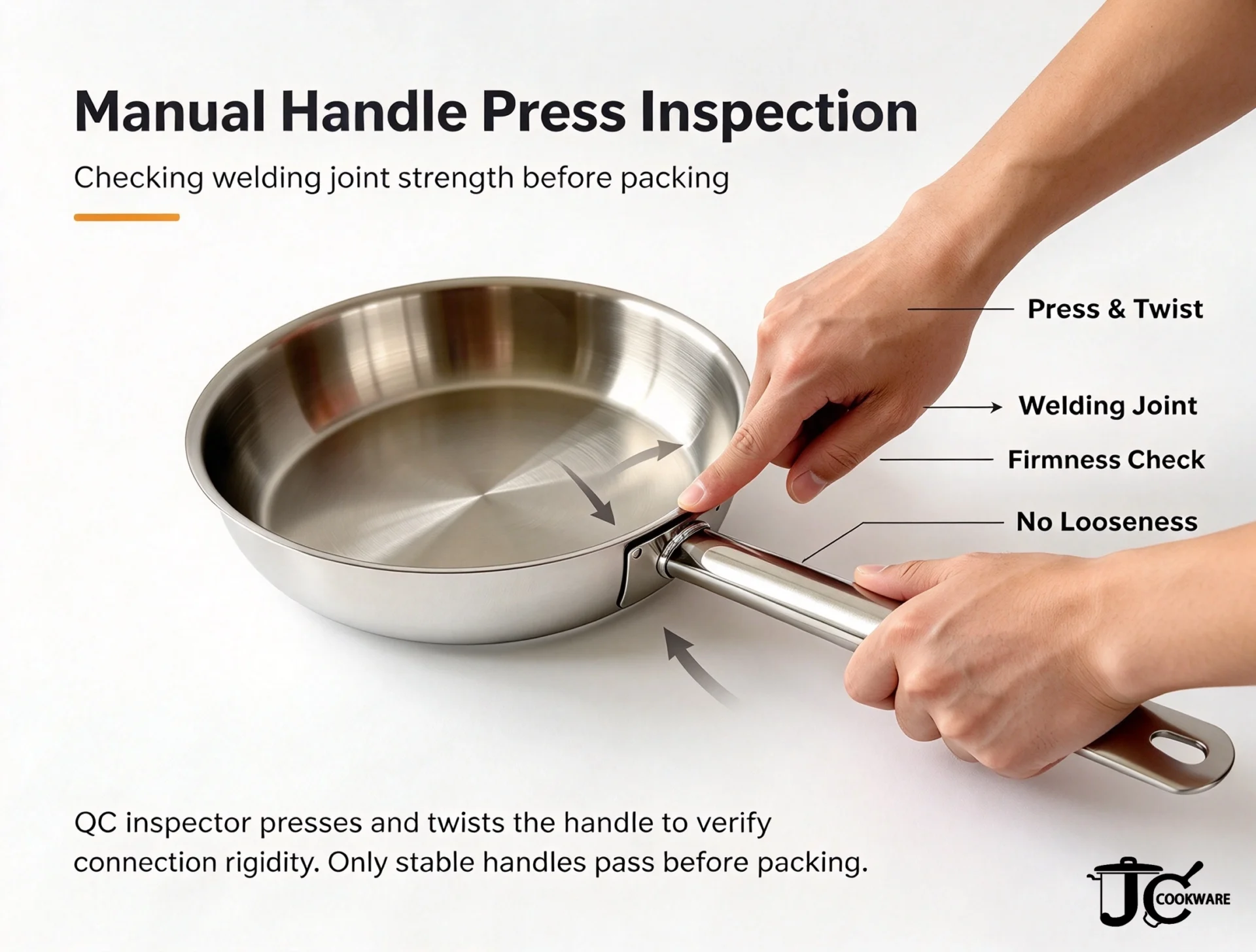
- A handle load requirement: the pan must support a specified weight (pan plus contents) without permanent deformation or loosening. Buyers commonly reference the EN 12983 series for domestic cookware; confirm the current version and the exact test method with your test house rather than relying on a supplier’s summary.
- A torque/twist check for the handle-to-body join.
- Heat resistance behaviour — what the handle does under prolonged hob use. Stainless handles get hot and need a sleeve or a stay-cool design; this should be a specification choice, not a discovery.
- A rivet or weld inspection point in the AQL list, so handle defects are counted as critical rather than argued about as cosmetic — a loose handle is a safety failure, and every sensible set of cookware quality standards treats it that way.
Any cookware quality standards document that doesn’t mention handles is missing the part most likely to generate a return.
Check 5: Lid Fit, Glass and Steam Vent
Lids are the most-replaced part in a cookware set and the least-specified. Three things go wrong:
- Rim fit — the lid rocks or rattles because the lid rim and pan rim don’t match. This is a tolerance issue and it should be specified: how much gap is acceptable, and how much the lid can move laterally.
- Glass — tempered glass is standard for view lids. The declaration that matters is that it *is* tempered, and what standard it was tempered to. Thermal shock resistance is the property at stake: a lid that survives a simmer can still fail if it’s taken from a hot pan to a cold surface.
- Steam vent and knob attachment — the vent hole must exist (a fully sealed lid on a boiling pot is a safety problem), and the knob must be attached with a method that survives heat and repeated removal.
Ask for the lid rim tolerance and the glass specification in writing. Both are cheap to control in production and expensive to fix after import. Lids are the classic blind spot in cookware quality standards — buyers specify the pan down to the base gauge and leave the lid to “as sample”.
Check 6: Food Contact Compliance and Migration Reports
This is the check that blocks shipments at customs, so it belongs high on any list of cookware quality standards. The principle across major markets is the same: a material in contact with food must not transfer constituents to the food in quantities that endanger health or change its composition. The implementations differ.
- EU — Regulation (EC) No 1935/2004 is the framework regulation for food contact materials. Germany additionally applies its LFGB requirements. National provisions vary, so confirm what your target market actually requires.
- United States — the FDA regulates food contact substances, with the relevant requirements set out in Title 21 of the Code of Federal Regulations.
- Other markets — many have their own positive lists or adopt EU or US frameworks by reference.
What to ask for is not a certificate with a logo on it. It is a migration test report that matches your product:
- Same alloy as the pan you’re buying (a report for 304 does not cover a 201 interior).
- Same simulant and contact conditions appropriate to the intended use — acidic foods, fatty foods, high temperature.
- Issued by a recognised third-party laboratory, within a validity period your market accepts.
- Tied to a batch or production period you can trace.
A supplier who sends you a generic food-grade certificate should be asked, politely, for the migration report instead. The difference between those two documents is the difference between a marketing claim and cookware quality standards evidence.
Check 7: Surface Finish, Cosmetic Defects and AQL Sampling
Cosmetic quality is where most disagreements happen, because without a written standard it’s entirely subjective. The fix is an AQL — an acceptable quality limit — applied through a defined sampling plan.
The mechanics:
- Sampling standard — most inspection bodies work to ISO 2859-1 (also published as ANSI/ASQ Z1.4) for attribute sampling by lot size. Name the standard, the inspection level, and the AQL numbers in your PO.
- Defect classification — agree in advance what counts as critical, major and minor. Typical split:
– *Critical*: anything unsafe or non-functional — delamination, loose handle, non-tempered glass, wrong alloy.
– *Major*: visible defects that affect saleability — deep scratches, dents on the cooking surface, inconsistent polish, weld marks, rattling lids.
– *Minor*: small cosmetic marks not visible at arm’s length.
- Typical AQL levels — commonly 0 for critical, 2.5 for major, 4.0 for minor in consumer goods. Your market and your brand positioning may justify tighter numbers; the point is that they’re written down before inspection, not negotiated during it.
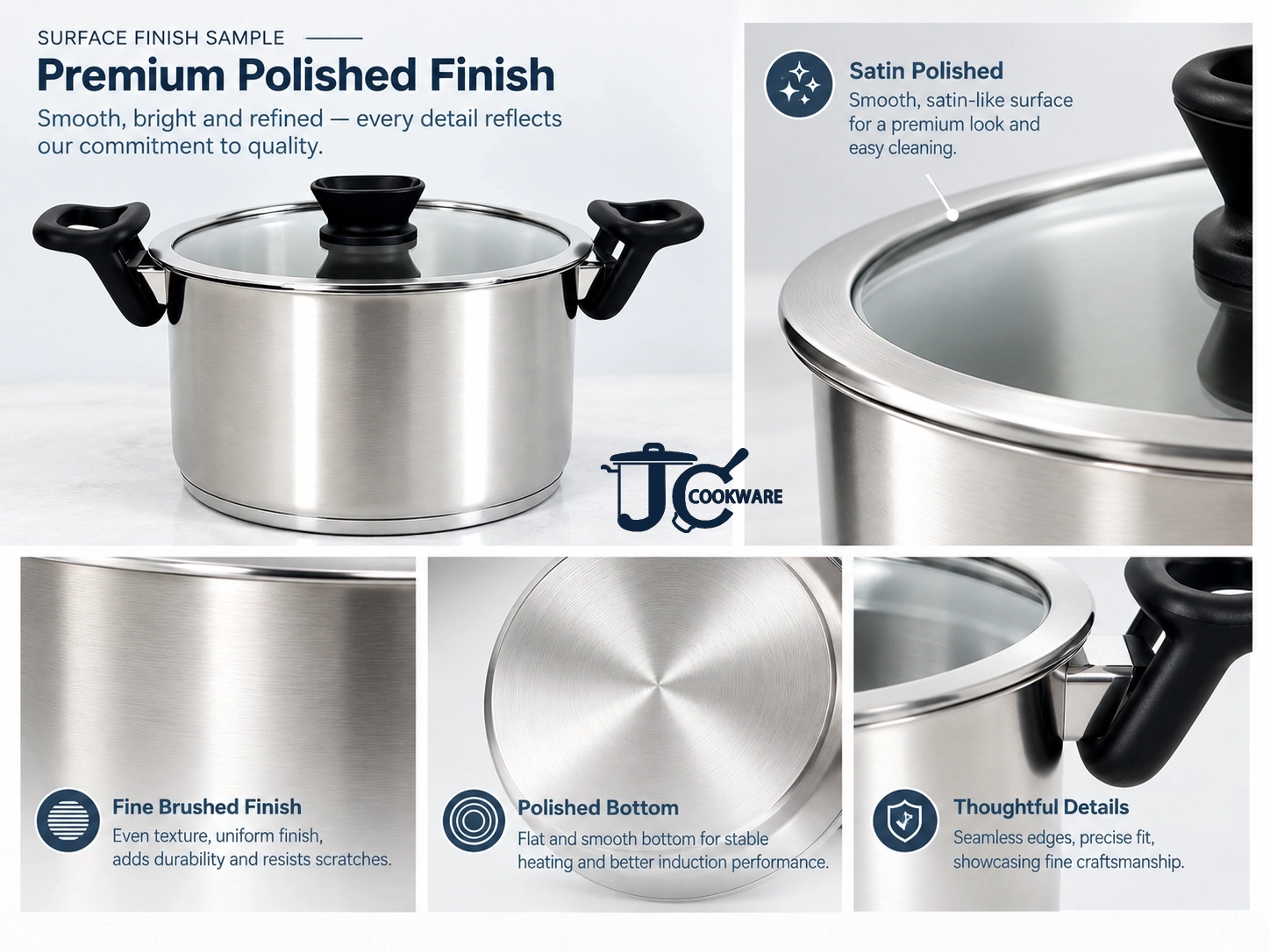
For stainless specifically, specify the finish explicitly: mirror polish, satin, or brushed, ideally with a reference sample or a photo standard. “Stainless finish” is not a specification. Our article on how to clean stainless steel cookware: https://jincui.com/clean-stainless-steel-cookware/ also touches on how different finishes age in real kitchens, which is worth knowing before you pick one.
Check 8: Packaging, Drop Test and Container Loading
A pan that arrives dented failed a quality standard even though nothing was wrong with the pan.
What to require:
- Carton specification — board grade, inner protection (each pan separated, lid protectors, corner protection), and drop-test method. Transit testing methods such as those published by ISTA give a common language here; agree which one applies.
- Drop test — usually a defined number of drops from a defined height onto faces, edges and corners, followed by an inspection of both product and carton.
- Set nesting — if you’re buying sets, how they nest affects both cube and damage rate. Nesting designs cut freight cost per unit, but a poorly designed nest concentrates load on the rims.
- A written packing spec — the count per carton, the protection per piece and the carton markings. Packaging belongs in the same document as the alloy grade, because arrival condition is as much a cookware quality standards outcome as the metal is.
- Container loading — cartons stacked rather than thrown, moisture protection for a sea voyage, and a loading photograph before the doors close. It costs nothing and settles most damage claims.
Check 9: Documentation, Traceability and the Audit Trail
The last of the cookware quality standards checks is the one that makes the other eight enforceable: can a complaint be traced back to a batch?
Ask for:
- ISO 9001 certification for the quality management system — this is about the process being documented and audited, not about any individual pan. It is the closest thing the industry has to a common language for cookware quality standards. You can read more about what the standard covers at ISO 9001: https://en.wikipedia.org/wiki/ISO_9001.
- A social compliance audit if your retail customers require one. BSCI is common for European buyers; other programmes exist for other markets.
- Batch traceability — a batch or lot number on the carton that links back to the material certificate, the production date and the inspection record. If a retailer asks you in eighteen months which batch a complaint came from, this is the only thing that answers the question.
- Pre-shipment inspection by a third party, against the written AQL and defect list from Check 7. An inspection without a written standard is an opinion.
- Corrective action history — what went wrong on the last order and what changed. A supplier who has never had a problem is either very new or not telling you something.
What Cookware Quality Standards Look Like on a Factory Floor
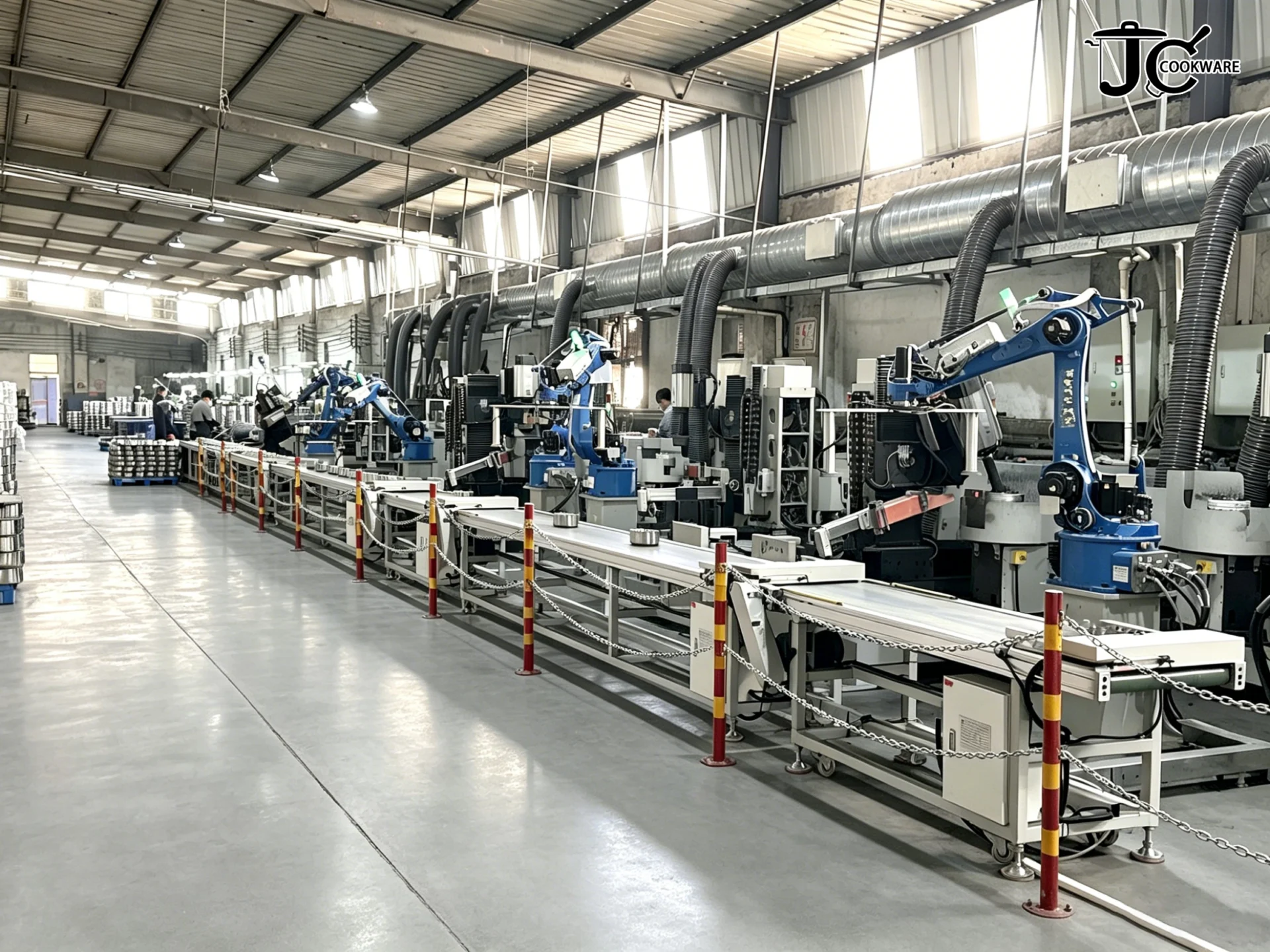
Standards are easy to write and hard to run. Here’s the honest version of what they look like from our side of the bench in Jiangmen, Guangdong, where we’ve been making stainless steel cookware since 2003.
Two lines, one system. We run Encapsulated Bottom Stainless Steel Cookware Sets and Whole-Clad Stainless Steel Cookware Sets side by side. They are different constructions with different bond risks and different inspection points, but they run under the same quality management system and the same BSCI and ISO 9001 audits. We also take on non-stick and coated cookware orders when a customer’s program calls for them, and those orders carry the same documentation expectations — the coating specification and its compliance paperwork are part of the buyer’s file, not an afterthought.
Specification first, production second. The orders that go smoothly are the ones where the buyer sent a specification. The ones that go badly are the ones where a sample was approved on looks and everything else was assumed.
Written AQL beats goodwill. Every buyer says they’ll be reasonable about minor marks. Then the container lands in a slow month and every mark gets counted. A written AQL protects both sides, and we’d rather agree on 2.5/4.0 in the PO than negotiate it over photographs.
Traceability is the real cost. Mill certificates, batch numbers and inspection records cost time on every order. They are also the reason a single complaint doesn’t turn into a relationship-ending fight. Any supplier who can’t produce them is asking you to absorb that risk yourself.
None of that is glamorous, and none of it is a substitute for a certificate. But cookware quality standards that only exist on paper aren’t standards — they’re brochures. The test is whether the factory can show you the record.
FAQ: Cookware Quality Standards
What are the most important cookware quality standards to put in a purchase order?
Material grade with a mill certificate, construction drawing with layer specification, base thickness with tolerance, handle load requirement, food contact migration report matched to your market, and a written AQL with defect classification. Everything else is refinement — and cookware quality standards only work when they’re written into the PO rather than discussed over email.
Is SS 201 a quality failure?
No — it’s a cost tier. It’s a legitimate stainless grade with lower corrosion resistance than 304. It becomes a quality failure when 304 is quoted and 201 is shipped, or when 201 is used for a product that will live in salty or acidic conditions without the buyer knowing.
What AQL should I use for cookware?
Commonly 0 for critical defects, 2.5 for major and 4.0 for minor under ISO 2859-1 sampling, though premium brands and certain retailers go tighter. The important part is agreeing the numbers and the defect definitions before inspection, not the specific values.
Do I need LFGB, FDA and EU declarations all at once?
Only for the markets you sell into. Ask your test house which applies and get a migration report scoped to those markets and to your actual alloy. A report for the wrong grade is the most common documentation failure we see.
What’s the difference between a quality management certificate and a product standard?
ISO 9001 certifies that a factory runs a documented, audited quality process. It says nothing about any individual pan. Product compliance — food contact, handle strength, material grade — is evidenced by test reports and inspection records for that specific batch.
How do I verify the alloy without destroying the pan?
Handheld XRF analysers give a composition reading in seconds without damaging the product. Any third-party inspector can bring one; it’s the fastest way to settle a grade dispute.
Can a factory change construction without telling me?
It happens, which is why the construction drawing belongs in the approved specification and the PO. Any change to layers, base thickness or alloy should require written approval — make that a contract term, not a courtesy.
Should I inspect before or after packing?
Both, in practice. In-process inspection catches systematic problems while they can still be fixed; pre-shipment inspection against your AQL is what protects you on the container. If budget only allows one, do pre-shipment against a written standard.
JC Cookware runs two stainless lines side by side in Jiangmen, Guangdong — Encapsulated Bottom Stainless Steel Cookware Sets and Whole-Clad Stainless Steel Cookware Sets — and takes on non-stick and coated cookware orders to customer specification. BSCI and ISO 9001 audited, shipping to brand owners worldwide since 2003, with our largest volumes going to Europe and the Middle East. If you’re building a specification or reviewing cookware quality standards for an existing range, get in touch: https://jincui.com/contact/ and we’ll talk through layers, tolerances and documentation.