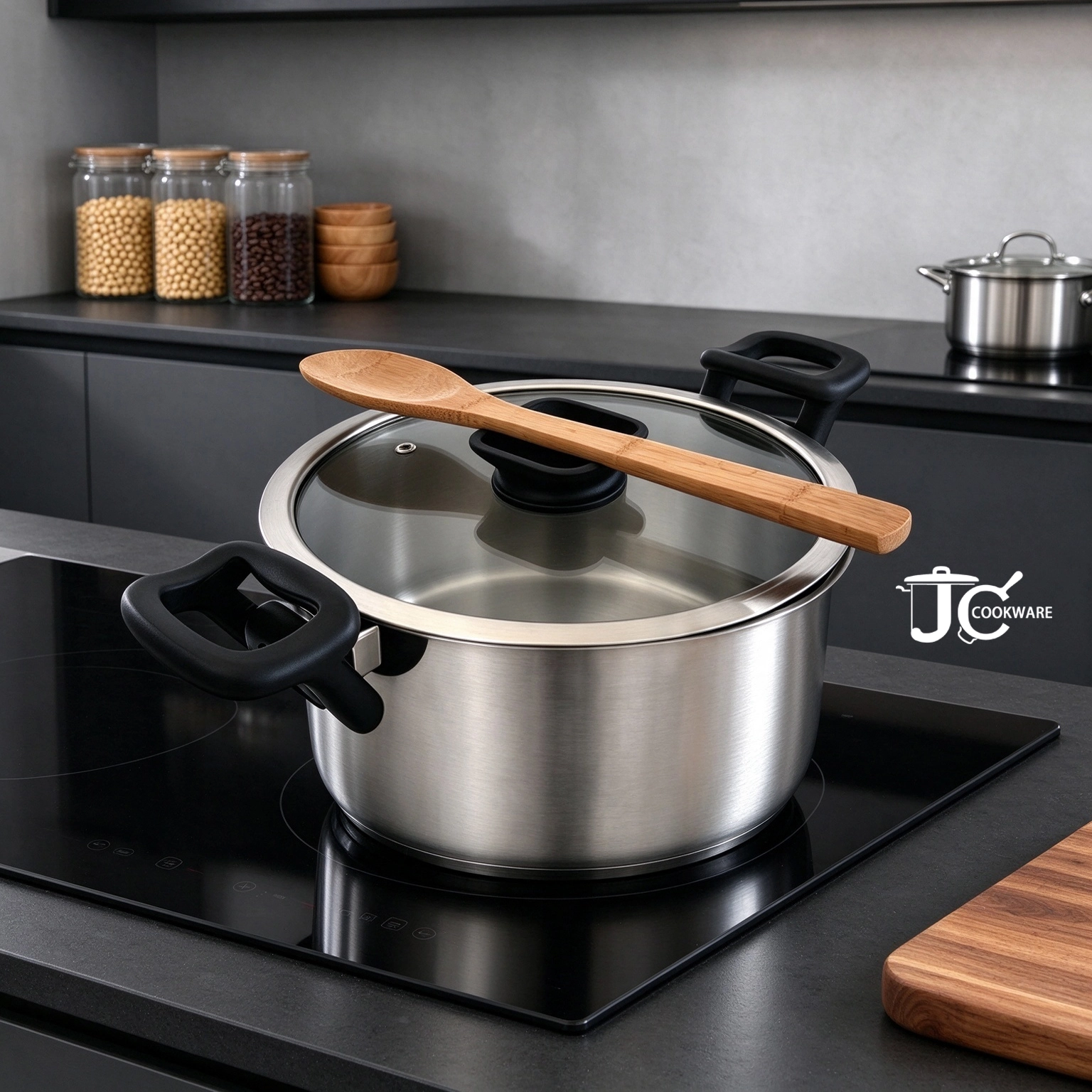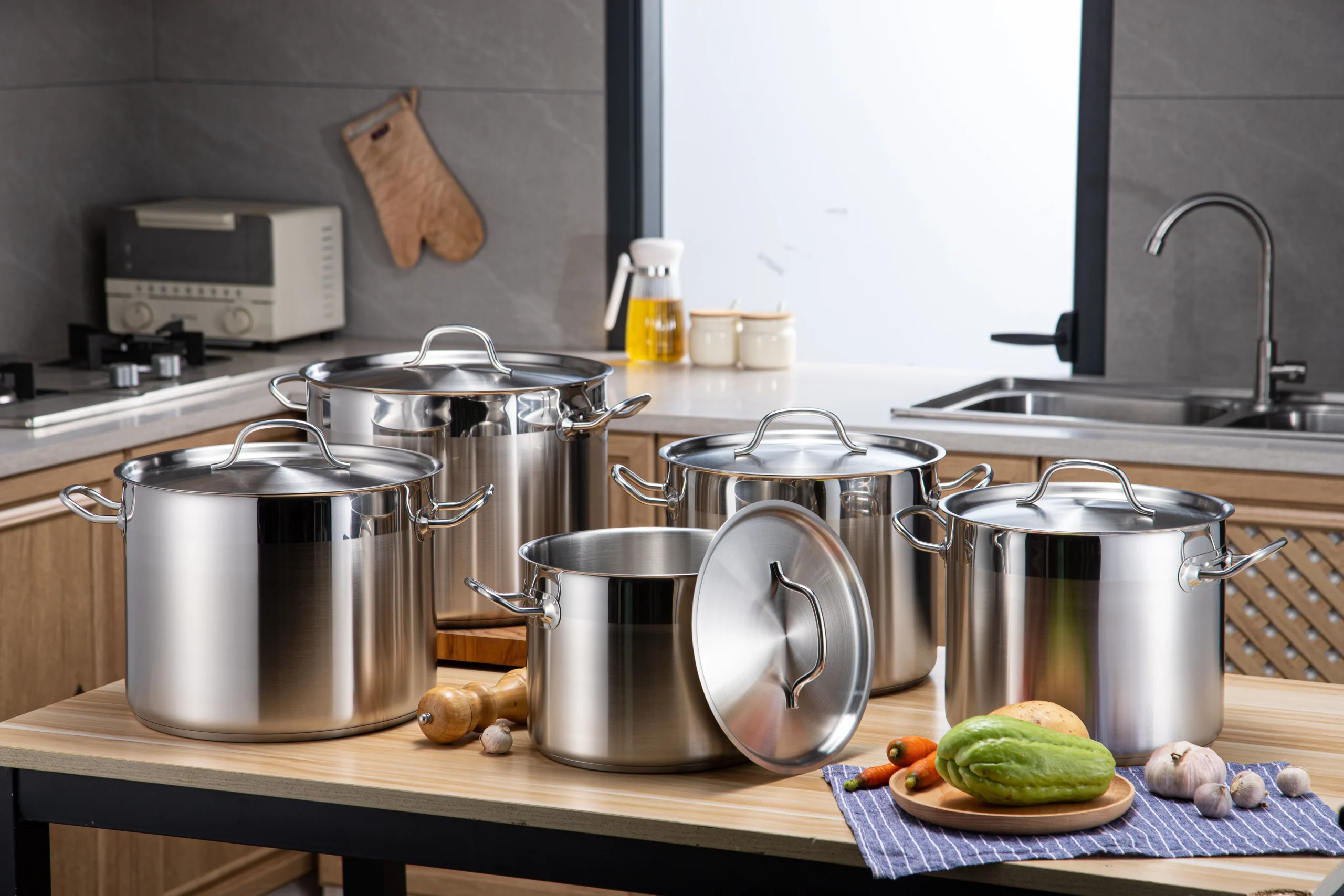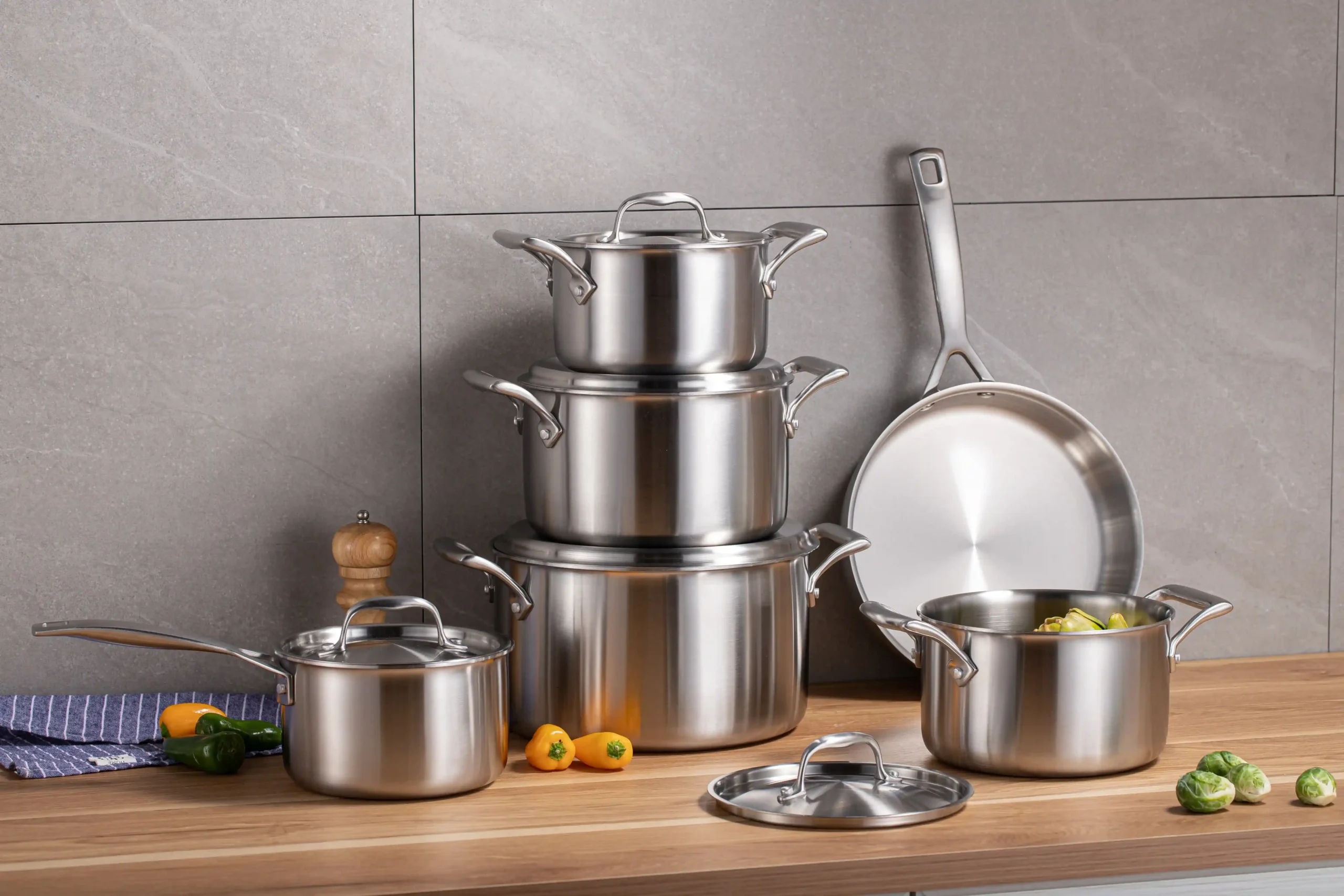
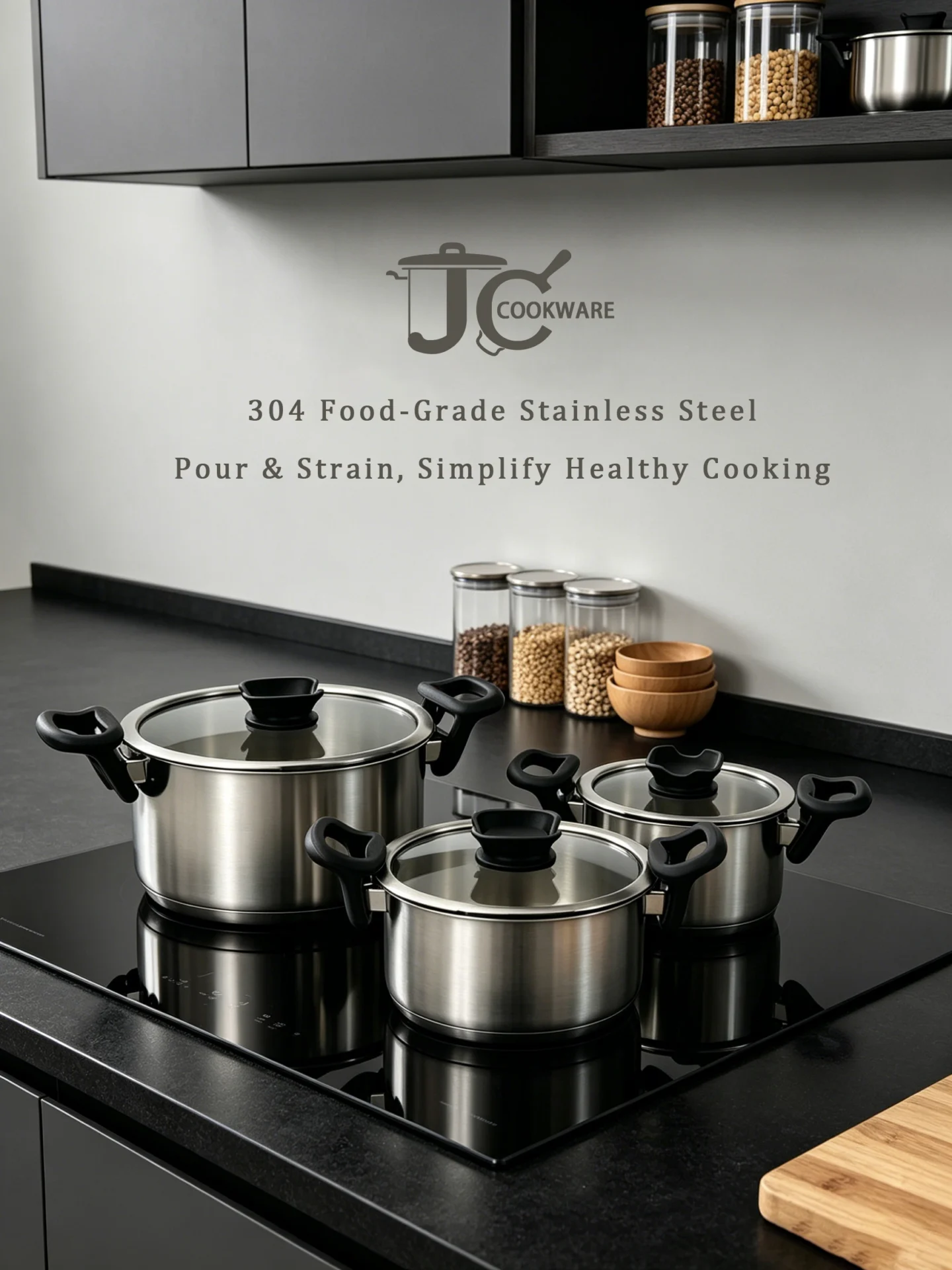
An induction hob doesn’t heat your pan with flame or radiant heat. It generates an alternating magnetic field that induces eddy currents directly inside the cookware itself — which means the pan is the heating element. That single fact explains everything about choosing the best cookware for induction: the metal, the base construction, even the flatness of the bottom all matter far more than they ever did on gas.
We should know what goes into that base, because we build them. Since 2003 we’ve manufactured stainless steel cookware in Jiangmen, Guangdong, supplying brands across the EU and Middle East markets, and a growing share of every production run is induction compatible cookware built for European kitchens where induction is now the default. Here are the seven rules we give buyers — and that we apply on our own lines.
Table of Contents
1. Best Cookware for Induction: What Actually Matters
2. Rule 1: The Magnet Test Comes First
3. Rule 2: The Hidden 430 Layer in Every Induction Base
4. Rule 3: A Flat Base Beats a Fancy Brand Name
5. Rule 4: Match the Base to the Cooking Zone
6. Rule 5: Clad Construction, But With a Magnetic Outer Layer
7. Rule 6: Materials That Will Never Work — and the Disk Workaround
8. Rule 7: How We Build Induction Bases in the Factory
9. FAQ: Best Cookware for Induction
Best Cookware for Induction: What Actually Matters
Before the details, the short version. When we evaluate the best cookware for induction — our own samples or a competitor’s — five factors do almost all of the work:
| Factor | What Good Looks Like | |
| 1 | Magnet response | A fridge magnet clamps firmly to the base |
| 2 | Base metal | A magnetic outer layer (430 stainless or carbon steel) |
| 3 | Flatness | Base sits flush on a glass top — no wobble, no spin |
| 4 | Base diameter | Covers at least 70% of the cooking zone |
| 5 | Core construction | Aluminum or copper core for even heat spreading |
Notice what’s missing from that list: brand name, price and marketing claims. None of them move a magnetic field. A premium-looking pan with an aluminum outer base will be ignored by an induction hob, while a modest magnetic-base pan heats instantly.
Rule 1: The Magnet Test Comes First
This is the fastest and most reliable test in all of cooking on induction, and it costs nothing. Press any magnet — a fridge magnet works — against the underside of the pan.
- The magnet snaps on and holds firmly. The base contains enough ferromagnetic material to couple with the hob’s field. This pan will work.
- The magnet sticks weakly or slides off. The base is only weakly magnetic — typically a lightly cold-worked austenitic steel. Performance on induction will be sluggish and uneven.
- Nothing happens at all. The base is aluminum, copper, or non-magnetic stainless. The hob will not detect the pan and will refuse to heat.
Why does this work? The most common food-grade stainless, 304, is an austenitic steel — the same nickel that makes it corrosion-resistant also makes it essentially non-magnetic. Ferritic grades like 430 contain almost no nickel, so they are strongly magnetic. This is exactly why the best cookware for induction puts a 430 outer layer on the base and keeps 304 on the food-contact surface — you can read more in our guide to 304 vs 316 vs 430 stainless steel cookware (https://jincui.com/304-vs-316-vs-430-stainless-steel-cookware/).
The magnet test takes five seconds and settles the question before price, reviews or packaging even enter the conversation.
Rule 2: The Hidden 430 Layer in Every Induction Base
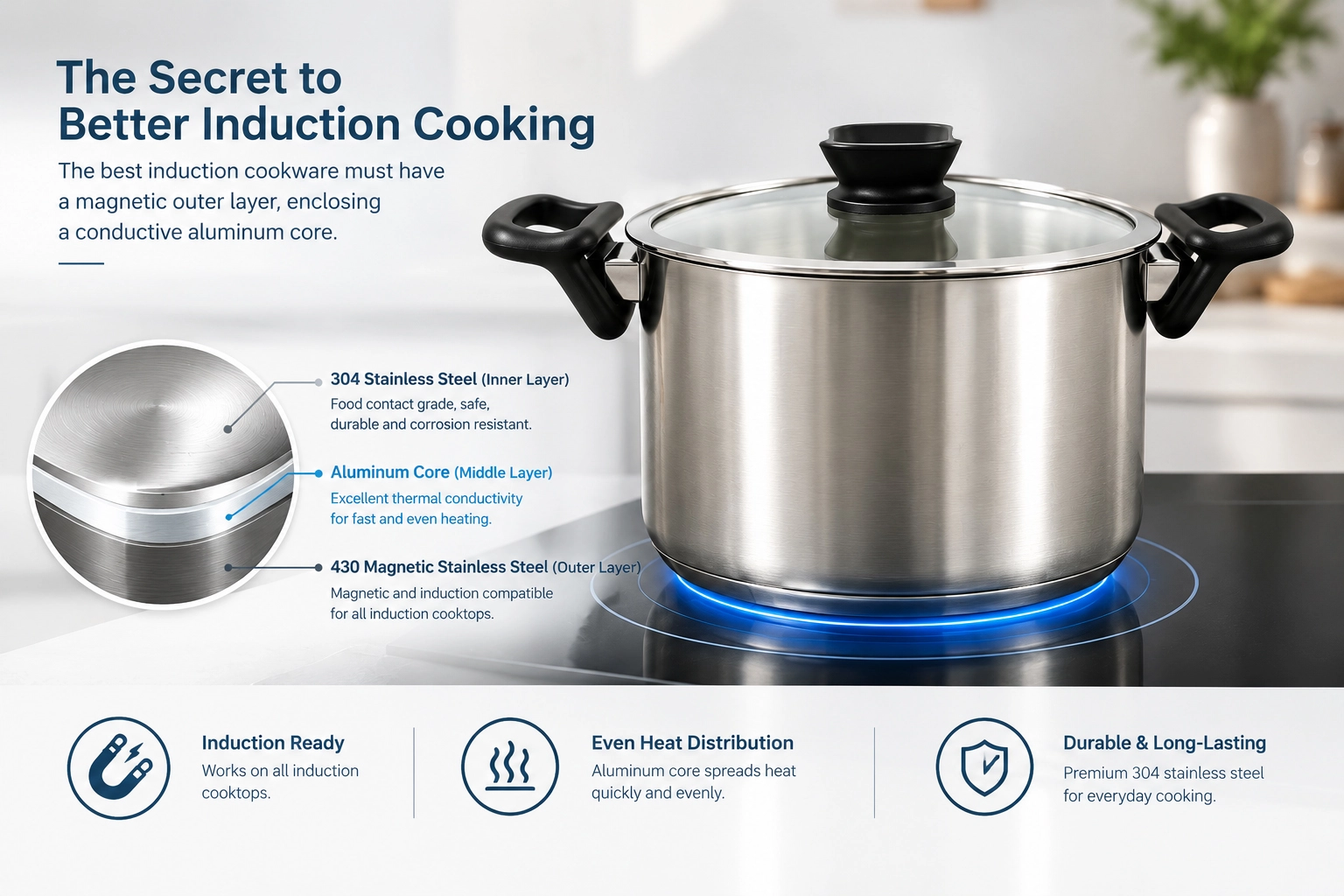
Here’s the part most buyers never see, because it’s buried in the base sandwich. Genuine induction cookware is a layered structure, and each layer has one job:
| Layer | Position | Typical Material | Job |
| Interior | Food contact | 304 stainless | Corrosion resistance, food safety |
| Core | Middle | Aluminum (sometimes + copper) | Spreads heat, kills hot spots |
| Outer | Hob contact | 430 stainless or carbon steel | Couples with the magnetic field |
A pan advertised as “18/10 stainless steel” describes only the interior. If the outer base layer were also 304, the pan would be beautiful, corrosion-proof — and dead on an induction hob. Every serious manufacturer of induction ready cookware therefore switches the outer layer to a magnetic ferritic grade.
So when a listing says “induction compatible,” the claim is only as good as the hidden layer behind it. The best cookware for induction makes this explicit: a 430 stainless outer base, bonded to an aluminum core, with 304 inside. If a seller can’t tell you what the outer layer is made of, the magnet test in Rule 1 is your answer.
Rule 3: A Flat Base Beats a Fancy Brand Name
Induction transfers energy across an air gap of only a few millimeters. Every extra millimeter of gap between pan and glass costs coupling efficiency — and a warped base can lift the pan 2–3 mm at the edges.
A warped pan on gas still works, badly. On induction it develops zones that barely heat, because the field couples strongest where the base is closest to the coil. The pan sears in one ring and stays cool in another.
Three checks, in order of speed:
- The counter test. Place the pan on a perfectly flat counter and press each corner. Any rocking is a disqualifier.
- The light test. Put the pan on the hob, turn it on low, and look for a hotspot ring far smaller than the base outline — a classic sign the center has bulged.
- The spin test. A flat pan on a glass hob resists spinning. A warped one spins like a lazy susan.
What causes warping? Usually a base that’s too thin for its diameter. Our cookware thickness guide (https://jincui.com/cookware-thickness-guide/) covers the numbers, but the short version: a bonded base in the 2.5–3.5 mm range holds flatness far better than a 1.5 mm disk under repeated heat cycling. This is one reason the best cookware for induction is rarely the thinnest pan on the shelf.
Rule 4: Match the Base to the Cooking Zone
Every induction hob coil has a fixed diameter, and the field is strongest inside that circle. A base that’s much smaller than the coil wastes energy and heats only a small center patch; a base that overhangs the coil by a lot heats only the covered ring.
The practical rules we give buyers:
- Cover at least 70% of the cooking zone for acceptable coupling.
- Don’t exceed the zone by more than about 2–3 cm — a 30 cm stockpot on a 14 cm zone will heat slowly and unevenly no matter how well it’s built.
- Small pans belong on small zones. A 16 cm milk pan on a large zone may not even be detected.
This is a compatibility issue, not a quality issue — even the best cookware for induction performs badly when mismatched to the hob. If your hob has bridge or flex zones, they exist precisely to solve this for griddles and fish pans.
Rule 5: Clad Construction, But With a Magnetic Outer Layer
Clad cookware — layers of different metals bonded through the whole body — was engineered to solve the oldest problem in stainless cookware: steel is durable but conducts heat poorly. An aluminum or copper core fixes that by spreading heat evenly to the walls.
The induction twist is that the outermost layer must also be magnetic. This is why modern clad pans are built like this:
304 stainless (interior) → aluminum or copper core → 430 stainless (exterior)
Austenitic inside for food safety; conductive in the middle; ferritic outside for the magnetic field. The best cookware for induction gets all three in one bonded package — fast response, even heating, and full hob compatibility.
If you’re unclear on how these layers are actually made — impact bonding versus roll-bonding versus brazing — our article on what clad cookware really is (https://jincui.com/what-is-clad-cookware/) breaks down each process. The manufacturing method matters because it determines how the layers behave after years of thermal cycling: a properly bonded base stays flat and quiet; a poorly bonded one delaminates, buzzes, and eventually warps.
Rule 6: Materials That Will Never Work — and the Disk Workaround
No base construction can save a fundamentally non-magnetic material. Here’s the full picture for cooking on induction:
| Material | Works on Induction? | Notes |
| Carbon steel | Yes | Strongly magnetic, lightweight, needs seasoning |
| Cast iron | Yes | Excellent coupling; heavy and slow to respond |
| Enameled cast iron | Yes | The enamel doesn’t block the field |
| Magnetic stainless (430) | Yes | The standard for induction bases |
| 304-only stainless | No (barely) | Weakly magnetic at best — unreliable |
| Aluminum | No | Completely non-magnetic |
| Copper | No | Superb conductor, invisible to induction |
| Glass / ceramic | No | Non-magnetic and slow |
The workaround is an induction interface disk — a flat magnetic plate you set between hob and pan, which then heats your non-magnetic cookware by contact. It works, but it throws away induction’s two best properties: instant response and efficiency. The heat must travel through the disk first, so a copper pan on a disk behaves like a mediocre electric hob, not like induction. Anyone using a disk regularly should accept that they’re not really cooking on induction anymore — and any of our magnetic-base lines would serve them better.
For aluminum pans there is a cleaner path: buy the same pan shape with an induction-ready bonded base. Most factories, ours included, offer identical tooling with either a standard or a magnetic base — the pan above the base line is unchanged.
Rule 7: How We Build Induction Bases in the Factory
The rules above are decided at the production stage, not at the store. A quick look at how it’s done on our lines in Jiangmen:
The base stack
Our brazed and impact-bonded bases start as a layered stack — stainless, an aluminum plate for heat spreading, and a magnetic outer layer of 430 stainless or iron. Some styles add a copper layer in the middle for faster response. Each layer is there for exactly one of the jobs in Rule 2.
The bonding
Under high pressure and heat, the layers bond into a single disk — molecular-level fusion rather than gluing or mechanical clamping. A poor bond announces itself later as a clicking base or a pan that buzzes on the hob.
The flatness check
Because Rule 3 is where cheap production fails first, base flatness gets checked before a pan leaves the line. A bonded base that passes inspection on day one still has to survive years of thermal cycling, which is what the layer thicknesses are calculated around.
The magnet stays in the loop
Magnetic response of the outer layer is part of what defines induction compatible cookware on our production paperwork — a pan that fails the magnet test never gets to claim induction compatibility.
This is also why “induction ready” claims vary so much in quality across the market. A base can be technically magnetic enough to trigger the hob but too thin to stay flat, or bonded well but made of marginal steel. The best cookware for induction comes from factories that control the whole stack — material, bond and flatness — not just the logo stamped on top.
If you’re sourcing cookware rather than buying one pan, ask a factory three questions: what grade is the outer base layer, what is the bonded base thickness by pan size, and what flatness tolerance do they hold before shipping. A factory that answers those three questions quickly is one that actually runs the process.
FAQ: Best Cookware for Induction
How do I know if my current pans work on induction?
Do the magnet test from Rule 1. If a fridge magnet clamps to the base, the pan will be detected and heated. Weak or no attraction means it won’t work, no matter what the box said.
Is induction safe for stainless steel cookware
Yes — and it’s arguably gentler than gas, because there’s no open flame and no combustion products near the handle. The hob only energizes when it detects a magnetic pan.
Do I need special cookware for induction, or just “induction compatible”?
The phrase you’ll see most is “induction ready,” and it should mean a magnetic outer base layer. The best cookware for induction goes further: aluminum core for even heating, 304 interior for food safety, and a base thickness that resists warping.
Why does my pan buzz on the induction hob?
Usually one of two causes: a fan or transformer in the hob itself (normal, especially at high power), or slight looseness between bonded base layers (a quality defect). A buzz that changes when you press the pan down points to the base.
Can I use cast iron on a glass induction hob?
Yes, and it couples beautifully. Just lift rather than slide it across the glass, because its rough seasoning layer can scratch the surface.
Do induction adapters damage the hob?
No, but they waste the advantages. A disk turns your induction hob into a slow contact heater — safe, but pointless when magnetic-base cookware exists for every pan shape.
Talk to the Factory
Looking for induction-ready stainless steel cookware from a factory that builds the base from the layers up? JC Cookware manufactures clad and bonded-base cookware in Jiangmen, Guangdong — BSCI and ISO 9001 audited, shipping to brands across the EU and Middle East since 2003. Contact us to discuss your induction cookware line: https://jincui.com/contact/
Further reading: What Is Clad Cookware? (https://jincui.com/what-is-clad-cookware/) · Cookware Thickness Guide (https://jincui.com/cookware-thickness-guide/) · 304 vs 316 vs 430 Stainless Steel Cookware (https://jincui.com/304-vs-316-vs-430-stainless-steel-cookware/)
Technical background on how induction heating works: Induction cooking — Wikipedia (https://en.wikipedia.org/wiki/Induction_cooking)