When sourcing stainless steel cookware, you’ll see “clad” everywhere — clad pans, clad pots, tri-ply, 5-ply, full-clad. But what is clad cookware, exactly? And more importantly, does it justify the price premium over standard single-ply stainless steel?
Since 2003, our factory in Jiangmen, Guangdong has manufactured stainless steel cookware for brands across the EU and Middle East markets — and in that time we’ve produced every type of clad construction imaginable, from budget 3-ply fry pans to premium 5-ply copper-core sauté pans. This guide breaks down what is clad cookware from a factory floor perspective: no marketing fluff, just the engineering facts and sourcing data that matter when you’re placing a PO.
Table of Contents
1. What Is Clad Cookware? A Clear Definition
2. How Clad Cookware Is Made: Inside the Factory
3. Clad Cookware Layers: 3-Ply vs 5-Ply
4. What Is Clad Cookware’s Core Advantage?
5. Clad vs Encapsulated Base: The Critical Difference
6. How to Identify Genuine Clad Cookware
7. What Is Clad Cookware Worth? B2B Pricing Guide
8. Common Clad Cookware Myths Debunked
What Is Clad Cookware? A Clear Definition
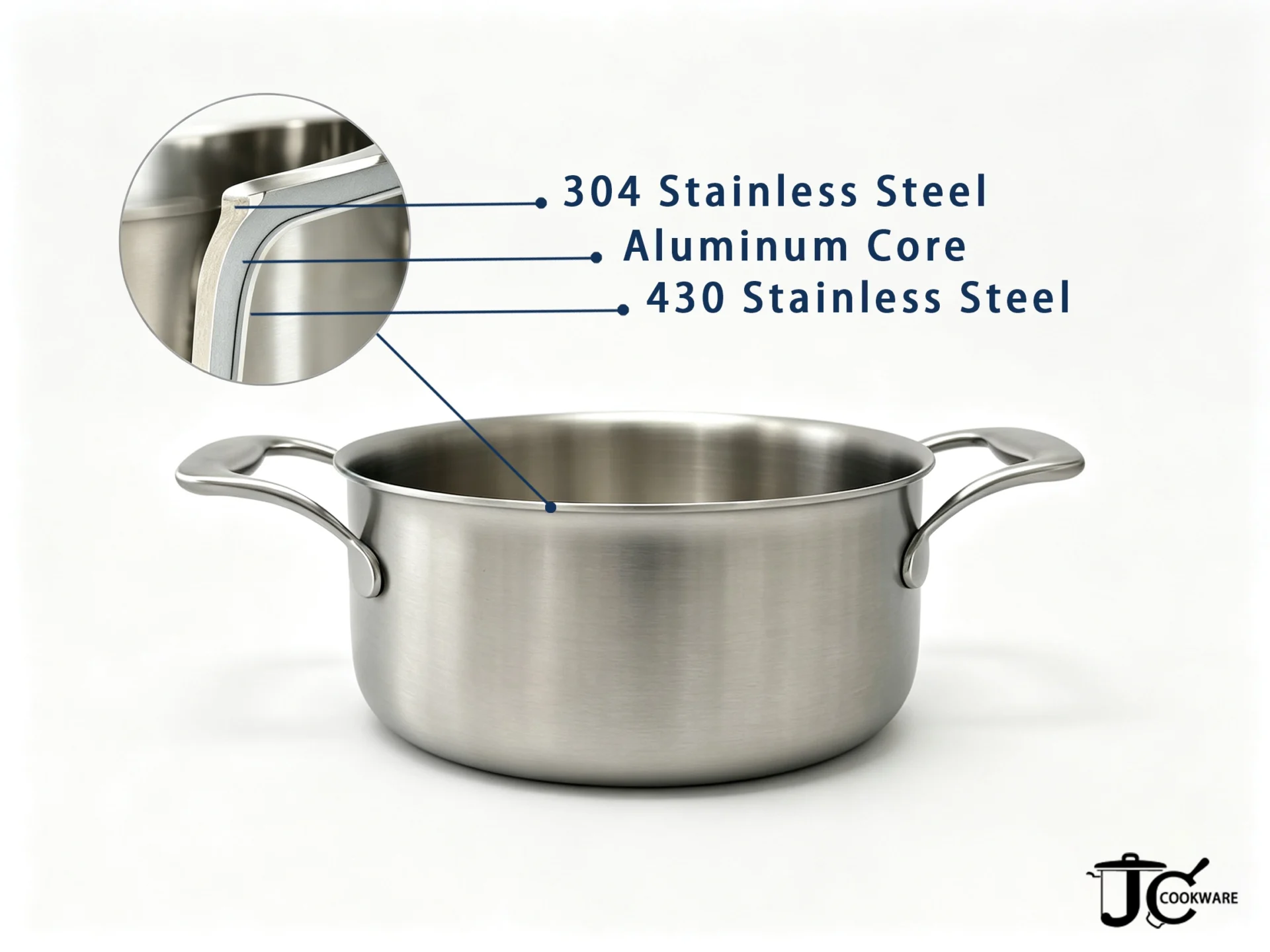
Clad cookware is cookware made by permanently bonding multiple layers of different metals into a single, unified piece. The most common configuration bonds a stainless steel interior (for food safety and corrosion resistance) with an aluminum or copper core (for heat conduction) and a magnetic stainless steel exterior (for induction compatibility).
To understand what is clad cookware and why it exists, you have to understand the fundamental problem with single-metal cookware:
| Metal | Strengths | Weaknesses |
| Stainless Steel (304) | Food-safe, corrosion-resistant, durable | Poor heat conductor; creates hot spots |
| Aluminum | Excellent heat conductor, lightweight | Reacts with acidic food, soft, scratches easily |
| Copper | Best heat conductor of all cookware metals | Expensive, tarnishes, reactive with food |
No single metal gives you everything. Clad cookware construction solves this by stacking metals so each layer does what it does best. The result is cookware that heats evenly like aluminum but stays as food-safe and durable as stainless steel.
So when someone asks what is clad cookware, the simplest answer is: it’s multi-metal cookware engineered to combine the best properties of each material into one pan.
How Clad Cookware Is Made: Inside the Factory
There are two primary manufacturing methods for producing clad cookware. The method used directly affects cost, performance, and quality — and understanding this is essential to knowing what is clad cookware at a technical level. Both methods run in-house in our Jiangmen facility: we operate roll bonding, impact bonding and brazing lines under one roof, with quality management audited to ISO 9001.
Method 1: Roll Bonding (Full-Clad)
Roll bonding is the traditional method for making full-clad cookware. Here’s how it works in our facility:
- Surface preparation: Stainless steel and aluminum sheets are cleaned and brushed to remove oxidation layers that would weaken the bond.
- Stacking: Metal sheets are stacked in the desired order (e.g., 304 stainless / aluminum / 430 stainless).
- Heating: The stack is heated to approximately 200–230°C.
- Roll pressing: The heated stack passes through heavy industrial rollers that apply tons of pressure, fusing the metals at a molecular level.
- Annealing: The bonded sheet is heat-treated to relieve internal stress.
- Deep drawing: The bonded sheet is pressed into the final pot or pan shape using hydraulic presses.
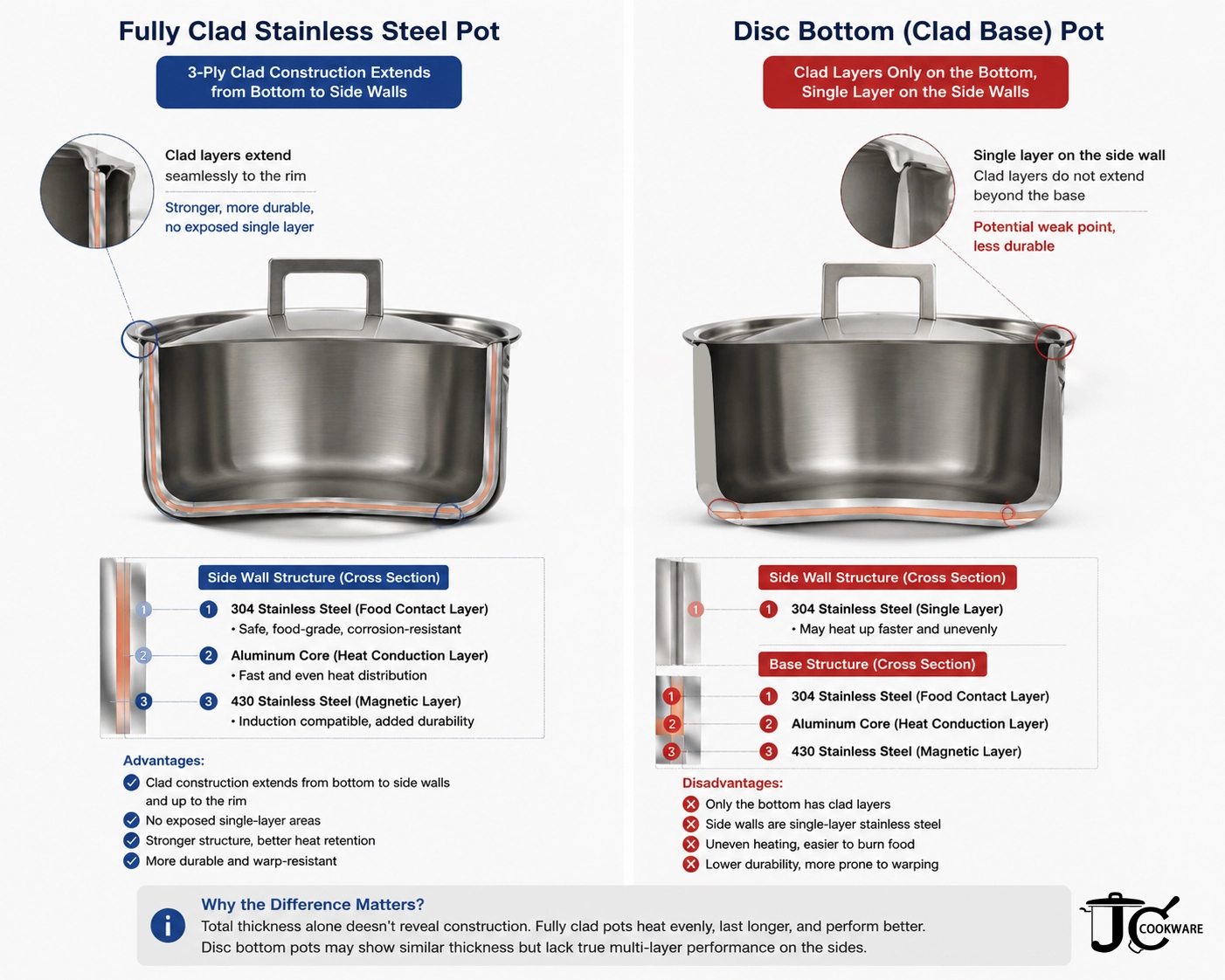
The key advantage of roll bonding is that the entire cookware body — sides and base — is clad, not just the bottom. This is what “full-clad” means, and it’s the construction that most people picture when they ask what is clad cookware.
Method 2: Impact Bonding (Encapsulated Base)
Impact bonding attaches a separate metal disk to the bottom of a single-ply stainless steel body:
- A stainless steel body is formed by deep drawing.
- An aluminum disk (sometimes with a copper layer) is placed against the base.
- A magnetic stainless steel disk is placed on the outside.
- High-pressure impact bonding fuses the disks to the body.
This creates cookware where only the bottom is multi-layer — the sides remain single-ply stainless steel. This is also called “encapsulated base” or “disk-bottom” construction.
For a deeper dive into the complete manufacturing process, see our guide on how stainless steel cookware is made (https://jincui.com/how-stainless-steel-cookware-is-made/).
Clad Cookware Layers: 3-Ply vs 5-Ply
Once you understand what is clad cookware, the next question is always: how many layers? The 3-ply vs 5-ply clad cookware debate is one of the most common questions we hear from buyers. Here’s how the configurations compare from our production data.
3-Ply (Tri-Ply) Construction
| Layer | Material | Typical Thickness | Function |
| Interior | 304 Stainless Steel | 0.4–0.5 mm | Food contact surface |
| Core | Aluminum | 1.5–3.0 mm | Heat distribution |
| Exterior | 430 Stainless Steel | 0.4–0.5 mm | Induction compatibility |
3-ply is the industry standard. It offers excellent heat distribution for most cooking tasks and keeps manufacturing costs reasonable. In our experience, for 80% of cookware products, 3-ply is the right choice — it answers what is clad cookware’s sweet spot between performance and price.
5-Ply Construction
Common structure: Stainless Steel – Aluminum – Stainless Steel/Iron – Aluminum – Stainless Steel. Some models add a copper layer at the center for enhanced thermal conductivity.
| Layer | Material | Typical Thickness | Function |
| Interior | 304 Stainless | 0.4–0.5 mm | Food contact |
| Core 1 | Aluminum | 0.6–1.0 mm | Heat conduction |
| Center | Stainless Steel / Iron (some: + Copper) | 0.3–0.8 mm | Structural rigidity; copper adds heat spreading |
| Core 2 | Aluminum | 0.6–1.0 mm | Heat conduction |
| Exterior | 430 Stainless | 0.4–0.5 mm | Induction, durability |
5-ply adds thermal mass and structural rigidity. It’s preferred for large-diameter pans (12 inches and above) where 3-ply might warp under high heat. When buyers ask what is clad cookware’s upgrade path, 5-ply is the natural next step.
3-Ply vs 5-Ply at a Glance
| Config | Best For | Cost Index | Heat Recovery |
| 3-Ply | Everyday cookware, value lines | 1.0x (baseline) | Good |
| 5-Ply | Professional lines, large pans | 1.4–1.6x | Excellent |
For more detail on how thickness affects performance at each ply level, see our cookware thickness guide (https://jincui.com/cookware-thickness-guide/).
What Is Clad Cookware’s Core Advantage?
If you strip away the marketing, what is clad cookware really good at? Three things:
1. Eliminates Hot Spots
Single-ply stainless steel pans have terrible heat distribution. Place a pan on a gas burner and the ring of flame creates a hot ring directly above it, while the center and edges remain cooler. This is why eggs scramble unevenly and sauces burn on one side.
An aluminum core spreads heat from the flame ring across the entire base and up the sides (in full-clad construction). Infrared thermography testing in our QC lab shows temperature variation dropping from ±35°C (single-ply) to ±5°C (3-ply clad) across the cooking surface. This is the single biggest reason what is clad cookware commands a price premium.
2. Warp Resistance
Clad cookware resists warping because the multi-layer structure distributes thermal stress more evenly. In repeated heating and cooling on our production line, full-clad pans hold flat far longer than single-ply equivalents, where concentrated thermal stress gradually bows the base. If you’re verifying this with a supplier, ask to see their thermal cycling or warp test data.
3. Induction Compatibility
The exterior layer of 430 stainless steel is magnetic, making clad cookware induction-compatible without requiring a separate induction disk. This is critical for European markets where induction cooktops dominate — and it’s another reason why what is clad cookware is a common question among buyers sourcing for EU markets.
Clad vs Encapsulated Base: The Critical Difference
This is where many buyers get confused. The clad vs encapsulated base cookware distinction matters because it affects both performance and cost. If you’re researching what is clad cookware, you need to understand the distinction between full-clad and encapsulated base:
| Feature | Full-Clad | Encapsulated Base |
| Cladding location | Entire body (sides + base) | Bottom only |
| Heat distribution | Base + side walls | Base only |
| Manufacturing method | Roll bonding | Impact bonding |
| Cost | Higher (30–60% more) | Lower |
| Warp resistance | Excellent | Good (base only) |
| Side wall cooking | Yes — heat reaches the sides | No — sides stay cool |
| Best for | Premium retail lines | Value/mid-range lines |
Our recommendation for B2B buyers: If your target retail price is under $40 per pan, encapsulated base is the right choice. For premium lines above $60 per pan, full-clad is expected by consumers and worth the investment.
You can explore our encapsulated base cookware sets (https://jincui.com/encapsulated-bottom-stainless-steel-cookware-sets/) or browse our full product catalog (https://jincui.com/cookingware-category/) to see both construction types.
How to Identify Genuine Clad Cookware
When sourcing cookware, you need to verify claims. Knowing how to identify clad cookware is a critical sourcing skill. Here’s how our QC team checks whether a pan is truly full clad stainless steel cookware:
The Edge Test
Look at the rim of the pan. Full-clad cookware shows distinct layers at the edge — like the layers of a sandwich. If you see only one metal at the rim, it’s either encapsulated base or single-ply. This is the fastest way to answer what is clad cookware vs what is disk-bottom cookware.
The Weight Test
Full-clad cookware is noticeably heavier than encapsulated base of the same size. A 10-inch full-clad fry pan typically weighs 900–1,200g; an encapsulated base equivalent weighs 600–800g.
The Heat Line Test
Fill the pan with water and bring to a boil. In full-clad cookware, you’ll see bubbles form on the side walls too. In encapsulated base, bubbles only form on the bottom — because the sides have no heat-conducting core.
The Magnet Test
Run a magnet along the exterior. Full-clad cookware will be magnetic on the entire outer surface. Encapsulated base cookware will only be magnetic on the bottom disk.
What Is Clad Cookware Worth? B2B Pricing Guide
Understanding what is clad cookware means understanding its cost structure. Here’s what drives price in OEM manufacturing:
| Cost Factor | Impact on Price | Notes |
| Number of layers | +15–25% per additional ply | More layers = more material + bonding complexity |
| Core material (Al vs Cu) | +30–50% for copper | Copper is roughly 3x more expensive than aluminum |
| Full-clad vs encapsulated | +30–60% for full-clad | Roll bonding is more complex than impact bonding |
| Pan diameter | Proportional | Larger pans need thicker cores to prevent warping |
| Surface finish | +5–15% | Mirror polish, brushed, or bead blast |
| Handle type | Variable | Riveted cast steel vs welded stainless |
Typical FOB Pricing (2026)
| Product | Encapsulated Base | 3-Ply Full-Clad | 5-Ply Full-Clad |
| 8″ Fry Pan | $3.20–4.80 | $5.50–8.00 | $8.50–12.00 |
| 10″ Fry Pan | $4.00–6.00 | $6.80–10.00 | $10.50–15.00 |
| 2QT Saucepan | $4.50–6.50 | $7.50–11.00 | $11.50–16.00 |
| 5QT Casserole | $6.00–9.00 | $10.00–15.00 | $15.00–22.00 |
| 10pc Set | $22.00–35.00 | $38.00–58.00 | $55.00–85.00 |
Prices are FOB China (Shenzhen port), indicative ranges for MOQ 1,000–3,000 units. Actual pricing depends on specifications.
For more on our manufacturing capabilities and OEM process, see our cookware manufacturer guide (https://jincui.com/stainless-steel-cookware-manufacturer-guide/).
Common Clad Cookware Myths Debunked
Myth 1: “More Layers Always Means Better”
Not necessarily. The performance difference between 3-ply and 5-ply is real but modest — ab out 10–15% better heat recovery. Diminishing returns kick in fast. When buyers ask what is clad cookware’s optimal configuration, we usually say 3-ply for most markets, and 5-ply for professional or large-format cookware.
Myth 2: “Clad Cookware Is Non-Stick”
Clad cookware is NOT non-stick. The stainless steel cooking surface requires proper preheating technique to prevent sticking. This is one of the most common misconceptions — people conflate what is clad cookware (a construction method) with non-stick cookware (a surface coating). For a deep dive, read our guide on why food sticks to stainless steel pans (https://jincui.com/food-sticking-stainless-steel-pan/) and how to prevent it.
Myth 3: “Copper Core Is Always Worth It”
Copper conducts heat approximately 2x better than aluminum, but the practical difference in a thin core layer (0.3–0.8mm) is measurable but not transformative. According to thermal conductivity data from The Engineering Toolbox (https://www.engineeringtoolbox.com/thermal-conductivity-d_429.html), copper’s conductivity is 401 W/(m·K) vs aluminum’s 237 W/(m·K) — a 1.7x difference, not the 2x often claimed. Copper cores add 30–50% to manufacturing cost. Unless you’re targeting the professional chef market, aluminum core is the smarter B2B choice.
Myth 4: “All Clad Cookware Is Made the Same Way”
The bond between layers is the most critical quality factor in what is clad cookware. Poor bonding leads to delamination — layers separating over time. If you’re sourcing clad cookware, always ask your supplier for their thermal shock test data and bond integrity reports. A pan that looks fine on day one can delaminate within a year if the bonding process was inadequate.
Conclusion: What Is Clad Cookware’s Role in Your Product Line?
Clad cookware is the backbone of any premium stainless steel cookware line. Understanding what is clad cookware — from the bonding process to layer configuration to cost structure — helps you make smarter sourcing decisions and avoid paying for features your market doesn’t need.
Quick Decision Framework
| Retail Segment | Recommended Construction | Core Material | Indicative FOB Cost |
| Value ($15–35) | Encapsulated base, 3-ply disk | Aluminum | $3–6/unit |
| Mid-range ($35–70) | 3-ply full-clad | Aluminum | $6–11/unit |
| Premium ($70–150) | 5-ply full-clad | Aluminum (optional copper) | $10–18/unit |
At JC Cookware — a 204-worker manufacturer in Jiangmen, Guangdong, audited to BSCI and ISO 9001, shipping FOB Shenzhen — we manufacture all of these configurations with full OEM/ODM customization. Contact us (https://jincui.com/contact-us/) to discuss your specific requirements, or browse our fry pans (https://jincui.com/frypan/), casseroles (https://jincui.com/casserole/), saucepans (https://jincui.com/saucepan/), and cookware sets (https://jincui.com/encapsulated-bottom-stainless-steel-cookware-sets/) to see examples of each construction type.
Have questions about clad cookware manufacturing? Our engineering team is available to consult on material selection, layer configuration, and cost optimization for your next product line.